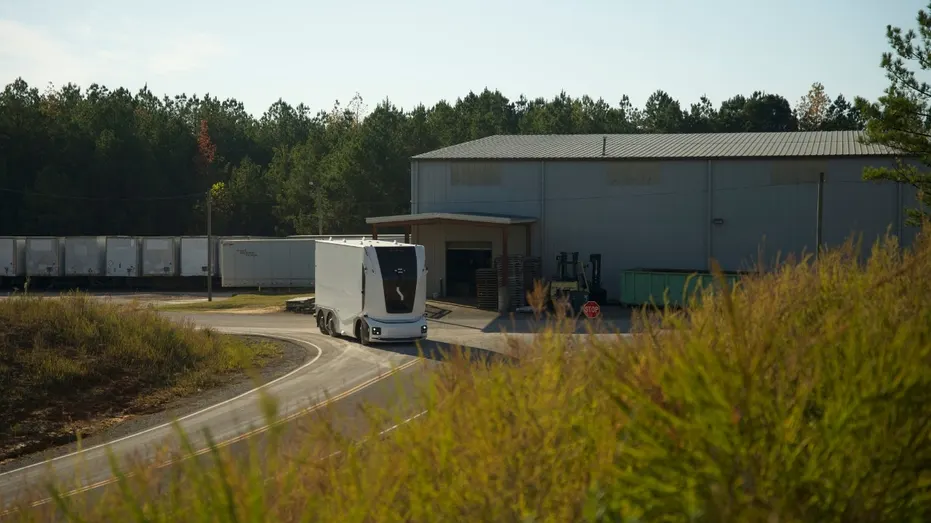
SouthernWorldwide.com – The future of freight transportation is taking a significant step forward with the introduction of cab-less electric trucks onto the roads of Marysville, Ohio, this summer.
EASE Logistics, a logistics company based in Ohio, has partnered with Einride, a company specializing in autonomous truck technology, to launch a proof-of-concept service. This initiative involves deploying two electric, cab-less trucks that will operate between EASE’s warehouse locations.
These autonomous vehicles will traverse both EASE’s private property and local public roads. The primary objective is to transport goods between warehouses while the companies gather crucial data on warehousing, distribution, and transportation operations.
This pioneering project is part of the Ohio Department of Transportation’s DriveOhio Truck Automation Corridor Project. It is being conducted in collaboration with the Indiana Department of Transportation, with the overarching goal of studying the impact of autonomous trucking on operational efficiency, safety protocols, and overall freight movement.
These are not conventional trucks with a human driver ready to take control. Einride’s vehicles are designed from the ground up to be electric, autonomous, and cab-less. This means they lack a traditional driver’s seat, steering wheel, or any internal structure designed for a human operator.
The trucks are equipped with SAE Level 4 autonomous technology. This advanced system enables the vehicle to operate autonomously under specific, approved conditions without any human intervention from within the vehicle.
Despite the autonomous nature, human oversight remains a critical component. A remote operator will continuously monitor the trucks from an off-site location and will be able to intervene if any issues arise. This dual approach is intended to ensure the safety and smooth operation of the vehicles during the testing phase.
The trucks are scheduled to transport freight between EASE Logistics warehouses in Marysville, Ohio, during the summer of 2026. Their operation will encompass both private property and local public roads, marking a significant step toward real-world application.
The distinction between testing in controlled environments and operating on public roads is crucial. This project moves beyond isolated test tracks, integrating autonomous trucks into the daily workflow of logistics operations.
EASE Logistics anticipates that this deployment will yield valuable data regarding the influence of autonomous trucks on warehouse logistics, the precision of distribution schedules, and the overall efficiency of transportation. The companies aim to assess the performance of this technology in dynamic real-world scenarios, where freight schedules and traffic conditions are rarely predictable.
Ohio has emerged as a significant testing ground for truck automation technologies. This latest deployment further expands the scope of the Ohio Department of Transportation and DriveOhio’s Truck Automation Corridor Project, reinforcing the partnership with the Indiana Department of Transportation. The project’s core mission is to meticulously evaluate the effects of autonomous technology on operational aspects, safety measures, and freight efficiency.
Peter Coratola, Jr., President and CEO of EASE Logistics, expressed his enthusiasm, stating, “EASE is proud to continue advancing the Truck Automation Corridor Project alongside DriveOhio and innovative partners like Einride.” He further emphasized, “Deployments like this help move autonomous trucking from controlled pilots into daily freight operations, where safety, reliability, and efficiency can be evaluated at scale.”
This initiative also signifies EASE Logistics’ third autonomous trucking deployment in collaboration with DriveOhio. This accomplishment positions the company among a select group of logistics providers actively testing multiple autonomous freight platforms in live operational settings.
When the term “driverless truck” is mentioned, the immediate concern for many is not necessarily efficiency, but rather the question: “What happens if something goes wrong?”
This is a valid concern, given the size and weight of these vehicles and their operation in proximity to the public. Consequently, safety will be the paramount factor in how this project is ultimately perceived.
Roozbeh Charli, CEO of Einride, commented on the significance of the deployment: “Deploying these autonomous trucks in daily logistics operations with EASE reflects years of rigorous development and real-world validation.” He added, “Safety is not a feature we add to our technology; it is the foundation everything is built on.”
Read more : Scientists Identify Mysterious Underwater Golden Orb
The companies also highlighted that a remote operator monitors the trucks from off-site and is equipped to intervene if necessary. While this provides a layer of reassurance, the public will undoubtedly seek clear explanations regarding routes, oversight procedures, emergency response protocols, and the precise mechanisms by which remote operators can step in. These clarifications will become increasingly vital as autonomous trucks transition from controlled testing zones to everyday traffic environments.
For logistics companies, the potential benefits of electric autonomous trucks are substantial. These vehicles offer the promise of reduced emissions, more predictable scheduling, and enhanced coordination within warehouse operations.
The focus on short, warehouse-to-warehouse routes is a logical starting point for early autonomous deployments. These limited routes simplify the operational study and allow for the collection of valuable data without the complexities of long-haul trucking across multiple states.
Nevertheless, the success of this rollout hinges on its ability to prove its efficacy. The trucks will need to demonstrate their capability to navigate diverse traffic conditions, varying road surfaces, and the unpredictable behavior of human drivers. These real-world challenges will serve as critical tests for the viability of autonomous freight transportation.
Autonomous trucking has progressed from ambitious promises to tangible, real-world testing. However, the industry still faces the challenge of building public trust and confidence.
This deployment in Ohio presents EASE, Einride, and transportation officials with a valuable opportunity to gather critical data. It also offers the public a closer and more tangible look at the evolving landscape of driverless freight operations.
The cab-less design is perhaps the most visually striking aspect of these trucks, signaling a more profound shift in design philosophy. These vehicles are conceptualized with the understanding that the truck itself, its sophisticated software, and a dedicated remote operations team can effectively manage the entire transport process.
This represents a fundamental departure from the traditional methods that have governed freight transportation for generations.
While you may not reside in Marysville, Ohio, this test has far-reaching implications, offering a glimpse into the future trajectory of freight transportation.
Should this project prove successful, it could encourage more companies to adopt autonomous trucks for intra-warehouse logistics. This, in turn, could fundamentally alter the way goods are moved before they reach consumers, impacting the entire supply chain from origin to destination.
Furthermore, this technological advancement may necessitate the creation of new job roles within the logistics sector, focusing on the monitoring, maintenance, and management of these autonomous systems. Concurrently, existing truck drivers and warehouse personnel will likely seek transparent answers regarding the long-term impact of these trucks on employment opportunities.
For consumers, the primary concern will likely revolve around trust. There will be a strong demand for demonstrable proof that these vehicles can operate safely and reliably alongside conventional traffic. Transparency regarding any incidents or malfunctions will also be crucial.
The deployment of cab-less electric trucks on Ohio roads might initially seem unsettling. However, this project underscores the rapid integration of autonomous freight into practical logistics operations. While the EASE and Einride deployment still has significant milestones to achieve, safety, public acceptance, the impact on the workforce, and consistent day-to-day reliability will be key determinants of its success. Nevertheless, this summer’s trials could provide the trucking industry with a clearer vision of what lies ahead. Driverless freight may commence with localized warehouse routes, but its long-term potential is to reshape the movement of goods across the nation.
Would you feel comfortable sharing the road with a cab-less electric truck if no driver was inside, but a remote operator was watching from miles away? Let us know by writing to us at CyberGuy.com.