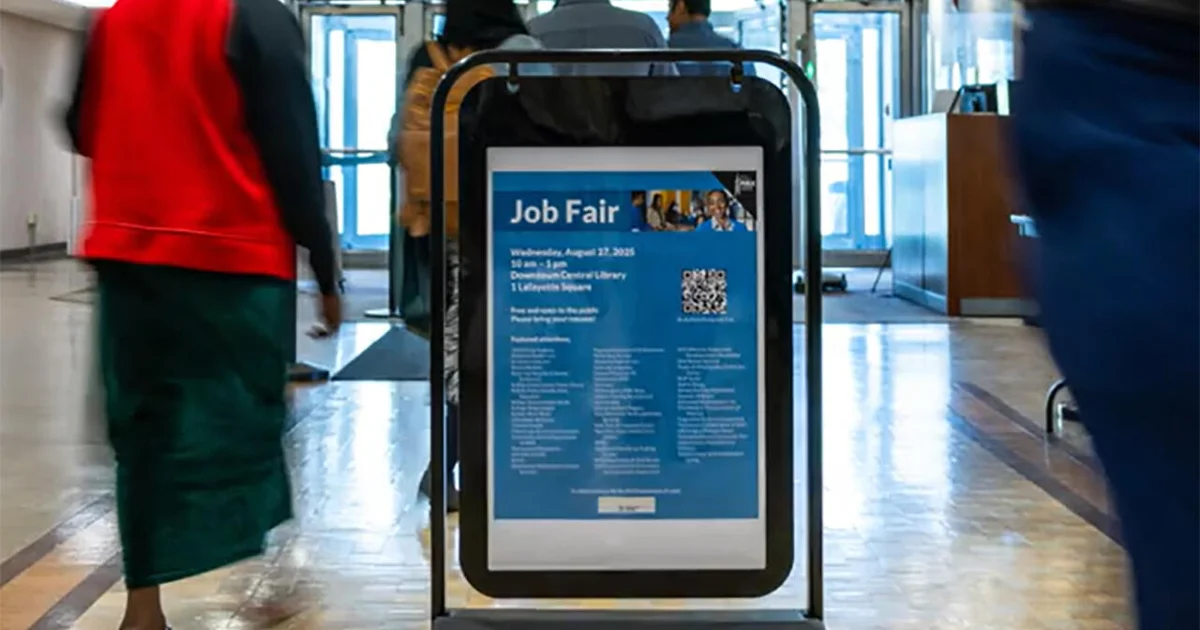
SouthernWorldwide.com – For generations, the path for young Americans has been clear: pursue higher education and then secure a job. However, recent graduates are finding the current job market to be exceptionally challenging.
Meghan Obetz from Philadelphia expressed the common sentiment, stating, “It feels like once you graduate, you know, you’re expecting things to just fall into place, and sometimes that’s just really not the case.”
This experience is shared by Olivia Bennett in New York, Michael Sundheim in Minneapolis, and Daniel Fischer in Anchorage. All have recently graduated but are encountering a slow and frustrating job search, despite submitting hundreds of applications.
“You know your résumé is getting thrown into a pile, and AI is basically sorting it through,” Obetz remarked, highlighting a prevalent concern about automated application screening.
Fischer shared a striking observation from his own experience: “The last position that I interviewed for had 300 applicants.” This sheer volume of competition is daunting for entry-level candidates.
From left: Recent graduates Meghan Obetz, Daniel Fischer, Michael Sundheim and Olivia Bennett.
CBS News
“And you’re not even hearing back,” added Bennett. “You can’t even get a rejection. You just submit into some kind of void.” This lack of communication leaves applicants feeling unheard and uncertain about their status.
Sundheim described the emotional toll: “It gets to a point where you definitely feel defeated.” The continuous cycle of applying without feedback can be demoralizing.
Fischer humorously speculated about the process: “It’s plausible to me that this is some kind of elaborate psychological experiment that’s being done on me and my classmates, to see, you know, how many applications they can get us to submit before we lose our minds!” His comment underscores the feeling of being stuck in an automated and impersonal system.
“Measures of uncertainty”
These graduates’ experiences are not isolated incidents. The unemployment rate among young people is significantly higher, approximately double the national average. Furthermore, a substantial 40% of college graduates are working in roles that do not require a degree, often taking on temporary or part-time positions.
Laura Veldkamp, an economics professor at Columbia Business School, noted the particular difficulties faced by first-time job seekers. “People who are trying to look for jobs for the very first time are having a really difficult time of it, the hardest time that they’ve had in years,” she stated.
Regarding the role of artificial intelligence in job displacement, Veldkamp offered a nuanced perspective. “There’s a little bit of truth to that,” she acknowledged. “The research that’s done on this suggests that AI has actually increased the unemployment rate by about 0.1 of a percent. So, that’s one in 1,000. But it’s definitely not the whole story of what’s going on with unemployment.”
CBS News
According to Veldkamp, the primary driver of the current job market difficulties is a weak economy. “Measures of uncertainty are at all-time highs recently. And when people are uncertain, they often freeze,” she explained. Employers are hesitant due to several factors, including the evolving impact of AI on their businesses and hiring needs, as well as fluctuating trade policies.
“The third thing that’s creating uncertainty is a lot of fluctuation in fuel prices,” Veldkamp added. “They’ve almost doubled in the last few months. And when its price moves around a lot, it creates a lot of uncertainty for the cost of doing business.” These economic variables contribute to a general sense of caution among employers.
Veldkamp elaborated on why young people and entry-level positions are disproportionately affected. “If you’re really uncertain about what to do and you freeze, that means, ‘I don’t want to do something new, like go look for a new person who may or may not work out.’ And so, that tends to be young people,” she said, indicating that companies are less likely to take risks on new hires during uncertain times.
Compounding these challenges, Veldkamp noted, “Wages are lower because there’s so much demand from potential workers.” This means that not only is finding a job more difficult, but the available positions may also offer less compensation.
“Play the long game”
Despite the challenging landscape, there are sectors showing promise for job growth. Laura Fuentes, who oversees human resources for Hilton, a company with 500,000 employees, highlighted industries such as healthcare, energy, AI, and hospitality as being particularly in need of new talent. “Those with the right hustle, the right mindset are piercing through, and we’re able to find them,” she stated.
Fuentes acknowledged the struggles of first-time job seekers facing a high volume of applications with minimal responses. “I do feel for students; I’m a mom of two kids, they’ve witnessed that. So, play the long game. Be patient and persevere.” She advises a strategy of persistence and patience.
“And I’d say open up your aperture,” she continued. “A lot of kids come out with this, like, ‘I wanna be X when I graduate.’ That first job, it’s not your identity, and it’s not your destination. It’s a launching pad, right?” This suggests a need for flexibility and a broader view of career beginnings.
Fuentes clarified her advice: “A little bit!” she laughed when asked if she meant “Don’t be so picky.” “Loosen up about the exact job title, the exact pay, the exact thing you will be doing.” Her counsel is to be more adaptable regarding the specifics of an initial role.
The perils of “one-click apply”
Ironically, some of the tools designed to simplify job searching may be contributing to the problem. Features like “one-click apply” on platforms such as LinkedIn, ZipRecruiter, and Indeed allow for the rapid submission of résumés to numerous listings.
This ease of application can lead to thousands of applications for a single job opening, diminishing each candidate’s chances of being noticed. Consequently, employers often resort to AI to manage the overwhelming influx of applications.
Laura Fuentes advocates for a more targeted approach: “As our recruiters lovingly say, ‘Don’t spray and pray,'” she advised. “Find a couple of entry points beyond your recruiter, and beyond the online application. Even as a student, your network is likely far broader than you imagine. Your professors, the people you babysat for, friends of the family. Keep at it. All you need is that one yes to get in the door.” Her recommendation emphasizes the power of networking.
Indeed, studies have consistently shown that a significant portion of jobs are filled through personal connections and networking.
All the recent graduates interviewed confirmed they have received similar advice: “Forget the job sites, go through a networking channel, someone you know.” This advice highlights the importance of personal connections in the job search.
“But in order to know somebody, you have to know somebody,” Daniel Fischer humorously pointed out. “And you don’t always, right?” His comment reflects the practical difficulty of building a strong network.
“And even if you do have a connection, you’re not guaranteed anything, which is incredibly disappointing,” added Olivia Bennett, underscoring the uncertainty even within networking efforts.
After months of diligent searching, both Bennett and Michael Sundheim eventually secured positions through personal contacts rather than job boards. Bennett accepted a role outside her intended field of study. “I went to college for international relations, and specifically U.S.-China policy,” she explained. “I now work in digital marketing in event production. So, kind of different.”
Meghan Obetz continues her job search, focusing on roles in music or marketing. Daniel Fischer is still seeking opportunities in law or political advocacy.
Fortunately, there are signs of improvement in the job market. According to Fuentes, “This month’s job report suggests that we’ve turned the corner, and we’re starting to see more jobs posted, more entry-level jobs posted that young people would be highly qualified for. We don’t stay frozen forever. Eventually, even amidst all the uncertainty, life must go on. Business must proceed. And we’re going to need more workers to make that happen.” This indicates a potential easing of the current hiring freeze.
For recent graduates like Fischer, this turnaround cannot come soon enough. “I mean, it doesn’t matter to me if it’s the economy [to blame] or not, right? Like, it is deeply personal. Like, I really would like to not live with my parents anymore. Because I need to start my life! I need to, like, have a career!” he expressed, emphasizing the personal impact of his prolonged job search.
For more info:
- Laura Veldkamp, professor of finance & economics, Columbia Business School
- Laura Fuentes, chief human resources officer, Hilton
Story produced by Gabriel Falcon. Editor: Carol Ross.
See more:
- Some job-seekers are paying thousands of dollars just to land an interview
- Looking to kickstart your career? These are the best jobs for 2026, Indeed says
- How is artificial intelligence affecting job searches?
- Indeed and Glassdoor to lay off 1,300 workers as AI shakes up job search business