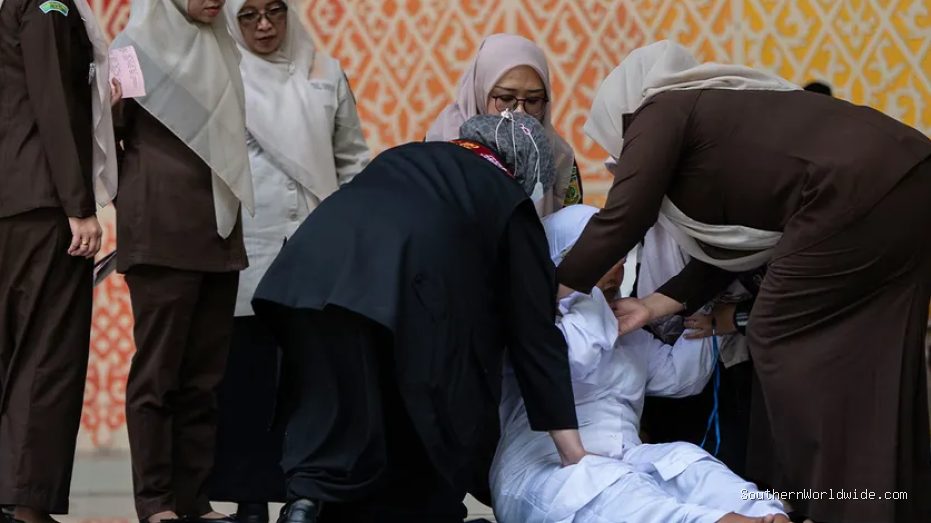
SouthernWorldwide.com – A young couple in Indonesia faced public caning on Thursday following an alleged incident of kissing during a TikTok livestream, an event that has ignited widespread outrage.
The couple, identified as a 22-year-old man and a 25-year-old woman, each received 21 lashes as punishment. This sentence was handed down according to reports from The Associated Press.
They were reportedly convicted of violating local morality laws under the purview of an Islamic Sharia court situated in Indonesia’s conservative Aceh province. This province is known for its strict adherence to Islamic law.
Having been detained in March, the couple had already spent four months in prison before the caning. This pre-punishment detention ultimately led to a reduction in their sentence, from an initial 25 lashes to the final count of 21, as stated by the AP.
Authorities indicated that the couple had filmed a TikTok video inside a car during a night in March. The video’s content was deemed an “immoral act” by officials.
As the video rapidly gained traction and went viral across the platform, the couple was subsequently apprehended. Their detention was based on what officials described as their engagement in an “immoral act.”
“Their actions were brought to light thanks to reports from residents who expressed distress over their immoral livestream content,” a spokesperson for the Sharia police stated in April. This highlights the role of community vigilance in enforcing local laws.
“The catalyst for this action was their livestream on TikTok while they were engaged in immoral acts within the car,” added Muhammad Rizal, the Head of the Sharia Police, in his official statement. “This incident sparked considerable criticism from both netizens and local residents, who subsequently reported them to the authorities.”
The court also ordered the confiscation of a cellphone and a USB flash drive that contained the TikTok video. Authorities have pledged to destroy these items, as reported by the AP, to prevent further dissemination.
A resident of Banda Aceh, Aini Nadhirah, aged 22, who witnessed the caning, expressed her belief that the punishment was “entirely justified.” Her sentiment reflects a segment of the local population’s perspective on the enforcement of moral codes.
“In my opinion, this caning is entirely justified because it serves as a crucial warning to other Aceh residents to exercise greater caution when utilizing social media platforms,” Nadhirah was quoted as saying by the AP. This underscores the perceived role of such punishments as deterrents.
“It also serves to raise public awareness that such actions are fundamentally unacceptable, thereby contributing to the education of the public on these matters,” she further elaborated. This perspective emphasizes the aim of public caning as a form of moral instruction.
Aceh stands as the sole province within Muslim-majority Indonesia that actively enforces its own distinct Islamic Criminal Code, which specifically governs matters of moral conduct. This unique status sets it apart from other regions in the country.
The province’s authority to implement Islamic law was officially granted by Indonesia’s secular central government around the year 2005. This was a significant component of a peace agreement aimed at resolving a long-standing separatist insurgency.
Subsequently, the scope of this policy was expanded to encompass and apply to non-Muslim residents as well, signifying a broader application of the Sharia-based legal framework within Aceh.
Under the provisions of the law in Aceh, offenses related to morality—which can include acts such as adultery and same-sex relations—carry potential penalties that can extend up to 100 lashes. Caning is also a prescribed punishment for individuals accused of various other transgressions, including gambling, consuming alcohol, adultery, and premarital intimacy.
The practice of public caning in Aceh has consistently drawn sharp criticism from various human rights organizations. Amnesty International Indonesia, for instance, has publicly denounced the practice, labeling it as both cruel and degrading to human dignity.
Despite Indonesia having formally ratified international conventions that explicitly prohibit cruel and inhumane forms of punishment, the authorities in Aceh continue to defend the practice. They argue that the caning administered within the province does not, in their view, fall under the definition of cruel punishment as outlined in these international agreements.