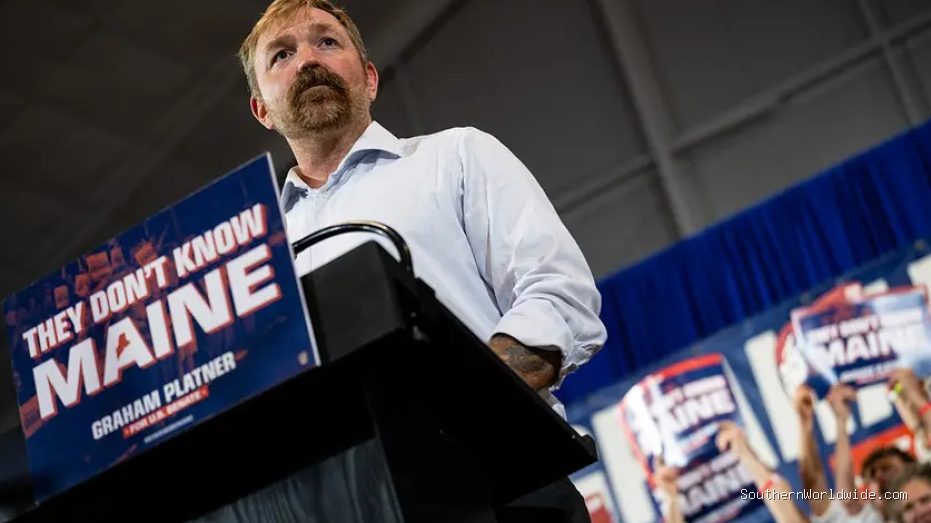
SouthernWorldwide.com – Democratic strategists are expressing concern over the party’s embrace of Graham Platner, a Senate candidate in Maine, citing his past controversies and questioning whether the party is compromising its values for political expediency.
Michael LaRosa, former press secretary to First Lady Jill Biden, criticized the party’s stance, stating that they have “pushed #MeToo well beyond the bounds of common sense.” He believes the reflexive support for Platner is akin to “pulling the plug on whatever credibility Democrats had left.”
LaRosa further elaborated that if standards are abandoned when they become politically inconvenient, then they were never genuine standards to begin with. This sentiment highlights a perceived hypocrisy within the party’s handling of accusations and allegations against its candidates.
Democratic strategist Doug Schoen echoed these concerns, suggesting that the party is prioritizing power and Senate control over addressing serious issues related to Platner’s past. He warned that this approach could have detrimental consequences for the party’s reputation.
Schoen characterized the decision as “sad” and one that “undermines the moral legitimacy of the Democratic Party as a whole.” He pointed to Platner’s “extreme left-wing positions, his toxicity as a person, the issues with relationships, arguably lying about his Nazi tattoo.”
These concerns arise despite Platner’s primary victory, which saw him receive more votes than any Democrat in Maine’s history. However, his campaign has been marked by accusations from former girlfriends detailing alleged discussions of rape fantasies, heavy drinking, and violent episodes.
Platner has also faced scrutiny over allegedly sexually explicit messages sent to women shortly after his marriage, a tattoo with Nazi associations, and online comments mocking a Purple Heart veteran. He has denied these allegations.
Despite these controversies, which surfaced just days before the primary, Platner secured a significant win. This has led to a debate within the party about the balance between electability and upholding ethical standards.
LaRosa suggested that the Democratic Party might face long-term repercussions for their association with Platner. Whether he wins or loses the general election, the party will have to “explain why you stood with him” or have “nothing to show for it except the association.”
Smith, another observer, noted that voters are increasingly disillusioned with the status quo. This sentiment, he argued, can lead some voters, whether Republican supporting Donald Trump or Democratic supporting Platner, to view criticism from elites as validation of their candidate’s path.
However, for others, the controversies surrounding Platner are too significant to overlook. LaRosa emphasized that voters value “guts, not willful blindness,” particularly when it comes to candidates with Nazi imagery. He feels Democratic leaders are lacking this courage.
The Democratic Party’s past use of “Nazi” as an attack line against President Donald Trump for over a decade makes their current support for Platner, who has had a Nazi-associated tattoo for 18 years, a point of contention.
President Trump himself commented on the situation, highlighting the irony of Democrats calling him a “Nazi” while now having a candidate with a Nazi tattoo. He noted, “They’re seeing all of these lunatics, like the guy in Maine… for ten years they’ve been calling me a ‘Nazi,’ and now they have a Nazi running. He’s got a tattoo on him.”
Schoen argued that the party’s stance on Platner weakens their ability to criticize Republican candidates with their own scandals, citing Texas Attorney General Ken Paxton as an example. He believes that for every criticism leveled at Paxton, Democrats will face similar criticism regarding Platner.
Smith agreed, stating that both parties are now dealing with candidates who create “their own version of heartburn” that can be exploited politically. Paxton, who is backed by Trump, won his primary despite being impeached and facing federal investigations.
LaRosa described the “uncomfortable truth” as Democrats viewing Platner as a mere “number, another vote, another seat, another data point on a spreadsheet,” rather than assessing his suitability for the job.
Schoen maintains that Platner’s primary victory does not erase his political baggage, and the party is left to deal with problems that “none needed to exist.” He expressed uncertainty about Platner’s ability to ultimately succeed given the ongoing concerns.
Ultimately, Smith believes that Maine voters will prioritize the economy in the upcoming election. He suggests that concerns about Platner might remain a localized issue within Maine, rather than having a significant national impact.
“Voters are unhappy with the economy, and I think most people are going to be voting on whether they believe the economy is better than when Trump was inaugurated, and the answer to that is a resounding no,” Smith said. “So I think as much as news stations like to talk about Graham Platner and what this means for Democrats overall, or vice versa, Ken Paxton and Republicans overall, most voters are not going to think about Graham Platner’s Nazi tattoo outside of Maine. So I think this is more of a localized Maine problem.”