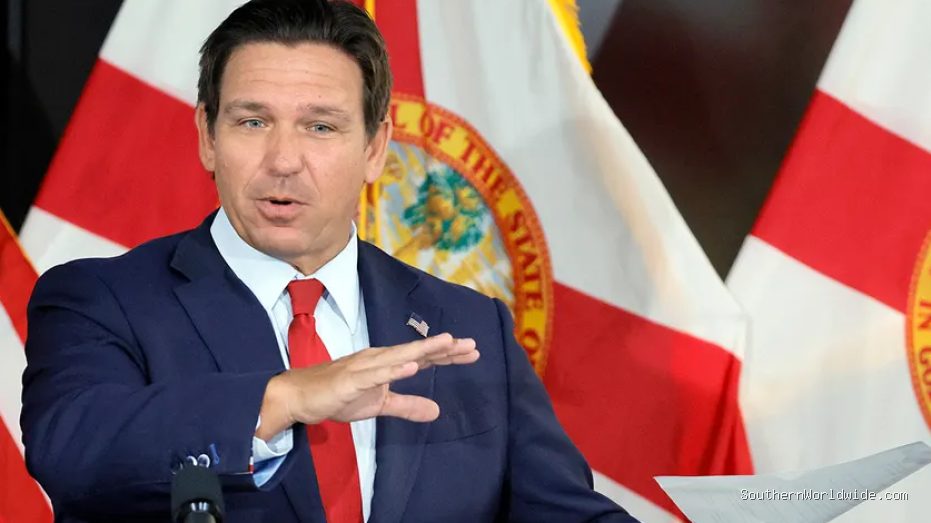
SouthernWorldwide.com – Florida Governor Ron DeSantis has announced plans to utilize a newly enacted state law to officially designate numerous groups as terrorist organizations. This significant move, however, requires further approval from the Florida Cabinet and has already drawn legal challenges from at least one of the targeted organizations.
The legislation in question, HB 1471, was signed into law earlier this year and officially took effect on Wednesday. Governor DeSantis stated that the state intends to leverage its new statutory authority to actively identify, designate, and counter terrorist organizations operating within Florida’s borders.
Under this new law, Florida officials are proposing to designate over 90 groups as terrorist organizations. The list includes prominent organizations such as the Council on American-Islamic Relations (CAIR), the Muslim Brotherhood, and Antifa. It is crucial to note that these proposed designations are not yet finalized and must undergo approval by both the governor and the Cabinet before they are officially enacted.
DeSantis emphasized the administration’s commitment to combating radical ideologies. He stated, “Last December, I signed an Executive Order to eliminate the influence of radical terrorist ideologies and the organizations that promote them in Florida. This year, I signed legislation to strengthen those protections and give Florida permanent statutory tools to combat terrorism while defending the Constitutional rights of our citizens. Today, we are officially designating terrorist organizations under Florida law.”
The governor further elaborated on the scope of the designations. “In addition to CAIR and the Muslim Brotherhood, we are adding Antifa to the list—along with more than 90 Foreign Terrorist Organizations, including cartels,” he announced.
The procedural framework established by HB 1471 outlines that the Chief of Domestic Security has the authority to designate qualifying organizations as either domestic or foreign terrorist organizations. However, the governor and the Cabinet retain the power to approve or reject these designations through a majority vote before they are officially published in the Florida Administrative Register.
The list of proposed foreign organizations includes entities such as the Islamic Revolutionary Guard Corps. Additionally, several prominent gangs have been included, such as Cartel de Sinaloa, Tren de Aragua, Cartel del Noreste, and Cartel del Golfo.
The new law empowers the governor and the Cabinet to review and either approve or reject designations initially put forth by the chief of domestic security within the Florida Department of Law Enforcement (FDLE). This provides a critical oversight mechanism in the designation process.
Florida Department of Law Enforcement Commissioner Mark Glass highlighted the importance of identifying threats for community safety. He stated, “Keeping our community safe starts with identifying the threat. The safety of our community is strengthened by that knowledge every day, and reinforced by the collaboration between our officers, our federal partners, and—most importantly—the people we serve.”
A key provision of HB 1471 directs state agencies to deny these designated groups any form of public support or taxpayer funding. The law also establishes state-level enforcement mechanisms and introduces criminal penalties for individuals found to be providing material support to designated terrorist organizations.
More specifically, the legislation imposes restrictions on certain public benefits, funding, and institutional support linked to the designated groups. It also creates criminal penalties for those who knowingly provide, attempt to provide, or conspire to provide material support or resources to a designated domestic terrorist organization.
Furthermore, the law includes a provision to ensure that foreign or religious legal codes cannot supersede the U.S. or Florida Constitutions within the state’s court system. This aims to uphold constitutional supremacy in legal matters.
The Council on American-Islamic Relations (CAIR), a Muslim civil rights organization, has strongly condemned the move. Following Governor DeSantis’s announcement, CAIR stated its intention to continue challenging the state’s actions. The organization asserts that it does not engage in “terrorist activity” and has never been charged or convicted of any crime.
CAIR and its Florida chapter, CAIR-Florida, have a history of legal action against the governor, having previously filed lawsuits challenging DeSantis’s December executive order that also targeted CAIR and the Muslim Brotherhood.
“Throughout CAIR’s long history, our civil rights organization has worked to protect the Constitution’s guarantees of free speech, religious freedom and equality under the law,” the group stated. “We have also pursued justice for all people, including American Muslims impacted by hate. This is exactly why Gov. DeSantis has repeatedly targeted our organization. We see through Gov. DeSantis’ latest biased attempt to punish us for our views and our values. We look forward to fighting these baseless attacks in court and proving once again that the Constitution is stronger than any politician’s bigotry.”
Critics, including CAIR and various civil liberties groups, have voiced concerns that the designations are politically motivated and could potentially infringe upon First Amendment-protected speech and association rights. Conversely, Governor DeSantis and state officials maintain that the law’s objective is to prevent taxpayer money from supporting groups they allege promote or endorse terrorism.
Both CAIR and civil liberties organizations have indicated their intent to challenge the designations, deeming them baseless and unconstitutional. Hina Shamsi, director of the ACLU’s National Security Project, issued a statement expressing strong opposition.
“Florida’s imminent designation of our clients is both dire and unmoored from reality. CAIR and CAIR-Florida’s speech and advocacy are protected by the First Amendment, which includes their right to criticize the governor, other officials, and their policies. We’re asking the court to protect our clients’ cardinal freedoms,” Shamsi stated.
It is important to distinguish these state-level designations from federal foreign terrorist organization designations. If approved by the Florida Cabinet, these designations would operate under Florida law and would not carry the same weight or authority as those made by the U.S. State Department.