SouthernWorldwide.com – A groundbreaking study from Virginia Tech has revealed that our canine companions might possess a remarkable ability to detect invasive spotted lanternflies, offering a novel defense against this destructive pest.
The research indicates, for the first time, that pet dogs could play a significant role in curbing the rapid proliferation of the spotted lanternfly, an insect that poses a serious threat to various plant species.
These invasive insects feed on a wide range of plants and secrete a sticky, sugary substance known as honeydew. This honeydew, in turn, encourages the growth of harmful mold, further damaging vegetation.
The spotted lanternfly is so detrimental to agriculture that several states have initiated public campaigns, encouraging residents to eliminate them on sight by stomping on them.
However, experts emphasize that the most effective long-term solution lies in eradicating their egg masses. The challenge, they note, is that these egg masses are often difficult to locate as they closely resemble dried mud and can easily blend into their surroundings.
Read more : A flaw in robot mowers could compromise your home network
This is precisely where the exceptional olfactory capabilities of dogs can be harnessed to assist in detection efforts.
“Dogs have one dominant sense, and that is their nose. We rely on our eyes, but dogs use their nose in a similar way that we use our eyes,” explained Katie Thomas, a participant in the study.
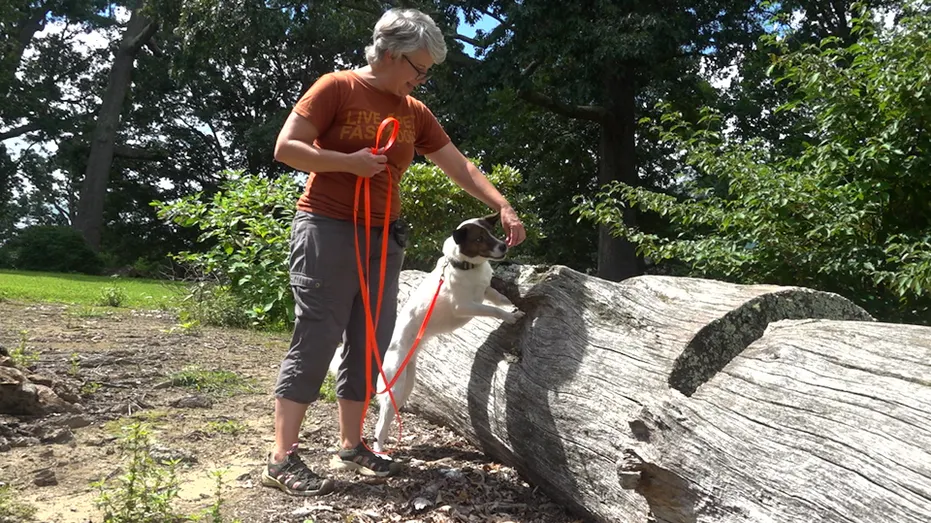
Thomas and her nine-year-old pitbull mix, Finch, were among the volunteers who participated in the research. Their involvement stemmed from a desire to leverage their extensive experience in recreational scent work for a practical, beneficial purpose.
The study involved both indoor and outdoor trials, where the dogs were tasked with sniffing out lanternfly egg masses. Successful detections were rewarded, reinforcing Finch’s accuracy.
“To be able to do something that we already enjoy and are having a lot of fun with, like training our dogs to sniff things, and then to be able to apply that to a real-world problem that affects our community is incredibly fulfilling,” Thomas shared.
The spotted lanternfly, which is native to Asia, was first identified in the United States over a decade ago in Pennsylvania. Since then, its invasive presence has unfortunately spread to 19 states, according to the U.S. Department of Agriculture.
“They are everywhere, and we need to actively search for the eggs. The critical issue is that by the time we see the adult lanternflies, it is often too late to effectively manage them,” stated Carolyn Shelburne, another study participant.
Shelburne, along with her 9-year-old border collie, Hermes, was among the initial group of five K9 and handler teams to successfully complete their field tests. Ultimately, the study saw the participation of 182 volunteer teams from across the United States.
In controlled indoor tests, the dogs demonstrated a remarkable success rate, correctly identifying the scent of lanternfly egg masses more than 80% of the time. In more challenging, real-world outdoor tests, their accuracy remained high, identifying the scent correctly over 60% of the time.
This level of performance significantly surpasses that of most human search efforts, highlighting the potential of canine detection.
“We hope that more people will realize that virtually any dog can be trained to do this. It also provides a fun and engaging activity to do with your dog,” Shelburne added.
The researchers are optimistic that this study marks the beginning of dogs playing a crucial role in safeguarding local environments. The potential extends beyond the spotted lanternfly; dogs could be trained to detect a variety of other invasive species, even in regions where lanternflies are not currently a significant concern.