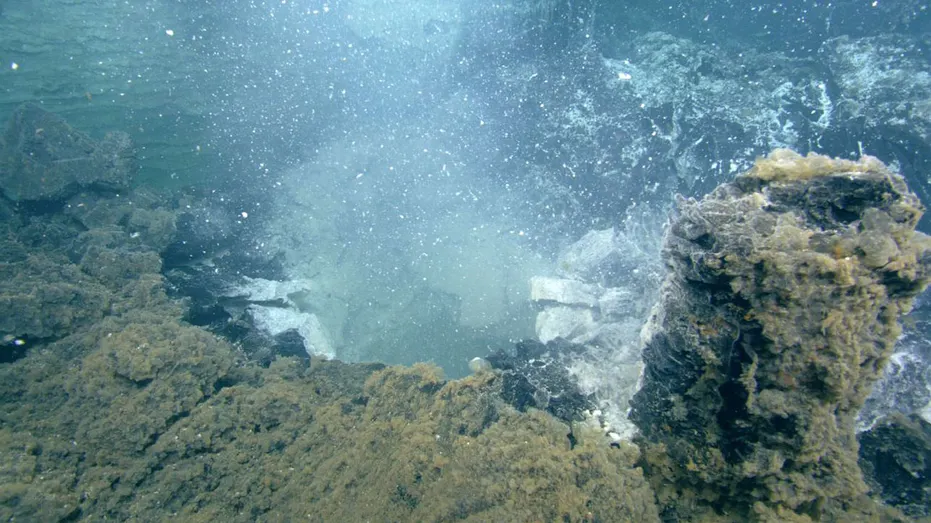
SouthernWorldwide.com – Scientists have predicted that an underwater volcano located approximately 300 miles off the coast of Oregon could erupt by the end of this year.
This underwater volcano, known as Axial Seamount, is situated more than 4,900 feet below the surface of the Pacific Ocean. It is showing signs that indicate it will erupt for the first time since 2015.
The formation of Axial Seamount is attributed to a hotspot, which is an area within the Earth’s mantle where plumes of molten material ascend through the crust. This process was detailed in a blog post by the University of Washington’s College of the Environment in April.
As the Earth’s crust moves over these stationary hotspots, chains of volcanoes are formed over extensive periods. Maya Tolstoy, a marine geophysicist and dean at the university’s College of the Environment, highlighted the significance of these processes.
Read more : Woman Loses $10K to Jury Duty Crypto Scam
“Over two-thirds of the Earth’s surface was formed by volcanic eruptions at these mid-ocean ridges,” Tolstoy stated. “Axial Seamount is a direct result of these fundamental processes that continue to shape our planet today.”
Despite the impending eruption, scientists have assured that it does not pose a danger to the public.
The blog post further explained that Axial Seamount is too deep and too far from the shore for any impact to be felt by people on land. It also clarified that an eruption at Axial Seamount is unrelated to seismic activity on land, thus alleviating concerns about it triggering major earthquakes or tsunamis in the Pacific Northwest.
The initial indicator of an eruption at this underwater volcano will be a significant surge in the number of earthquakes occurring in its vicinity.
Deborah Kelley, a professor at the UW School of Oceanography and director of the Regional Cabled Array, provided insight into the volcano’s current state. “The volcano has already surpassed the inflation we observed in 2015, but the earthquake activity is still quite low,” she noted.
Kelley elaborated on the expected seismic activity. “We’re seeing 200 to 300 earthquakes per day, with some spikes around 1,000 per day due to the tides. If what we learned in 2015 is correct, I would expect to see more than 2,000 per day for a few months before the eruption.”
These earthquakes are a direct consequence of magma ascending towards the surface, as explained in the blog post.
William Wilcock, another professor at the UW School of Oceanography, described the process. “That period lasts about an hour, and then the magma reaches the surface,” he said.
“Lava flows spread across the caldera, and lava-filled fissures open up to the north or the south, reaching as far as 40 kilometers (about 25 miles),” Wilcock continued.
He added that the seismic activity tends to decrease rapidly over the subsequent few days, while the eruption itself continues at a slower pace for approximately a month.