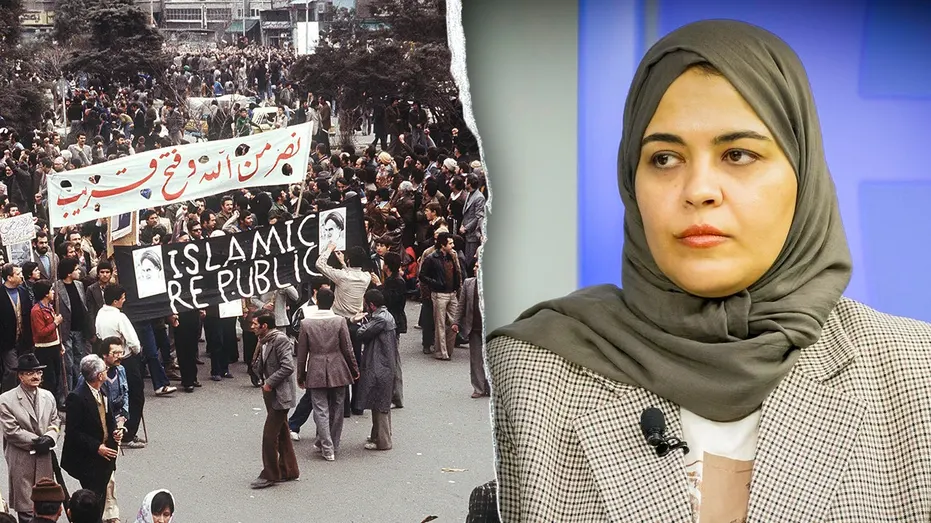
SouthernWorldwide.com – A Muslim scholar who was compelled to leave Egypt after denouncing Hamas’s October 7th attacks has issued a stark warning to America’s far-left: their alliance with Islamist extremism mirrors the path that led to Iran’s 1979 revolution, ultimately resulting in an Islamic regime seizing power after a partnership with leftist factions.
Dalia Ziada, a Middle East scholar and coordinator at the Institute for the Study of Global Antisemitism and Policy based in Washington, D.C., has since relocated to the United States. She observes troubling parallels between the current dynamics in America and historical events.
Her cautionary message arrives as a global network of anti-Israel activist groups prepares for coordinated “Nakba 78” protests across the United States and internationally this weekend. These demonstrations, timed with the anniversary of Israel’s founding, are viewed by critics as challenges to the Jewish state’s legitimacy and, in some instances, calls for its dissolution.
Ziada explains that Islamist movements, including those linked to the Muslim Brotherhood, have for years leveraged the Palestinian cause to garner support and forge alliances with Western activist movements. This phenomenon has been characterized by some analysts as a “red-green alliance.”
She further contends that Islamist movements have increasingly targeted Jewish communities in the West, viewing them as a crucial pillar supporting liberal democratic systems. Ziada elaborates on their shared objective: to dismantle the current Western order and replace it with their own vision.
“They agree on one thing, that they need to destroy the West as we know it today and replace it with something else. For the radicalists, they want to replace it with the Marxist system. For the Islamists, they want to replace it with an Islamist system, which they think is the ideal system,” she stated.
Global Protest Network
This weekend, an estimated 736 events are organized by these groups across 39 countries.
Ziada posits that this alliance is fueled by a shared animosity towards Western liberal democracies and has been amplified in the wake of the October 7th Hamas attacks.
She suggests that the conflict in Gaza has provided a “moral umbrella” for this movement.
“They used that to give themselves some moral legitimacy to go on and accelerate the process of destroying the West,” she commented.
Lessons from Iran
Ziada points to the 1979 Iranian Revolution as a historical precedent and a cautionary tale.
Read more : Rudy Giuliani Describes 'Spiritual Experience' During Pneumonia Coma
“We saw this exactly happening in Iran in the 1970s. The Islamists used the left because the legitimacy of the left is stronger, because they don’t come from a religious background,” she recalled. “They allied the communists there, made them believe that we all are going to change Iran and make it a better place. And how it ended in 1979, the Islamic Revolution happened. The Islamists took over the country and the first group they sacrificed … was the communists, the leftists in Iran.”
Ziada warns that similar patterns could emerge in the United States if these ideological alliances continue to deepen. She argues that movements united by shared opposition often fracture once power is achieved.
While the participating groups may appear aligned in the short term, their long-term objectives are fundamentally at odds, a pattern she notes has recurred throughout the Middle East.
She emphasizes that such alliances are typically transient, with more extreme factions often consolidating power once their initial objectives are met.
The protests themselves are anticipated to follow a familiar script of anti-Israel demonstrations, which Ziada describes as “very well organized worldwide.”
“I don’t think this time it would be any different in the general sense of demonizing Israel, trying to blame Israel for everything,” she remarked.
Ziada expects protesters to employ terms like “apartheid” and “genocide” when referring to Israel, language she believes indicates a broader, coordinated alignment of groups sharing similar messaging and goals.
She explains that the term “Nakba,” meaning “catastrophe,” has been recontextualized over time. Ziada argues that it was originally used, in part, to critique Arab leaders for rejecting a proposed Palestinian state, a nuance largely absent from contemporary protests.
“I wouldn’t say it’s kind of a bureau… but they all agree on one thing, which is destroying the United States or weakening the Western world,” she stated.
Ziada asserts that she has personally witnessed the repercussions of such alliances in the Middle East.
“I have seen my native Egypt being destroyed by these groups, by these people, and I’ve seen the entire Middle East actually falling under this. And I don’t want to see the United States, the country that has given me my education, has given my career, has given me a refuge when these radicals tried to kill me — I don’t want to see being destroyed by the same bad guys.”