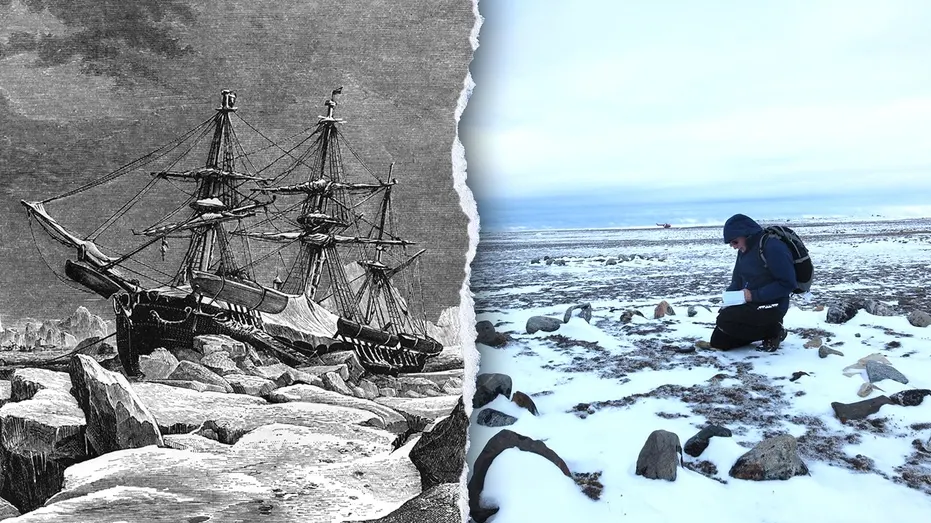
SouthernWorldwide.com – Approximately 180 years after the ill-fated expedition of Sir John Franklin to discover the Northwest Passage ended in tragedy, scientists have successfully identified four more crew members using DNA analysis.
This significant advancement in understanding one of history’s most notorious Arctic disasters was spearheaded by researchers from the University of Waterloo in Ontario, Canada.
The newly identified individuals are William Orren, Able Seaman; David Young, Boy 1st Class; John Bridgens, Subordinate Officers’ Steward; and Harry Peglar, Captain of the Foretop aboard HMS Terror.
In 1845, British explorer Sir John Franklin embarked on a mission with 129 officers and crew members, sailing on HMS Erebus and HMS Terror, with the aim of charting the elusive Northwest Passage.
Tragically, in September 1846, the ships became ensnared in the ice near King William Island in Nunavut. Sir John Franklin himself passed away in 1847.
By April 1848, the surviving crew made the desperate decision to abandon their vessels. They attempted to escape on foot, dragging their boats across the harsh Arctic landscape, but their efforts were in vain, and no one survived.
The University of Waterloo stated in a release on May 6 that “All 105 died trying to escape.” Their comprehensive study was published in the Journal of Archaeological Science: Reports in May.
Since the mid-19th century, remains of expedition members have been discovered on King William Island and the Adelaide Peninsula.
Anthropologists from the University of Waterloo conducted DNA analysis on skeletal remains recovered from various sites associated with the Franklin expedition. They successfully matched these samples with DNA provided by living descendants.
Read more : SpaceX Tests Updated Super Heavy-Starship Rocket
Co-author of the study, Stephen Fratpietro of Lakehead University, meticulously compared the DNA from the recovered remains with that of living descendants, confirming exact genetic matches in all four identified cases.
These recent discoveries bring the total number of identified sailors from the Franklin expedition to six. Previously, John Gregory was identified in 2021, followed by Captain James Fitzjames in 2024.
The primary dangers faced by the expedition stemmed from the unforgiving Arctic environment. These included extreme winter cold, a severely limited sailing season that often necessitated overwintering, ice strong enough to crush ships, immense physical and mental strain on the crew, and the constant threat of death from illness or injury sustained during their difficult work.
Stenton noted that the DNA analysis process yielded several unexpected findings. One such surprise was the identification of Captain James Fitzjames in 2024, whose remains exhibited evidence of cannibalism.
He further explained that Captain Fitzjames is not the sole member of the expedition whose body met such a fate, but he is the only one who has been definitively identified as such.
Researchers were also astonished to find that five of the six identified sailors were discovered in close proximity to two boats, located less than 1.25 miles apart along Erebus Bay.
The identification of Peglar proved particularly surprising, as his remains were found dressed in the attire of a steward. This initially led some experts to believe the remains belonged to someone else.
Stenton posits that Peglar may have been dressed as a steward due to a demotion resulting from misconduct.
He elaborated, stating, “A petty officer is an experienced sailor with important responsibilities. … Because of the clothing, many researchers assumed that Peglar had died and that the body was not his, but [rather] that of a friend who was a steward and who was carrying Peglar’s papers home to his family.”
However, Stenton affirmed that “167 years after the discovery of the body, our research has conclusively disproven that theory.”
Extracting usable DNA from the remains presented considerable challenges, as genetic material naturally degrades over time, even in the cold Arctic conditions, according to Stenton.
To enhance their chances of success, scientists primarily focused their analysis on teeth. The robust enamel of teeth offers better preservation of DNA over extended periods of exposure to the elements.
Stenton explained that the Northwest Passage was highly coveted because it was perceived as a potential trade route connecting the Atlantic and Pacific oceans, thereby offering more expedient access to Asian markets.
The Franklin expedition was also described as “the largest and arguably best-equipped Arctic expedition of its time.” Its successful completion would have brought immense prestige and national pride to Britain.
Future endeavors will involve collaborating with genealogists and descendants to identify additional crew members, as well as potentially collecting more archaeological DNA samples in the coming years.
Stenton believes that DNA research is instrumental in helping scientists develop “a better understanding of the catastrophic loss of life” while also offering a measure of closure to the affected families.
He concluded by stating, “Just as importantly, the research both depends on and invites the participation of descendants of the men who never returned home, which feels especially fitting.”