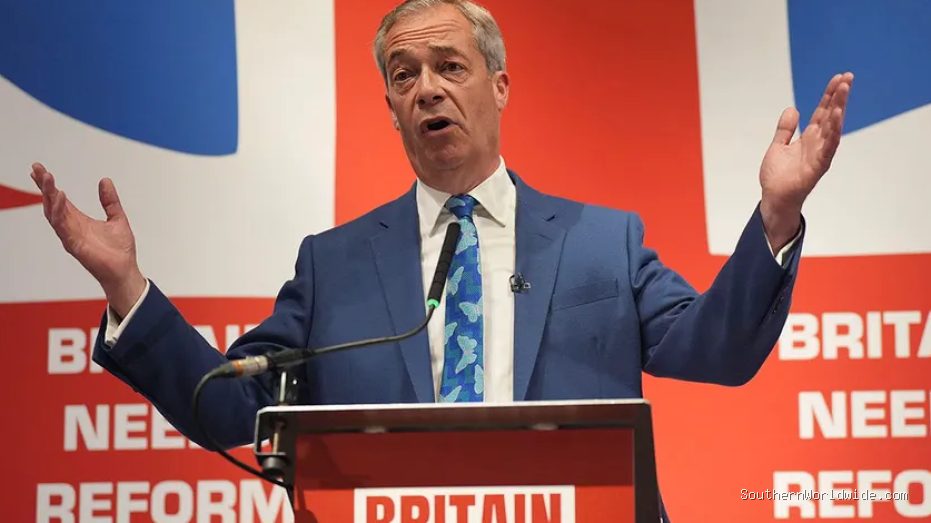
SouthernWorldwide.com – Nigel Farage, a prominent figure in British politics and leader of Reform UK, has declared that mass migration has irrevocably altered the United Kingdom, making it “literally beyond recognition.” Speaking at the Alliance for Responsible Citizenship conference in London, Farage asserted that the recent political upheaval, including the resignation of Labour leader Keir Starmer, is a direct consequence of the Brexit vote a decade ago.
Farage referred to the Brexit referendum as a “political earthquake in Britain,” emphasizing that the two major political parties have struggled to adapt to its aftermath. He believes that the current political instability is a continuing ripple effect of this significant event.
The leader of Reform UK has consistently argued that the British political establishment has failed to address the public’s desire for stricter border controls and enhanced national sovereignty. This has been a central theme of his political career.
Keir Starmer’s resignation, announced on a Monday, marked the potential for Britain to see its seventh leader in a decade. Reports indicate that Andy Burnham is positioned to succeed Starmer, with the Labour leadership contest slated to commence on July 9.
Farage pointed to the local elections earlier this year as a turning point for Starmer. Reform UK achieved substantial gains in areas traditionally held by Labour, indicating a shift in voter sentiment. He identified these voters as the same demographic that propelled the Brexit movement, with immigration remaining a key grievance.
He stated that these were “all Brexit voters” and that Starmer’s perceived intention to move Britain closer to the EU was at odds with the reasons many voted for Brexit, particularly concerning immigration and border control. The issue of migrant boats crossing the English Channel, he noted, significantly harmed Starmer’s standing.
While Farage doesn’t believe Starmer’s reportedly strained relationship with former US President Donald Trump was the direct cause of his resignation, he conceded it contributed to an image of a leader who had lost control of the political narrative.
Farage offered a stark assessment of Britain’s political landscape, highlighting the rapid succession of prime ministers. He noted that with Andy Burnham potentially becoming prime minister, it would mark the sixth leader in seven years, suggesting a fundamentally broken political system.
He questioned the legitimacy of Burnham potentially entering Downing Street via a leadership contest rather than a general election, arguing that this would leave him without a public mandate. Farage admitted he was unsure of Burnham’s policy positions.
Consequently, Farage advocated for a general election to secure a fresh mandate for the country. He expressed confidence that Reform UK would have a strong chance of winning such an election.
Farage also framed Britain’s political turmoil within a broader Western crisis concerning borders, national identity, and traditional values. He issued a cautionary note to Americans, urging them to learn from what he described as Britain’s missteps in diversity policies, policing, justice, and immigration.
“Mass migration has changed this country, certainly in many of our cities, literally beyond recognition,” he asserted. He criticized the lack of selectivity in immigration, deeming it a significant contributing factor to the current situation.
He suggested that the pendulum had swung too far in the direction of Diversity, Equity, and Inclusion (DEI), leading to a situation of “two-tier policing, with two-tier justice” in Britain.
Farage predicted that “political change is coming” to America, and that “all of this nonsense will get reversed.”
He lamented a perceived loss of direction and a reluctance among leaders to defend traditional values.
Regarding the relationship with the United States, Farage expressed his belief that Britain should foster closer ties, particularly in trade and financial services.
He highlighted his lifelong connection with the US, mentioning his first job in 1982 with Wall Street firm Drexel Burnham Lambert.
Farage expressed optimism about his ability to build rapport with American leaders and believed they would reciprocate.
He underscored the enduring bonds between the UK and the US, rooted in investment, language, and culture.
He pointed out that the US is the largest foreign investor in Britain, and the UK remains a significant investor in America. He emphasized the shared heritage beyond just language, encompassing culture and more.
Farage strongly advocated for a closer relationship with America, suggesting that reducing trade barriers, particularly in financial services, would benefit both nations.
He dismissed any serious prospect of Britain rejoining the European Union.
Farage argued that rejoining the EU would necessitate abandoning the Pound Sterling and incurring substantial annual membership fees. He stated there is no public demand for such a move, except perhaps among those within the “Westminster bubble.”
As the United States approaches its 250th anniversary, Farage drew a parallel between the American Revolution and the Brexit movement, viewing the former as a precursor to the latter.
“America was the first Brexit,” he declared, asserting that the US forging its own path led to its status as the world’s most successful country.