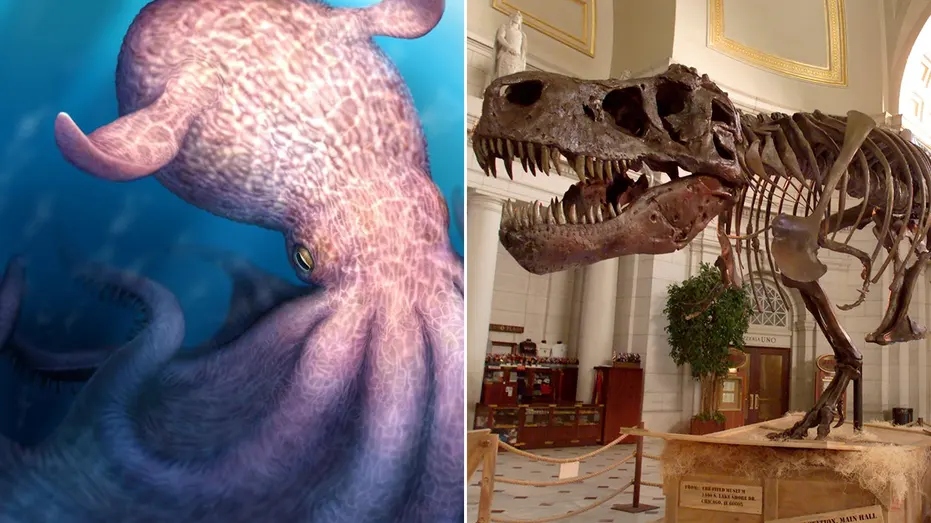
SouthernWorldwide.com – Ancient octopuses that lived 100 million years ago were likely enormous predators that coexisted with dinosaurs, according to a recent study.
While scientists previously estimated the earliest octopuses to have emerged around 15 million years ago, researchers from Hokkaido University discovered fossilized jaws within rock samples from the Late Cretaceous period. This finding pushes back the known timeline significantly.
The challenge in tracing octopus evolutionary history lies in their soft bodies, which rarely fossilize. Only their jaw bones, known as beaks, tend to preserve, making them a rare but crucial source of information.
To locate these ancient fossils, the researchers employed advanced techniques. They utilized high-resolution grinding tomography, a method for detailed internal imaging, and an artificial intelligence model. These tools helped them identify the fossilized jaws within rock samples.
These rock samples were collected from seafloor sediments in Japan and Vancouver Island. They date back to a period between 100 and 72 million years ago, placing them firmly in the era of dinosaurs.
The Late Cretaceous period marked the final epoch of the Mesozoic Era. This era was famously dominated by a diverse array of dinosaurs, including well-known species like Tyrannosaurus Rex and Triceratops.
The discovered fossils are attributed to an extinct group of finned octopuses called Cirrata. Based on the evidence, researchers believe these ancient cephalopods were formidable predators, capable of crushing their prey with remarkably powerful jaws.
“Our findings suggest that the earliest octopuses were gigantic predators that occupied the top of the marine food chain in the Cretaceous,” stated Professor Yasuhiro Iba of Hokkaido University. He was a lead author of the study.
Professor Iba further elaborated on the size of these ancient creatures. “Based on exceptionally well-preserved fossil jaws, we show that these animals reached total lengths of up to nearly 20 meters,” he explained. This estimated size could have even surpassed that of large marine reptiles living during the same period.
One of the most striking discoveries was the condition of the fossilized jaws themselves. Professor Iba highlighted the significant wear and tear evident on them, noting extensive chipping, scratching, and cracking.
“In well-grown specimens, up to 10% of the jaw tip relative to the total jaw length had been worn away,” he described. This level of wear is greater than what is observed in modern cephalopods that consume hard-shelled prey.
This extensive wear strongly indicates a feeding strategy involving repeated and forceful interactions with prey. It points to an unexpectedly aggressive approach to hunting for these ancient marine invertebrates.
These new findings necessitate a reevaluation of the predator dynamics during the Late Cretaceous. Previously, scientists largely assumed this period was dominated by vertebrate predators, with invertebrates occupying lower positions in the marine food web.
“This study provides the first direct evidence that invertebrates could evolve into giant, intelligent apex predators in ecosystems that have been dominated by vertebrates for about 400 million years,” Professor Iba emphasized. This challenges long-held assumptions about prehistoric marine ecosystems.
Read more : Fox News AI Newsletter: Chatbots' Left-Wing Bias
The research suggests that specific evolutionary traits were crucial for developing into large, intelligent marine predators. “Our findings show that powerful jaws and the loss of superficial skeletons, common characteristics of octopuses and marine vertebrates, were essential to becoming huge, intelligent marine predators,” Professor Iba concluded.