SouthernWorldwide.com – Astronomers have recently detected a rare interstellar object traversing our solar system. A prominent physicist from Harvard University suggests that its peculiar characteristics might point towards it being more than just a typical comet.
Dr. Avi Loeb, a science professor at Harvard University, shared his thoughts with Fox News Digital, stating, “Perhaps the trajectory was intentionally designed.” He elaborated, “If it had an objective, such as deploying mini probes to these planets or monitoring them… it appears quite anomalous.”
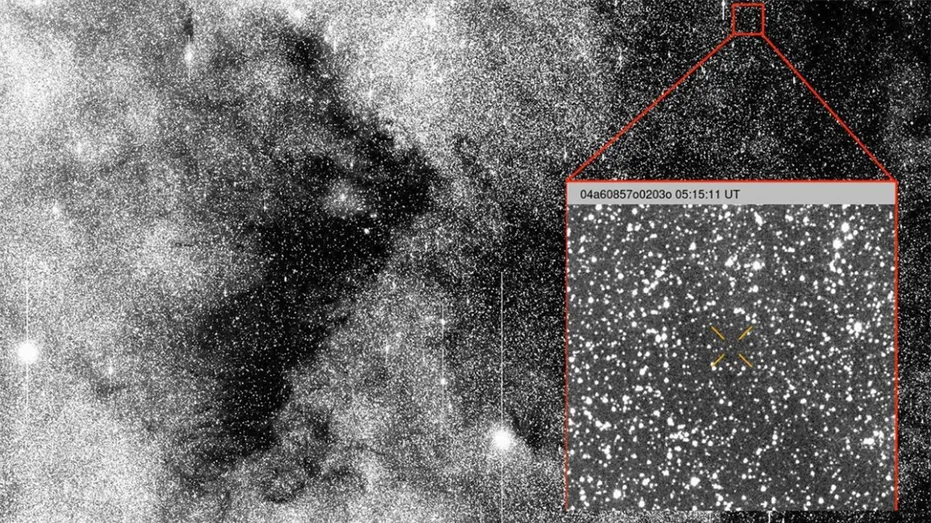
This object, identified as 3I/ATLAS, was first observed in early July by a telescope from the Asteroid Terrestrial-impact Last Alert System, or ATLAS, situated in Chile. According to NASA, this discovery marks only the third instance of an interstellar object being observed entering our solar system.
While NASA has officially classified the object as a comet, Dr. Loeb pointed out an intriguing detail from an image of the celestial visitor. He noted an unexpected glow emanating from the front of the object, rather than trailing behind it, which he found “quite surprising.”
METEORITE FRAGMENT THAT SLAMMED THROUGH HOMEOWNER’S ROOF IS BILLIONS OF YEARS OLD, PREDATES EARTH: PROFESSOR
Dr. Loeb explained to Fox News Digital, “Typically, comets exhibit a tail, a cometary tail, where dust and gas reflect sunlight, and this is the characteristic signature of a comet. However, in this case, we observe a luminescence at its front, not at its rear.”
Measuring approximately 20 kilometers in diameter, making it larger than Manhattan, 3I/ATLAS also displays unusual brightness for its current distance. However, Dr. Loeb highlighted its trajectory as its most peculiar attribute.
RARE JUPITER-SIZED PLANET DISCOVERED 3,200 LIGHT-YEARS AWAY USING EINSTEIN’S SPACE-TIME WARPING METHOD
“If we consider objects entering the solar system from random directions, only one in 500 would be so precisely aligned with the orbits of the planets,” he remarked.
Read more : AI in the Disney Experience: A Fox News Look
The interstellar object, originating from the center of the Milky Way galaxy, is also anticipated to pass in close proximity to Mars, Venus, and Jupiter. Dr. Loeb indicated that such an occurrence is also highly improbable by chance.
“The probability of it coming close to each of them is one in 20,000,” he stated.
ASTRONOMERS MAKE GROUNDBREAKING DISCOVERY ABOUT LARGEST COMET EVER OBSERVED FLYING THROUGH DEEP SPACE
According to NASA, the 3I/ATLAS object is projected to reach its closest point to our sun, approximately 130 million miles away, on October 30.
“If it proves to be technological in origin, it would undoubtedly have a significant impact on the future of humanity,” Dr. Loeb commented. “We must carefully consider how we will respond to such a discovery.”
In a related incident in January, seven years after SpaceX CEO Elon Musk launched a Tesla Roadster into orbit, astronomers at the Minor Planet Center, part of the Harvard-Smithsonian Center for Astrophysics in Massachusetts, mistakenly identified it as an asteroid.
CLICK HERE TO GET THE FOX NEWS APP
A spokesperson for NASA did not immediately provide a comment to Fox News Digital’s request.