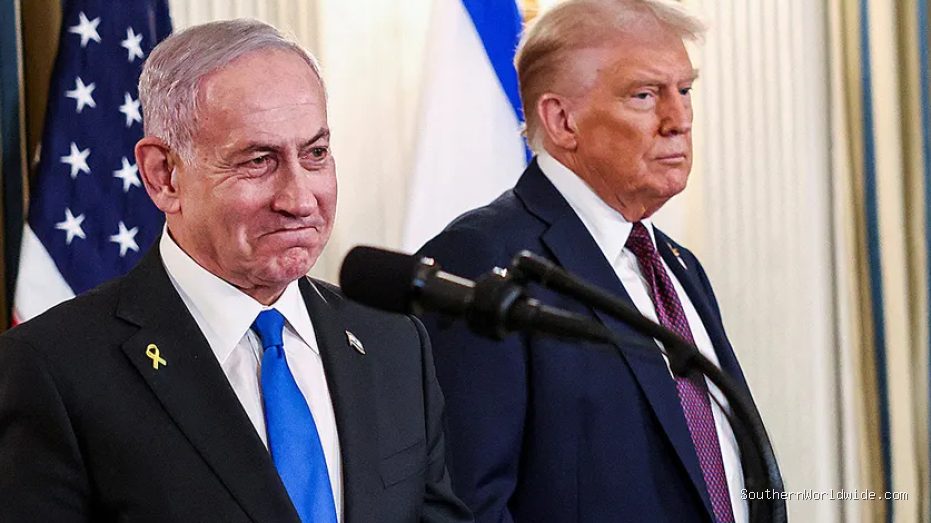
SouthernWorldwide.com – A regional analyst has indicated that concerns are mounting in Jerusalem regarding President Donald Trump’s potential shift in stance towards Prime Minister Benjamin Netanyahu, particularly as a critical U.S.-Iran peace agreement approaches. These anxieties were amplified on Sunday following a second strike by the Israeli Defense Forces (IDF) on Beirut.
The strikes occurred despite explicit U.S. warnings that such actions would jeopardize any potential breakthrough with Tehran. This development came as Netanyahu was preparing to convene Israel’s Security Cabinet and shortly after Trump announced that a new U.S.-Iran memorandum of understanding (MOU) was expected to be signed imminently.
Following these events, Trump took to Truth Social to condemn Israel’s strikes and, in a separate communication with Axios, stated that Netanyahu “had no f—ing judgment.”
Natan Sachs, a senior fellow at the Middle East Institute, acknowledged the existence of “absolutely this fear in the Israeli government.” He characterized this apprehension as “a rational and healthy fear” concerning the impending deal.
Sachs pointed out a significant “strategic chasm” between the two allied nations. He contrasted Netanyahu’s long-standing strategy of sustained military pressure with Trump’s focus on achieving immediate diplomatic victories.
Amid ongoing discussions mediated by Pakistan, the Israeli prime minister’s office issued a statement shortly after Trump’s June 11 announcement regarding the potential deal with Tehran.
Netanyahu declared that Jerusalem “is not a party to the memorandum of understanding” between Washington and Tehran. He reiterated on June 12 that Iran was actively “working to destroy the Jewish state” and assured Israelis that he had dedicated his life to preventing such an outcome.
On Sunday, a senior Israeli official reported that Hezbollah attacks had targeted Israeli civilians for the preceding three days, coinciding with Israel’s preparations for potential Iranian retaliation.
Earlier this month, Trump had reportedly criticized Netanyahu during a phone call, allegedly calling him “crazy” in response to an initial strike on Beirut that was perceived as complicating the administration’s negotiations with Iran.
“It’s not just that there seems to be a crisis — and there were clearly expletives used by the president toward the prime minister on the backdrop of a joint and large military operation,” Sachs observed.
Sachs explained that at the commencement of Operation Epic Fury and Roaring Lion on February 28, “Israel and Netanyahu had first looked at Trump and saw both enormous carrots and enormous potential sticks.”
“Trump was a huge opportunity for Netanyahu because he was willing to break the mold on anything, but Israel has made a potentially strategic, historic mistake in putting all its eggs in one basket,” he elaborated.
“Netanyahu was always prepared for the long haul,” Sachs continued. “And the long haul is not four months; the long haul is years. Trump likes quick wins. Once the quick win did not materialize — and it did not — now you have a whole new set of problems.”
“Trump’s preference seemed far from pursuing a much broader campaign aimed at achieving the goals that Israel prefers, and he also has a much narrower conception of what a deal would be,” Sachs added.
Sachs did note, however, that Trump and Netanyahu largely shared common objectives concerning Iran’s nuclear ambitions, the elimination of Hezbollah’s armed presence in Lebanon, and the establishment of a post-Hamas future for Gaza.
He cautioned, though, that “having that wish list is not the same as having a strategic goal. They haven’t both committed to them as strategic goals that dictate concerted action going forward.”
Sachs also suggested that the tensions between Trump and Netanyahu stem from their differing temperaments.
“Netanyahu thinks of himself as a strategic thinker — very able, and of course, he has a very high opinion of himself — but he is completely different,” Sachs commented.
“Netanyahu is an erudite, well-educated, patient, highly suspicious and extremely pessimistic man by nature. His self-image is more, ‘I have thought everything through in ways you could not, because I’m smarter than you.'”
“He’s very suspicious of everyone around him, and he’s been surrounded by this same coterie of individuals for decades.”
“In terms of personality and where they come from, their worldview is also actually very different,” Sachs added.
“You can’t imagine Netanyahu spending hours at night on social media. He doesn’t go on it himself, and it’s hard to imagine President Trump spending hours reading books, which Netanyahu likes to portray himself as doing. I doubt he has time for it, but that is an image he projects, and I think it is partially true.”
“Netanyahu also believes you live with a problem, you manage it, and you kick the can down the road. Trump is the opposite.”
“The U.S. may turn away and be uninterested; Israel simply does not think it has that privilege,” Sachs stated.
“Netanyahu and Trump have very different time horizons, and that is partly geography and interest — and partly personality.”