SouthernWorldwide.com – In a remarkable discovery, archaeologists have unearthed the well-preserved remains of an 18th-century bake house buried for centuries beneath the Lebanon Town Green in Connecticut.
This significant find dates back to the Revolutionary War era and served a crucial purpose: baking bread for French soldiers who were supporting the American Revolution.
The excavation, conducted in June in the New London County town, revealed the foundation of the bake house, providing a tangible link to a pivotal period in American history.
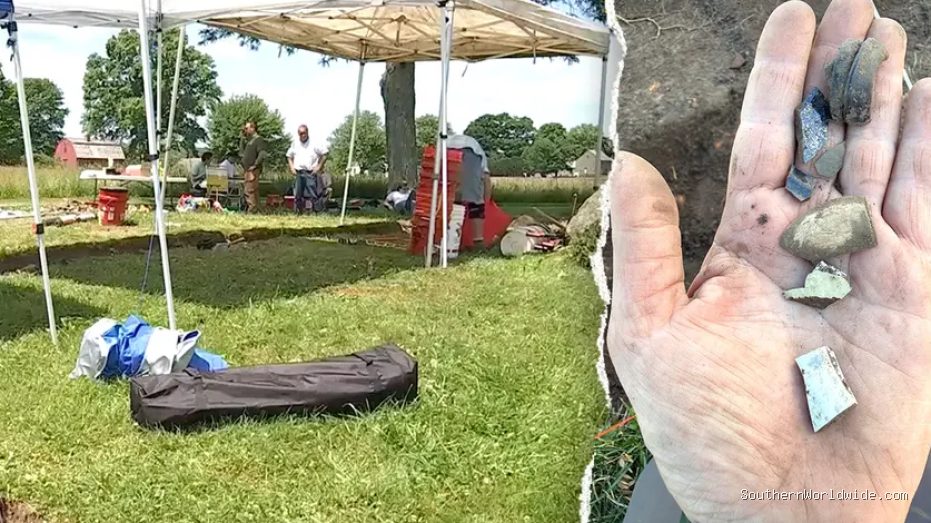
While the site yielded a limited number of artifacts, one discovery stood out to State Archaeologist Sarah P. Sportman: a gun flint.
Gun flints were essential components of flintlock firearms, used to create the spark needed to ignite gunpowder and fire the weapons during the Revolutionary War.
The discovery of the gun flint directly links the unearthed structure to the military activities of the time.
Other artifacts found at the site offered a glimpse into the area’s layered history, with ceramic and glass fragments from the late 19th century suggesting later landscaping work.
Deeper excavation revealed older ceramic fragments, animal bones, clay smoking pipe pieces, and older bottle glass, dating back to the late 18th century.
Historians had long suspected the presence of a French bake oven on the town green, with a commemorative plaque marking the presumed location.
An amateur excavation in 1896 reportedly uncovered masonry and bricks at the site, but lacked any documentation like maps, photographs, or preserved artifacts.
This modern archaeological excavation is the first to systematically document and analyze the bake house.
“We hope that additional testing in the fall will clarify some of those features and help us better understand the site,” Sportman stated.
Sportman confirmed that the 1896 dig did not appear to have significantly damaged the foundation, which was found to be largely intact.
The bake house was likely intended to be semi-permanent, as the French encampment in the area lasted for several months.
The foundation’s construction, described as not very robust with less tightly built stonework, suggests a functional rather than a grand architectural design.
However, it was more substantial than the temporary earth ovens sometimes used by troops on the move.
The structure appears to have utilized stone for its base and brick for the oven portions.
The discovery of the bake house is part of a larger archaeological initiative in Lebanon as the nation approaches its 250th anniversary.
Researchers have identified numerous sites related to 18th-century militia training and the potential location of a French hospital, highlighting Lebanon’s significant role during the Revolutionary War.
“The project is also important because the Lebanon encampment was part of the route of French troops under General Rochambeau who came to help the American colonists overthrow British rule,” Sportman explained.
She emphasized the crucial role of French allies in the American victory and the enduring strength derived from such partnerships.
A ground-penetrating radar survey conducted before the excavation indicated that the excavated stone and brick structure might be part of a larger complex of buildings on the green.
Further testing planned for the fall aims to clarify these features and provide a more comprehensive understanding of the entire site.