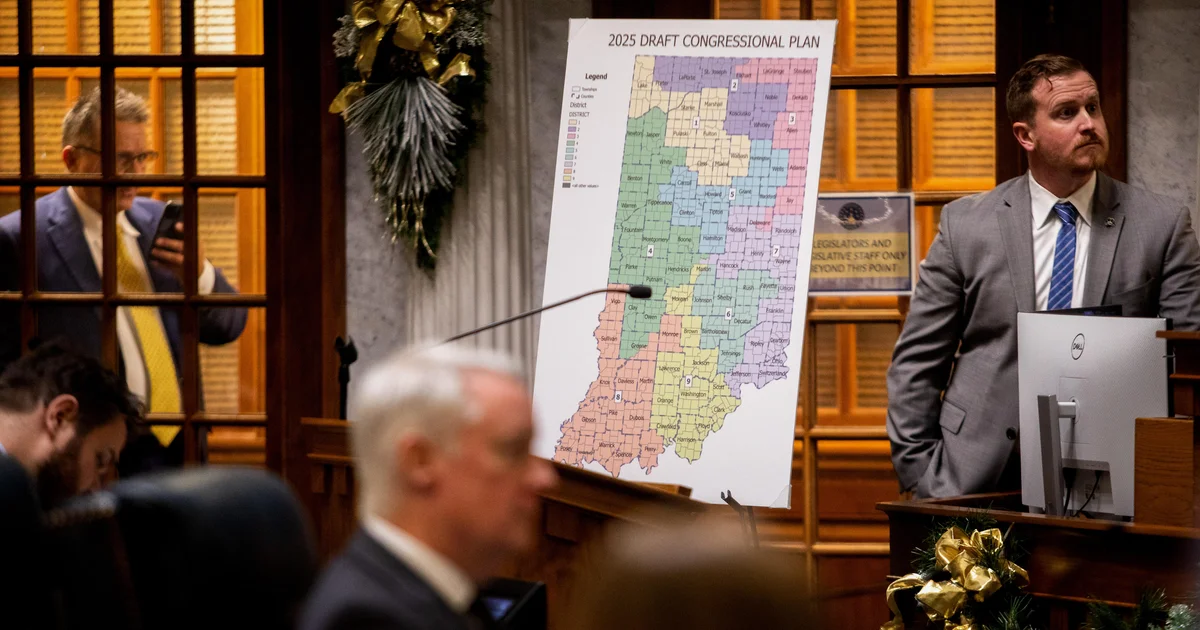
SouthernWorldwide.com – The Indiana State Senate is scheduled to vote on Thursday regarding a new congressional map that would exclusively favor Republicans, potentially awarding them all nine of the state’s U.S. House districts. This development is a significant political objective for the Trump administration, as states, both Democrat- and Republican-led, are engaged in a nationwide redistricting competition ahead of the 2026 midterm elections.
However, the proposed map has ignited a contentious debate, leading to bomb threats and swatting incidents targeting Indiana lawmakers. A sufficient number of Republican state lawmakers in Indiana have voiced opposition to the new map, casting doubt on its approval.
Currently, Republicans hold seven of Indiana’s nine congressional districts, with Democrats representing two: one situated near southwest Chicago and another encompassing Indianapolis. The proposed map aims to significantly alter the Indianapolis-based district represented by Democratic Rep. André Carson, with the intention of diluting the city’s Democratic voting strength.
The map successfully passed the Indiana State House earlier this month with a vote of 57-41. Despite this, Indiana Senate President Rodric Bray has previously stated that the necessary votes for the map’s passage are not yet secured in the Senate.
A minimum of 25 out of the state’s 50 senators must vote in favor for the map to be approved, with Republican Lieutenant Governor Micah Beckwith holding the tie-breaking vote. The chamber comprises 40 Republican senators. According to the IndyStar, at least 12 state senators have publicly declared their opposition to the map, with several others keeping their positions private.
“It’s a toss-up,” commented Marty Obst, a GOP operative and chair of the nonprofit “Fair Maps Indiana,” which advocates for a mid-decade redistricting. He indicated that approximately ten Republican state senators remain undecided, partly due to their desire to gather more constituent feedback and engage in further debate on the Senate floor this week.
“We’ll obviously need a few of those to get to 25,” Obst added. “It should be an interesting day on Thursday. It’s truly up in the air.”
Lawmakers opposing the map have expressed skepticism about the Republican Party’s ability to win all nine seats under the proposed configuration. They have also cited constituent backlash and the unusual nature of redrawing congressional lines midway through a decade, rather than following the decennial Census, as was the case for Indiana and the rest of the country in 2021.
Read more: GOP Redistricting Strategy May Backfire in Virginia Midterms
“What’s taking people by surprise is the novelty of politicians who prioritize fidelity to principle, over flirtations with politics. It’s so old it’s new again,” remarked Indiana GOP operative Pete Seat.
Conversely, state Republicans who support the map argue that Indiana should not be a passive observer in the process of gerrymandering. They point to instances of gerrymandering by Democratic-led states, such as California and neighboring Illinois.
“We’ve consistently seen the Democrats use that process to increase and rule their influence in Washington D.C …. what the administration is challenging Republicans with is that we have to push back,” stated state Republican Sen. Andy Zay in an interview with CBS affiliate WANE in Fort Wayne, Indiana.
Three Republican senators on the Indiana Senate elections committee, who voted to advance the map on Monday, have indicated that they reserve the right to vote against it on Thursday.
Throughout the year, the White House has exerted political pressure to advance redistricting efforts in Indiana.
President Trump publicly criticized Republican holdouts in the Indiana Senate on Wednesday via a Truth Social post, referring to Bray as “either a bad guy, or a very stupid one.”
“Anybody that votes against Redistricting, and the SUCCESS of the Republican Party in D.C., will be, I am sure, met with a MAGA primary in the Spring,” the former president wrote. “Rod Bray and his friends won’t be in Politics for long, and I will do everything within my power to make sure that they will not hurt the Republican Party, and our Country, again.”
Vice President JD Vance has engaged in multiple meetings with Indiana GOP lawmakers this year in both Indianapolis and Washington D.C. to advocate for a mid-decade redraw. Mr. Trump himself met with Indiana House and Senate leaders in the Oval Office in August and has personally contacted state lawmakers regarding redistricting.
“I will be strongly endorsing against any State Senator or House member from the Great State of Indiana that votes against the Republican Party, and our Nation, by not allowing for Redistricting,” Trump stated in a Truth Social post in November.
This external pressure campaign was already in motion prior to the votes. Obst’s nonprofit, Indiana Fair Maps, has reportedly spent over $250,000 on advertisements encouraging lawmakers to pass the map. On Monday, a super PAC associated with his nonprofit announced plans to allocate up to seven figures in the 2026 primary elections to support proponents of redistricting, as well as to recruit and provide financial backing for challengers against lawmakers who oppose it. Obst asserts that this initiative will proceed regardless of whether the map is ultimately approved.
Turning Point USA, the conservative organization founded by the late Charlie Kirk, hosted a rally at Indiana’s Statehouse earlier this month, where Indiana Governor Mike Braun spoke in favor of the new map. Several Turning Point USA officials, including Trump adviser Alex Bruesewitz, have also publicly criticized lawmakers opposing redistricting on social media over the past two months.
However, as redistricting in Indiana has garnered increased attention, several state Republican lawmakers, along with Governor Braun, have reportedly received bomb threats and been subjected to swatting incidents. Republican State Sen. Jean Leising, who opposes the new congressional map in Indiana, was the target of a pipe bomb threat. She attributed this incident to “D.C. political pundits for redistricting.”
“I fear for this institution. I fear for the state of Indiana, I fear for all states if we allow intimidation and threats to be the norm,” stated Republican State Sen. Greg Walker, the sole member of the state Senate’s election committee who voted against advancing the new map.
Obst described the threats as “uncalled for” and emphasized that he does not endorse any threats made against lawmakers. “I’ve been in Indiana politics for 20 years… we’re trying to have a debate and get redistricting done. But this is uncalled for,” he said.
Indiana’s push for mid-decade redistricting follows similar efforts across the nation. This summer, Texas Republicans redrew their congressional map at Mr. Trump’s request, aiming to net up to five additional seats for their party. Subsequently, California’s Democratic Governor Gavin Newsom spearheaded a ballot measure that passed with over 60% of the vote, leading to a redrawing of their map to potentially gain up to five Democratic seats. Missouri’s legislature then redrew its map in an attempt to shift one more seat towards Republicans, and North Carolina undertook a comparable effort to unseat a Democrat in its 1st Congressional District. Other Democrat-led states, such as Maryland and Illinois, are also considering redraws to increase their number of Democratic seats.