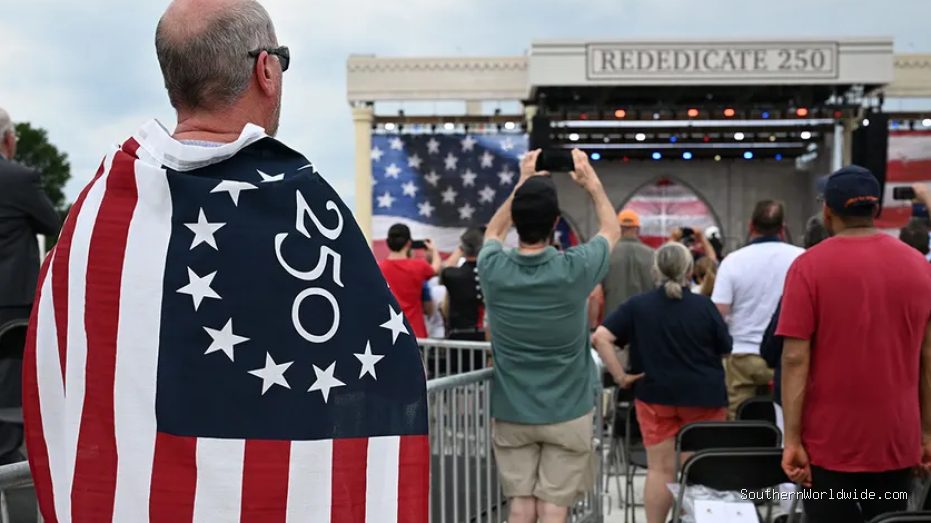
SouthernWorldwide.com – A significant event occurred 250 years ago at Independence Hall in Philadelphia, where the Founding Fathers finalized the Declaration of Independence. More recently, another momentous event took place at the same historic site: the burial of a time capsule.
Congress passed a resolution mandating the burial of a time capsule a few feet from Independence Hall to commemorate the nation’s 250th anniversary. The instructions are explicit: the capsule is not to be opened until the year 2276, exactly 250 years from its interment.
Representative Robert Aderholt of Alabama, who was among a bipartisan group of lawmakers present, stated, “Our responsibility is not simply to remember what happened here on these grounds. But to preserve those same ideals of whose generation came before and that will come after us.”
Philadelphia served as the nation’s capital when Congress met there from 1790 to 1800 before relocating to Washington, D.C. The District of Columbia’s existence is partly a result of the Pennsylvania Mutiny of 1783, when Continental Army soldiers threatened Independence Hall’s security due to unpaid wages from the nascent American government.
Alexander Hamilton championed the establishment of a federal “District” as the “seat of government,” as outlined in the Constitution. The primary aim of this unique federal territory was to ensure the protection of Congress.
“The Congressional time capsule is a reflection of our faith in the future of this grand experiment in self-governance,” remarked House Speaker Mike Johnson of Louisiana. “When this capsule is finally opened, those Americans will be as distant from us as we are today from the men who signed their names on our declaration.”
Each U.S. state and all six of its territories contributed artifacts to be interred in the stainless steel time capsule. Among the items were letters from Congressional leaders, as well as from NBA Commissioner Adam Silver, NHL Commissioner Gary Bettman, and MLB Commissioner Rob Manfred.
When asked about the content of his letter, MLB Commissioner Rob Manfred declined to comment, stating that the message was intended for future recipients and its contents should remain a mystery. This secrecy mirrors the current enigma of the New York Mets’ performance, who, despite having the second-highest payroll in baseball, remain in last place.
The burial of the time capsule in Philadelphia marked the intersection of three temporal lines. Each object represented a piece of America’s past, the burial itself symbolized the present moment of America’s 250th birthday, and the ceremony was simultaneously a gesture towards the future.
One can envision historical figures like Thomas Jefferson walking across the green by Independence Hall 250 years ago. Then, consider contemporary visitors touring the National Constitution Center and viewing the Liberty Bell during this year’s holiday. Finally, project oneself into the future, imagining the appearance of that same green and the individuals one might encounter in another 250 years.
The time capsule contains items from one of the most significant events in American history: 9/11. House Minority Leader Hakeem Jeffries of New York explained, “We have a piece of metal from the Freedom Tower that obviously represents both the struggle initially and what happened on September 11th. But then ultimately, the resilience of rising from the ashes, as America has always done.”
However, the desire to include more personal or symbolic items was palpable. Jeffries humorously added, “Well, a New York Knicks championship ring would be incredible.”
Representative Brendan Boyle of Pennsylvania, whose district includes Independence Mall and the time capsule’s location, had advocated for a Joint Session of Congress to be held in Philadelphia for the occasion, though this did not materialize. Lawmakers did convene in Philadelphia in 1987 for the Constitution’s bicentennial and in New York for a Joint Session in 2002, following the 9/11 attacks.
Boyle, like Jeffries, expressed a desire for more whimsical inclusions. “Part of me as a Philadelphian wants to say a Philly cheesesteak. But that would not age well over 250 years,” he commented. “If there could be a piece of Independence Hall as part of the time capsule, I think that that would be wonderful.”
Here is a glimpse into some of the other contents of the time capsule:
Georgia contributed a medallion from the Masters Golf Tournament and, given its status as the home of Coca-Cola, a vintage glass Coke bottle.
A significant item within the capsule is a piece of bone from a North Atlantic Right Whale, one of the most endangered large whale species. This inclusion serves as a testament to aquatic preservation, with the hope that this species will still be thriving in 2276.
California provided one of the most intriguing artifacts: an AI prompt given to the chatbot Claude, asking for predictions about the country in 250 years. Like Commissioner Manfred’s letter, Claude’s response is now sealed for future discovery.
In 1776, colonists wore tri-cornered hats and powdered wigs, attire that is no longer common. New Mexico’s contribution includes bolo ties, a culturally significant piece of apparel in the American Southwest, raising questions about their prevalence in 250 years, let alone any type of necktie.
Lawmakers who attended the event in Philadelphia acknowledged the boldness, courage, and risk-taking nature of the Founding Fathers, who acted without knowing their actions would still be celebrated today. Boyle emphasized, “The 56 men who signed the Declaration of Independence were signing their death forms. After all, they knew what they faced had they not succeeded.”
The artifacts within the time capsule represent America’s current standing and offer hints about its potential future trajectory. Items include an Olympic Gold medal won by an American athlete at the Winter Games in Milan and Cortina earlier this year, and an Apple iPhone.
While iPhones are ubiquitous now, future generations might view them as comparable to older technologies like the BlackBerry.
Ironically, time itself is the greatest adversary of a time capsule. Michael Berilla of the National Institute of Standards and Technology noted, “Our main takeaway here is that of the longer generation time capsules, water has destroyed most of them. Time has destroyed many others and things get lost or the items inside react.” He recalled personal experiences with failed high school time capsule projects.
This degradation is why a football, with its leather component prone to deterioration, was not included. This concern for preservation is far more significant than any past controversy.
The hope is that the time capsule at Independence Hall will endure, mirroring the hope for the nation’s continued success. This way, future generations can gather on the green and unearth the treasures sent from the past. And as they open the capsule, perhaps they might even enjoy a cheesesteak, if it remains a Philadelphia delicacy in 2276.