SouthernWorldwide.com – U.S. Ambassador to the United Kingdom, Warren Stephens, has issued a stern warning regarding China’s escalating influence over global maritime routes, characterizing it as a tool for “political coercion” that “we cannot afford to ignore.” This declaration coincides with President Donald Trump’s renewed emphasis on securing U.S. control over Greenland, citing similar concerns about Chinese and Russian maritime threats in the Arctic.
Stephens articulated his concerns in a statement to the International Maritime Organization (IMO) Council, highlighting China’s strategic acquisition of port concessions and infrastructure worldwide. He asserted that these moves are not solely for commercial benefit but are designed to extend Beijing’s strategic reach and to “weaponize that access against sovereign nations.”
In a post on Truth Social following his speech, Stephens elaborated on this critical challenge. He stated, “I spoke about a challenge that we cannot afford to ignore: China’s systematic effort to use maritime power as an instrument of political coercion.”
The U.S. ambassador emphasized that America is not a passive bystander in maritime affairs, but rather a “cornerstone of the global maritime economy.” He underscored the significant economic contribution of the U.S. Maritime Transportation System, which reportedly supports $5.4 trillion in economic activity and nearly 30 million jobs annually.
The ambassador’s warning comes at a time when President Trump is actively engaged in diplomatic efforts, including those in the Strait of Hormuz. Simultaneously, he is pressing Denmark and NATO allies for U.S. control over Greenland, citing the growing threats to free navigation in the Arctic posed by China and Russia.
During a NATO summit in Ankara, Turkey, Trump voiced his concerns, stating, “Denmark doesn’t spend money to really help Greenland, but it’s an important part for the United States. And it’s surrounded by China ships and Russian ships.” He further argued that for global security, Greenland “should be controlled by the United States, not by Denmark.”
Trump expressed frustration with Denmark’s stance, noting, “They wouldn’t go along with it.” He also alluded to the substantial financial contributions the U.S. makes to European security, particularly in relation to Russia, suggesting that U.S. military presence in Europe could be re-evaluated if its strategic interests, like control over Greenland, were not accommodated.
Greenland’s strategic location, situated between the Arctic and the North Atlantic, positions it as a critical component of U.S. national security planning. Stephens reiterated this sentiment, stating, “President Trump has made restoring American maritime leadership a national priority.”
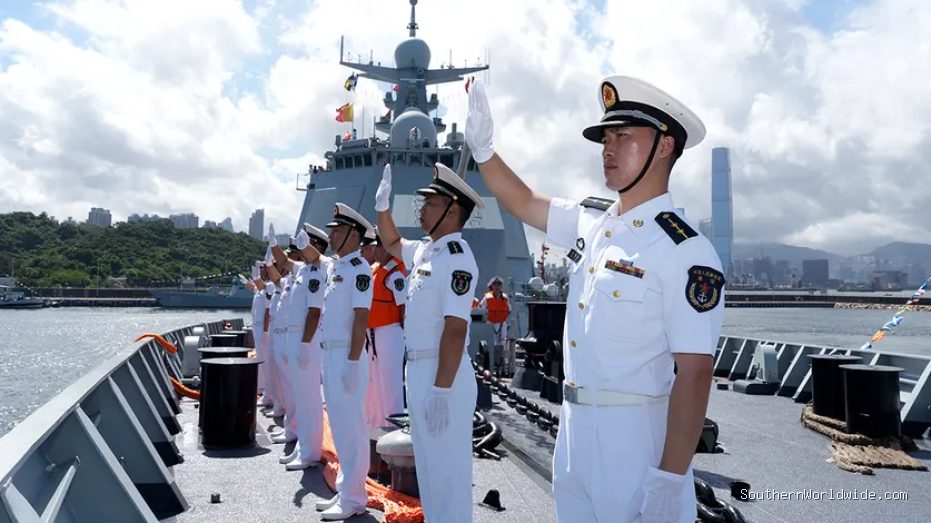
The evidence of China’s growing maritime dominance is, according to Stephens, “clear and growing.” He pointed to statistics indicating that China builds more than half of the world’s ships and dominates the production of essential maritime equipment like ship-to-shore cranes and shipping containers.
As a recent illustration of China’s assertive tactics, Stephens cited the case of Panama. He referenced a ruling by Panama’s Supreme Court that declared the port concessions granted to CK Hutchison at the Balboa and Cristóbal terminals unconstitutional. These terminals are strategically located at opposite ends of the Panama Canal, a vital global trade artery.
Stephens described China’s reaction to the Panama ruling as “swift and punishing.” He alleged that Beijing took retaliatory actions against Panama-flagged vessels, a move the U.S. interpreted as an attempt to undermine Panama’s sovereignty and disrupt international supply chains.
“What happened to Panama is a warning to every nation in this room,” Stephens declared, emphasizing the broader implications of such actions for global maritime stability.
He further elaborated that when a nation permits a foreign power or its proxies to control its ports, it transcends a mere commercial arrangement. “It accepts a vulnerability,” Stephens warned.
The ambassador urged member states of the IMO to conduct thorough scrutiny of any agreements that allow foreign entities, particularly state-linked enterprises, to operate critical port infrastructure. He stressed that “Transparency, the rule of law and genuine sovereignty are not obstacles to commerce. They are its foundation.”
Stephens also outlined the U.S. commitment to promoting maritime security, enforcing sanctions, protecting flag state rights, upholding freedom of navigation, and advancing updated standards for polar operations, autonomous vessels, and cyber risk management.
“The pattern is consistent: China uses its maritime and economic power to coerce, to intimidate and to punish those who assert their sovereign rights,” Stephens concluded, painting a clear picture of China’s alleged strategy.
The Chinese government has consistently refuted these accusations, portraying its overseas infrastructure investments, including Belt and Road projects, as mutually beneficial commercial partnerships that foster global trade and development, rather than instruments of coercion.
Stephens affirmed that the U.S. will continue to contribute its expertise, resources, and leadership to the IMO. However, he issued a stark reminder that the existing rules-based maritime order cannot be taken for granted. “A free and open ocean is not guaranteed,” he stated. “It must be defended.”