SouthernWorldwide.com – While the NATO summit in Ankara is dominated by discussions on Iran, Russia’s war in Ukraine, and defense spending, an increasingly concerning issue that has largely escaped media attention is the escalating antisemitic rhetoric from Turkish leaders.
Relations between Turkey and Israel have reached a new low, sparking a heated exchange of words between the two nations. This verbal sparring has led to accusations that Turkey’s criticism of Israel has crossed the line into antisemitism.
During an interview with CNN Türk on July 2, Turkish Foreign Minister Hakan Fidan stated that Israel has “become a burden that humanity can no longer bear.” The Jerusalem Post reported that Fidan also characterized Israel as representative of “humanity’s common problems” and urged other countries to exert pressure on the Jewish state, according to Israel National News.
In response to Fidan’s remarks, Israeli Foreign Minister Gideon Sa’ar issued a press statement calling them “a clear call for genocide.” Sa’ar emphasized that the Jewish people understand the consequences of allowing such rhetoric to go unchallenged, noting that “the first step on the road to genocide is dehumanization.”
“This is a sentence that sounds very familiar to sentences from about 100 years ago,” Sa’ar added. He questioned the implication of speaking about a people as a “problem for humanity” and what one does with a “burden that you can no longer bear.”
According to analysis, the escalation of anti-Israel rhetoric from Turkey can be traced back to 2008. This was when President Recep Tayyip Erdoğan began to significantly alter the bilateral relationship between Israel and Turkey. However, following the events of October 7, this rhetoric intensified dramatically.
One observer noted that they had “never heard any Arab leader utter the words that Foreign Minister Fidan has said,” highlighting the severity and unprecedented nature of the Turkish Foreign Minister’s statements.
Despite these strong statements, President Erdoğan has publicly condemned antisemitism. Turkish Minute reported that in March, he addressed Turkish religious minority representatives at an Ankara dinner, stating that “just as Islamophobia is a crime against humanity, antisemitism is also a crime, an evil that cannot be considered reasonable or legitimate.”
However, critics point out that despite his condemnation, both Erdoğan and other ministers have continued to engage in rhetoric critical of the Jewish state. This inconsistency has raised concerns about the sincerity of Turkey’s commitment to combating antisemitism.
In June, Turkish Interior Minister Mustafa Çiftçi vowed that the world would “witness the liberation of Jerusalem,” as reported by The Times of Israel. He suggested that Jerusalem would be returned to “Turkish hands,” a statement interpreted by some as a historical and political claim.
This is not the first time Erdoğan has made controversial remarks about Israelis. In May 2021, The Times of Israel reported that Erdoğan had called Israelis “murderers,” alleging they were “only satisfied by sucking their [victims’] blood.”
At that time, the U.S. State Department spokesperson issued a strong condemnation of Erdoğan’s “anti-Semitic comments regarding the Jewish people,” labeling them as “reprehensible.” The U.S. government has consistently opposed such rhetoric.
In May 2025, Erdoğan employed similar language, accusing Israel of being “a terror state that feeds on the blood, lives and tears of the innocent,” according to Israel National News. These repeated accusations have fueled concerns about the nature of Turkey’s stance towards Israel.
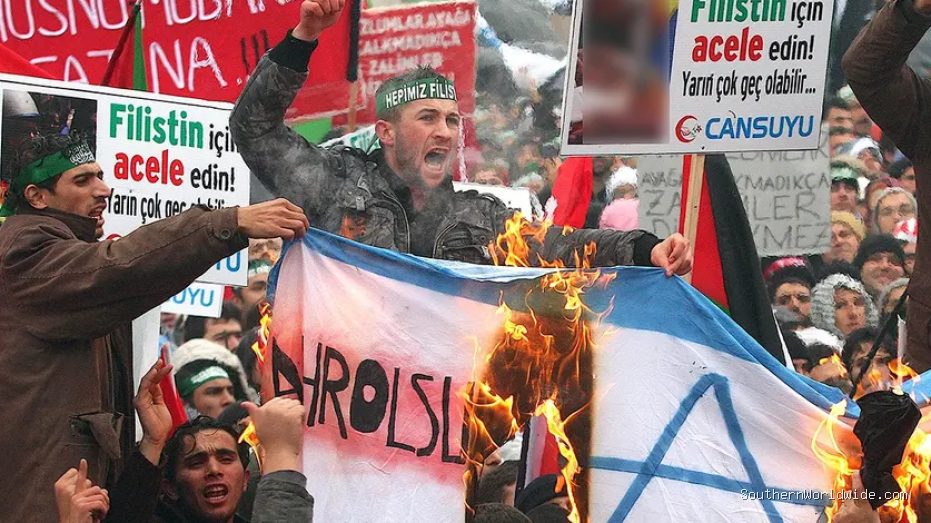
The sentiment against Israel in Turkey appears to extend beyond its leadership. A Pew Research poll conducted in June revealed that Turkey exhibited the highest level of anti-Israel sentiment among all surveyed countries. The poll indicated that 91 percent of the Turkish population held “very unfavorable” views of Israel, with an additional 6 percent expressing an “unfavorable” view. Only a mere 1 percent expressed any favorability towards Israel.
Experts suggest that there are several avenues through which the U.S. State Department and the Trump administration could address Turkey’s actions. These include direct presidential engagement with Turkish counterparts to demand an apology, or official statements from the State Department condemning the remarks.
Furthermore, placing Turkey on a watchlist for its rhetoric could serve as a significant diplomatic signal. Such measures aim to hold member states accountable for their actions and statements that may undermine democratic norms and human rights.
As the NATO summit in Ankara concludes, there is a concern that Turkey might attempt to downplay these issues and portray itself as a key ally within the organization. This could involve efforts to “whitewash its human rights record” and deflect attention from its controversial rhetoric.
A warning has been issued that the ability to safeguard democratic norms, rights, and practices within allied nations is compromised if member states like Turkey are not held accountable for the threats they present. This underscores the importance of consistent diplomatic pressure and clear communication regarding international standards of conduct and rhetoric.