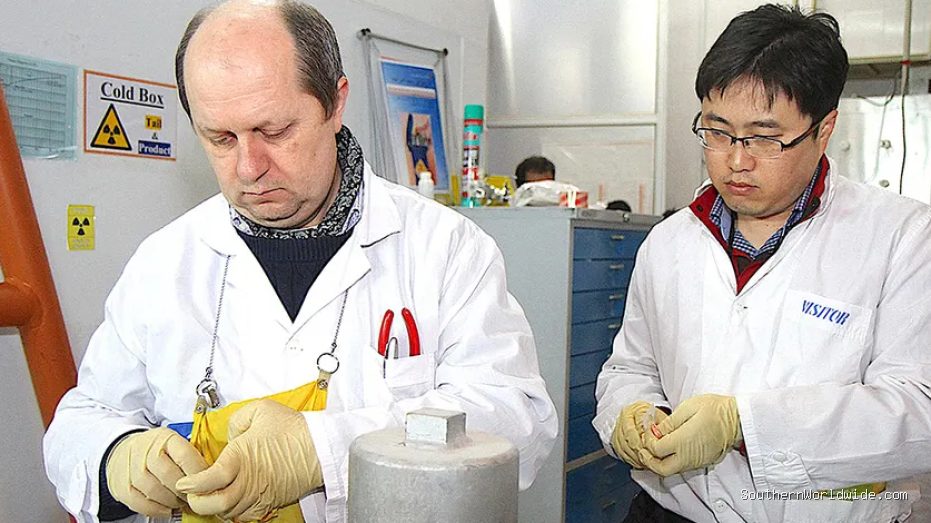
SouthernWorldwide.com – The potential for peace hinges on Iran’s willingness to grant inspectors from the International Atomic Energy Agency (IAEA) access to its nuclear weapons facilities, a critical point that has been a sticking point for two decades.
Conflicting statements from President Trump and Iran’s Foreign Ministry suggest that the IAEA will likely face the same obstructionist tactics from Tehran it has encountered previously. This recalcitrant policy, which includes blocking inspectors from thoroughly verifying Iran’s extensive nuclear facilities, some of which are underground, could prove to be a deal-breaker for President Trump.
THE RACE AGAINST TIME TO DESTROY IRAN’S ILLICIT NUCLEAR WEAPONS PROGRAM HEATS UP AMID FRESH STRIKES
According to Albright, a physicist and president of the Institute for Science and International Security, Iran has a history of creating action plans that are designed to be prolonged, rendering the process a “pointless exercise.”
For experts like Albright, Iran’s mastery of procrastination has enabled them to extend negotiations for decades while simultaneously advancing their work on nuclear weapons and the missile systems needed for their delivery.
Consequently, Albright stated that this history “colors my view of the MOU [Memorandum of Understanding]” that was agreed upon between the U.S. and Iran, which outlines IAEA inspections of Iran’s atomic weapons program.
Albright views the IAEA’s access as a crucial indicator of the success of U.S.-Iran talks. He emphasized that “The way Iran treats the IAEA will tell us if the negotiations are meaningful,” noting Tehran’s past poor treatment of the IAEA.
OBAMA-ERA INSPECTION FLAWS IN IRAN COULD PERSIST AS EXPERTS WARN OF NUCLEAR BLIND SPOTS
A statement on the website of the Islamic Republic of Iran’s Ministry of Foreign Affairs declared that “Foreign Ministry Spokesman Esmaeil Baghaei, speaking to reporters, denied reports published by certain media outlets claiming that the Islamic Republic of Iran has invited the International Atomic Energy Agency (IAEA) to inspect its nuclear facilities.”
The regime-controlled outlet, Islamic Republic News Agency, reported that Deputy Foreign Minister for Legal and International Affairs Kazem Gharibabadi stated on his X account that no meeting was held with IAEA Director General Rafael Grossi in Switzerland, despite Grossi’s request for a meeting. Gharibabadi explicitly said, “There is no plan for access to the facilities that were attacked or to the nuclear materials.”
Conversely, IAEA Director Rafael Grossi told reporters in Japan that “This agreement expressly indicates that the nuclear part will be supervised, monitored, by the IAEA.” He further elaborated that “a Memorandum of Understanding (MOU) was subscribed by the two presidents, by President Donald Trump and President Pezeshkian from Iran, and this agreement expressly indicates that the nuclear part will be supervised, monitored, by the IAEA.”
Grossi mentioned that “initial conversations” have commenced regarding inspections of Iran’s nuclear sites and expressed hope for access “soon.” However, it remains unclear whether Grossi’s team will be permitted to examine all of Iran’s nuclear weapons facilities and suspected nuclear sites.
IRAN EXPANDS WEAPONIZATION CAPABILITIES CRITICAL FOR EMPLOYING NUCLEAR BOMB
Albright indicated that the Israeli government has identified over ten sites where Iran is suspected of engaging in nuclear weapons-related activities. The IAEA spokesman declined to comment on whether their inspectors would seek access to these specific sites.
The Joint Comprehensive Plan of Action (JCPOA), negotiated by the Obama administration in 2015, has been sharply criticized by Albright. He argued that the Obama-era deal overlooked Iran’s lack of cooperation, stating it was “swept under the rug.” Albright cautioned that it is “really important that the U.S. [Trump administration] not do a JCPOA.”
TRUMP’S NEW IRAN DEAL FACES NUCLEAR BLIND SPOT OVER URANIUM STOCKPILE, EXPERTS WARN
President Trump withdrew the U.S. from the JCPOA in 2018, characterizing it at the time as a “horrible one-sided deal that should never ever have been made.”
Brodsky stressed that “Any new agreement should include more robust inspection powers.” He added that Iran’s refusal to allow inspections at damaged nuclear facilities since June 2025 constitutes a violation of its obligations under the Nuclear Non-Proliferation Treaty.
Vance stated on Monday that “The Iranians have agreed to invite IAEA inspectors back into their country. That is a major milestone for the American people, and the first step in permanently denuclearize, easing or permanently ending a nuclear weapons program in Iran.” He emphasized, “And that’s exactly what we wanted to do. That’s exactly what we asked to happen.”
President Trump posted on Truth Social: “Despite their protestations and false statements to the contrary, coupled with the drumbeat of the Fake News, which is doing everything possible to make the U.S. Victory as small and insignificant as possible, Iran has fully and completely agreed to highest level Nuclear inspections long into the future (Infinity!!!). This will insure ‘Nuclear Honesty.’ If they did not agree to this, there would be no further negotiations!”
The U.S. State Department declined to provide a comment on the matter.