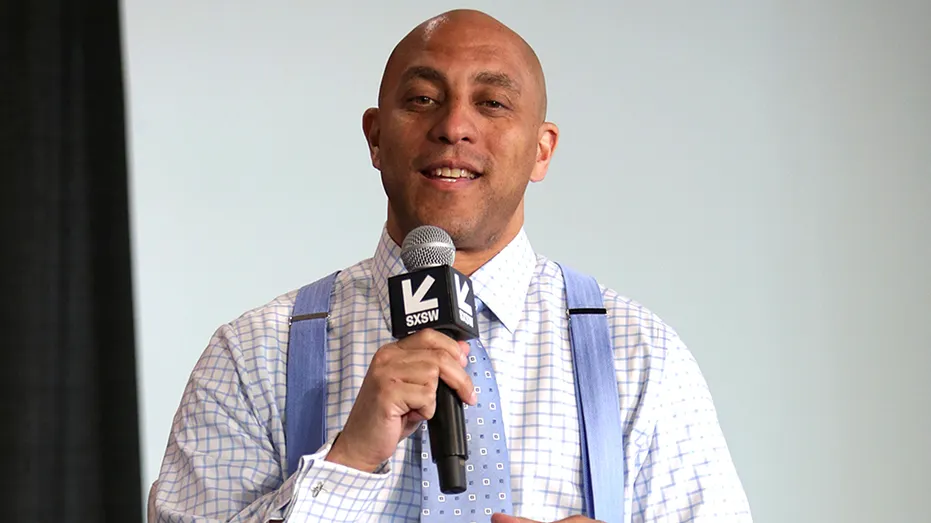
SouthernWorldwide.com – Professor Jonathan Turley has highlighted concerning rhetoric from Hasan Kwame Jeffries, a history professor at Ohio State University and brother of House Minority Leader Hakeem Jeffries. Jeffries has called for citizens to rise up and fight the system “by any means necessary,” drawing a parallel to John Brown, a figure known for his violent anti-slavery actions.
Jeffries, in a social media post, stated that “John Brown understood that the only way to free Americans from the scourge of White supremacy was to get rid of White supremacists by any means necessary. He was right then. He is right now.” This statement has been widely interpreted as a justification for political violence, adding to a climate of increasing unrest and attacks.
This is not the first instance of academics advocating for John Brown as a model for contemporary activism. Stacey Patton, a journalism professor at Howard University, previously promoted a similar idea in a blog post. Patton argued that White liberals should stop asking how to be a better ally and instead consider more direct action.
Patton’s blog, titled “John Brown Didn’t Ask Enslaved People How to Be A Good White Ally,” criticized the tendency to center the asker’s confusion over the target’s danger. She described the repeated requests for guidance as a form of protection that still centers the privileged, leading to emotional outsourcing for those who are suffering.
John Brown is historically recognized for his role in “Bleeding Kansas” and the Pottawatomie massacre in 1856. During this event, Brown and his followers forcibly removed five Kansas settlers from their homes and executed them. At least three of the victims were known sympathizers of the pro-slavery movement.
Brown’s actions were reportedly intensified after his son, Salmon Brown, recounted the caning of abolitionist Charles Sumner by Preston Brooks. This event apparently caused Brown and his brother to become “crazy, crazy,” leading to more extreme actions.
Following his raid on Harpers Ferry, John Brown was captured and subsequently hanged. While some view him as a catalyst for the Civil War who recognized that slavery could only be eradicated through force, his methods involved murder and kidnapping, employing terror and vigilantism to achieve the abolitionist goal.
Frederick Douglass, a prominent abolitionist, expressed complex emotions regarding John Brown. Douglass admired Brown’s convictions and passion, even hosting him at his home. He described Brown as the “thunder clap” that helped ignite the struggle for freedom.
However, Douglass was also critical of the raid on Harpers Ferry, advocating for political rather than violent change. He explicitly stated that he “never encouraged by my word or by my vote” the actions taken at Harpers Ferry.
Abraham Lincoln, on the other hand, denounced John Brown as an insane zealot. Lincoln characterized Brown’s actions not as a slave insurrection but as an attempt by White men to incite a slave revolt, which the slaves themselves refused to participate in.
Lincoln drew a parallel between Brown and those who attempted to assassinate kings and emperors. He described an “enthusiast” who, driven by the perceived oppression of a people, believes they are divinely commissioned to liberate them, often leading to their own execution.
Patton, and now Jeffries, appear to suggest that Brown’s violent legacy is worthy of emulation. Patton praised Brown for prioritizing the end of “racist f*ckery” over being understood. She advised White allies to “Be like John Brown” and consider what they are willing to sacrifice for others.
Patton further stated, “If you don’t want to die like John Brown, fine. But understand that somebody always does.” This sentiment implies an acceptance of martyrdom for the cause, a stark contrast to calls for peaceful change.
Professor Jeffries is now echoing this call to embrace John Brown’s legacy. Brown himself believed that the nation’s “crimes will never be purged away but with blood,” having previously hoped for a less violent resolution.
Baca juga di sini: Guardiola's Agent Confirms Contact Over Potential Al-Nassr Move
According to his university biography, Jeffries’ teaching interests include “Power, Culture, and the State,” the “Black Power Movement,” and “Race, Ethnicity, and Nation.” He was also featured by PBS in its series “Black America Since MLK.”
Hakeem Jeffries, Hakeem’s older brother, has faced accusations of fueling societal rage, including sharing images of himself with a baseball bat. He has remained silent on his brother’s promotion of “Bloody Kansas” as an inspirational model for students and activists.
The encouragement to embrace John Brown’s legacy, alongside celebrations and rationalizations of assassinations of public figures, sends a clear signal. Many may interpret this as a justification for violence, viewing it as not only warranted but righteous.
The pervasive use of “rage rhetoric” in politics is already evident, with extreme candidates attracting significant voter support. This trend is further exemplified by recent political developments.
In Texas, Democratic voters supported a candidate who advocated for the imprisonment and castration of “Zionist billionaires.” This demonstrates a willingness among some voters to embrace radical and violent proposals.
In Maine, Democratic Senate candidate Graham Platner has identified himself as an “Antifa supersoldier.” Antifa is widely recognized as a violent and anti-free speech group. Platner’s rhetoric has been described as unhinged and strikingly similar to John Brown’s.
Platner stated, “There are times in this world when, for the good of tolerance and humanity, you need to kill a motherf—er.” He added a Brownesque perspective, noting that “Sadly most people who are true believers in tolerance and humanity find that activity repulsive.”
In his book, “Rage and the Republic,” Turley explores the rise of radical voices calling for violent action in the context of America’s 250th anniversary. He likens these “new Jacobins” to the forces behind the “Terror” in France, where citizens abandoned restraints to express their rage and dismissed nonviolent political action.
Platner’s observation that tolerance, while morally good, is “pragmatically a shortfall” echoes the sentiment of some revolutionary figures who prioritized immediate, forceful action over nuanced approaches.
During the French Revolution, a lawyer named Robespierre advocated for violence as a “pragmatic choice,” declaring that “Terror is nothing other than justice, prompt, severe, inflexible; it is therefore an emanation of virtue.”
Ultimately, Robespierre himself met the same fate as tens of thousands of his victims, being guillotined. The French Revolution serves as a cautionary tale for those who seek to incite rage for political gain.
Jacques Mallet du Pan, a French writer, observed in 1793 that “Like Saturn, the Revolution devours its children.” This sentiment highlights the self-destructive nature of revolutions fueled by unchecked rage and violence.