SouthernWorldwide.com – A federal judge in Georgia has denied a request from Fulton County officials to have election ballots and other materials from the 2020 election returned to them. These items were previously seized by the FBI during a court-authorized search earlier this year.
U.S. District Judge Jean-Paul Boulee stated on Wednesday that Fulton County’s legal team had not presented sufficient evidence to demonstrate that the FBI’s affidavit, which formed the basis for the seizure, was so flawed as to constitute a “callous disregard” for the county’s rights.
However, Judge Boulee did acknowledge that the affidavit had certain deficiencies. He noted that it contained misleading information regarding the final ballot count in Fulton County for the 2020 election and also highlighted “troubling” omissions concerning the mechanisms used for ballots.
“While the Affidavit was certainly far from perfect, this is not a situation where an officer left out all the facts that might undermine probable cause or where an officer intentionally lied,” Boulee wrote. He further elaborated, “the Court cannot say that the Affidavit was so deficient that its shortcomings rise to the ‘high[] threshold’ of callous disregard.”
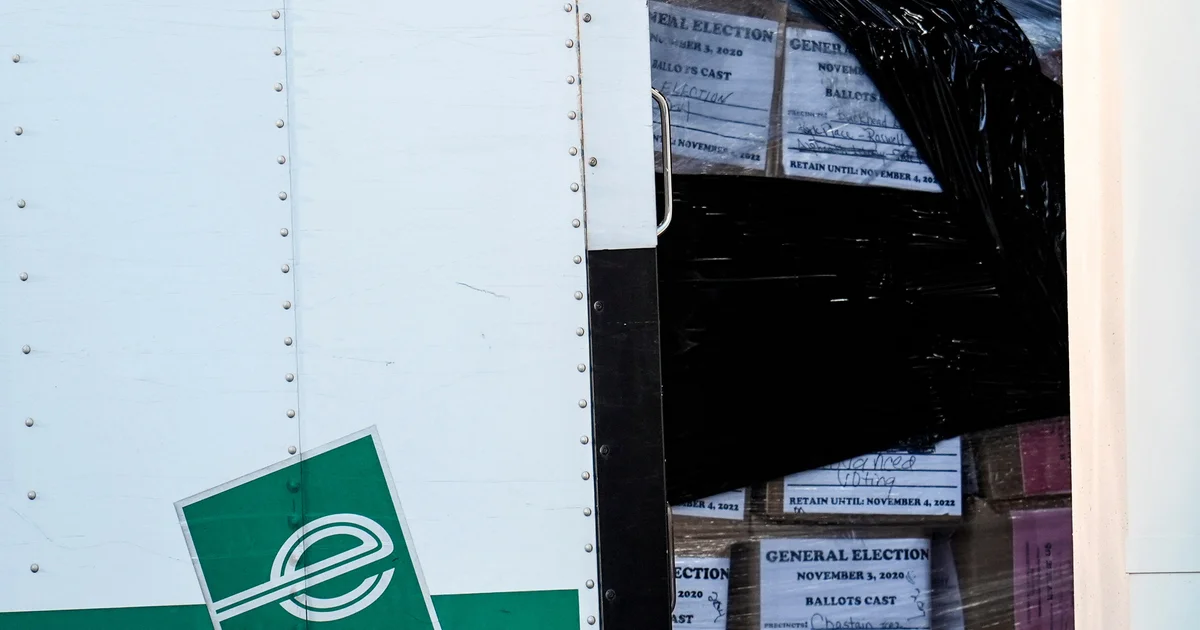
Boulee’s decision comes more than two months after FBI agents executed a search warrant at a Fulton County elections office. The warrant authorized the seizure of “all physical ballots” from 2020, along with tapes from vote-tabulating machines, ballot images, and voter rolls.
Fulton County, which includes Atlanta, played a critical role in former President Joe Biden’s narrow victory in Georgia in 2020. Mr. Trump and his allies have persistently, though without evidence, alleged widespread fraud in the county.
In a lengthy ruling, Boulee recognized that “the seizure in this case was certainly not perfect” and that “the events leading up to this case are, in a variety of ways, unprecedented.” Nevertheless, he emphasized the need to apply established legal precedents regarding court-ordered seizures consistently.
The judge rejected Fulton County’s assertion that the FBI’s seizure of the ballots violated the county’s 10th Amendment rights concerning the administration of elections. He also dismissed the argument that the warrant was obtained in “bad faith,” particularly after the Justice Department faced pushback in a separate civil legal proceeding related to the documents.
“Petitioners have not shown that their rights were callously disregarded either through supposed defects in the warrant or through the manner in which the warrant was executed,” Boulee stated. He further added that the county’s evidence of irreparable harm should the election materials not be returned was “unpersuasive.”
Attorneys representing Fulton County and spokespeople for the Justice Department did not immediately respond to requests for comment.
Fulton County had initiated a lawsuit earlier this year, seeking the return of the seized materials. They also requested an order directing the government to “maintain, but not review, any copies of the seized materials until this matter is resolved.” The county contended that the search “callously disregards multiple Fourth Amendment rights” and constituted a “gross intrusion” into the state’s authority over elections.
According to a controversial FBI affidavit at the core of the search, the bureau is investigating potential violations of two federal laws. One of these laws criminalizes election officials who intimidate voters or deprive them of a fair election by submitting fraudulent ballots or voter registration applications.
The other law mandates that election officials retain federal election records for a period of 22 months. Abbe Lowell, an attorney representing Fulton County, argued that the statute of limitations for both potential violations had expired.
However, Judge Boulee rejected this argument. While acknowledging that the election took place more than five years ago, he wrote that “the Court cannot ignore” witness testimony presented in the affidavit. This testimony alleges that ballot images in the county’s possession might have been altered as recently as 2024.
During a contentious hearing in March, Lowell argued that the FBI affidavit supporting the search warrant contained “nothing” to substantiate an ongoing, relevant investigation in Fulton County. He also cautioned that the ballots could potentially be used “for some future crime that may not exist.”
Read more: Is the Supreme Court More Divided Now? Justice Gorsuch Weighs In
Lowell further contended that “a number of things were omitted” from the affidavit concerning the election and alleged misconduct by the county. Ryan Macias, an election expert and witness for Fulton County, testified that the “information in the affidavit does not make sense.”
Macias described “incoherent terminology” in the affidavit and stated that the agent and FBI appeared to “conflate certain things.” He informed the court that the election had “already been looked at and investigated” and that the affidavit merely recycled discredited rumors from over six years prior.
During the hearing, Judge Boulee expressed significant concern about the Justice Department’s justification for seizing over 630 boxes of election materials. He remarked that “that piece bothers me” to “a rather considerable” extent.
“How far does that affidavit have to go?” Boulee questioned Tysen Duva, the Justice Department attorney leading the arguments for the federal government.
Duva dismissed Lowell’s arguments as “woefully inadequate.” Responding to Boulee’s inquiries about flaws in the affidavit, Duva stated, “this isn’t grading a paper.”
“Are there places in the affidavit where the agent could have done better? Sure,” Duva conceded, adding that he “may have missed a thing or two.” Duva also acknowledged that the FBI’s seizure of the ballots might not result in any charges.
“If there is an indictment, that remains to be seen,” he said. “What may happen later? Maybe nothing.”
State officials in Georgia, including the Republican governor and secretary of state, have consistently defended the integrity of the 2020 election. They have pointed out that three separate recounts confirmed Biden’s victory over Mr. Trump in the state. The election results in Georgia were central to Mr. Trump’s efforts to overturn the election outcome, with Fulton County, encompassing Atlanta, being a significant Democratic stronghold.
The affidavit indicated that the current investigation originated from a referral made by Kurt Olsen. The FBI identified Olsen as a “Presidentially appointed Director of Election Security and Integrity.” In 2020, Olsen was an attorney who collaborated with Texas Attorney General Ken Paxton to urge the Supreme Court to overturn the election results.
The Justice Department provided further details about the genesis of its criminal investigation in a court filing on May 1. This filing followed Boulee’s partial granting of a motion by Fulton County officials to compel additional information from the Justice Department. The government informed the court that Olsen formally referred the investigation to the FBI “no later than” January 5. The FBI initiated an “assessment” the following day, and an FBI official in Atlanta approved a full investigation approximately a week later. An investigative summary was then converted into a search warrant affidavit starting on January 22.
At the March hearing, Lowell stated that one of the witnesses cited by the government in the affidavit has a criminal record. He also brought up two instances of court sanctions against Olsen and argued that approximately half of the witnesses would be classified as “election deniers.”
In 2022, Olsen was subpoenaed by the House Jan. 6 Committee, which was investigating the aftermath of the 2020 election and the January 6, 2021, attack on the U.S. Capitol. The subpoena alleged that Olsen “contacted various high-level officials at the Department of Justice” at the president’s direction to discuss filing challenges to the election results. The committee stated that Olsen had multiple phone calls with Mr. Trump on January 6, 2021.
Separately, earlier this month, Fulton County Board of Registration and Elections officials asked a federal judge in Georgia to quash a grand jury subpoena from the Justice Department. This subpoena seeks information on thousands of individuals who assisted in running the 2020 election in the county.
The subpoena, issued in April, was served by federal prosecutors in the Middle District of North Carolina. It requests personal information, including names, addresses, and phone numbers, for election workers and volunteers who served during the 2020 election in Fulton County. Their roles ranged from those who operated voting units to election volunteers and ballot reviewers.