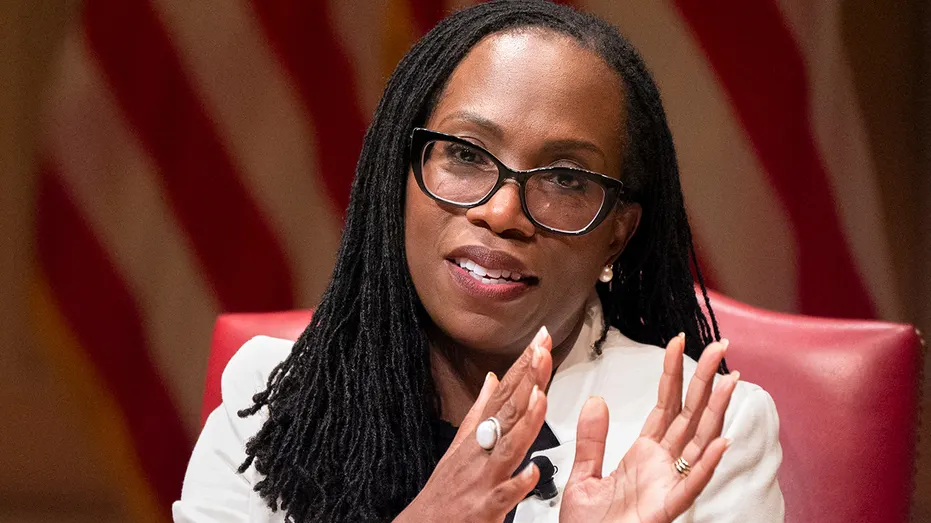
SouthernWorldwide.com – Justice Ketanji Brown Jackson has recently distinguished herself from her colleagues on the Supreme Court, notably breaking ranks to voice strong opposition to the court’s decision to expedite a landmark ruling that dismantles a crucial component of the Voting Rights Act.
This solo dissent by Justice Jackson is not an isolated incident; the Biden-appointed justice has frequently found herself in a minority position. She has consistently criticized the court for not exercising greater judicial oversight over former President Donald Trump’s executive actions. These stances have, at times, drawn criticism from her fellow justices who have perceived her positions as flawed.
Ideological disagreements on significant cases are not uncommon within the court. The liberal wing of the court, comprising three justices, has largely presented a united front against the Trump administration’s policies. They have opposed decisions that aimed to restrict universal injunctions, permit states to ban gender-affirming medical treatments for minors, allow Trump to remove members of independent agencies, and authorize the government to revoke Temporary Protected Status for immigrants, among others.
However, even within these cases where the liberal bloc generally aligns, Justice Jackson has on occasion issued solitary dissents, underscoring deeper internal divisions within the liberal faction of the court.
WHY JUSTICE JACKSON IS A FISH OUT OF WATER ON THE SUPREME COURT
The following are five recent instances where Justice Jackson’s opinions stood alone.
Last month, the Supreme Court invalidated Louisiana’s redistricting map, determining in a 6-3 decision that it constituted an unconstitutional racial gerrymander.
Upon request, the Supreme Court also made the significant decision, by an 8-1 vote, to fast-track this landmark ruling. Instead of releasing the decision in approximately a month, as is customary, it was issued immediately. This allowed several Republican-leaning states to move more swiftly in implementing new congressional district lines after the court had weakened Section 2 of the Voting Rights Act by limiting the consideration of race in congressional redistricting.
Justice Jackson, the most junior member of the court, diverged from her eight colleagues on this particular decision. She argued that the court had improperly “dove into the fray” of ongoing elections by issuing its judgment immediately.
“Not content to have decided the law, it now takes steps to influence its implementation,” Justice Jackson wrote in her dissent.
LATEST SCOTUS LEAK A GIFT TO LIBERALS ‘SALIVATING’ OVER CONTROL OF HIGH COURT NARRATIVE: EXPERTS
Justice Samuel Alito, in a concurring opinion joined by Justices Clarence Thomas and Neil Gorsuch, penned a sharp critique solely aimed at dismantling Justice Jackson’s dissent. He asserted that her claims were “groundless and utterly irresponsible.”
The Supreme Court is still deliberating on former President Trump’s significant policy proposal to drastically limit birthright citizenship. However, the court previously addressed this issue last year by examining how lower courts nationwide had consistently issued nationwide injunctions against the plan.
In a 6-3 decision, the high court ruled against such nationwide injunctions. Nevertheless, it left avenues open for judges and plaintiffs to pursue alternative methods when seeking broad relief.
Justice Jackson submitted a separate, dissenting opinion in this case, which drew notable criticism from Justice Amy Coney Barrett.
“We will not dwell on Justice Jackson’s argument, which is at odds with more than two centuries’ worth of precedent, not to mention the Constitution itself,” Justice Barrett wrote in the court’s opinion in 2025. “We observe only this: Justice Jackson decries an imperial Executive while embracing an imperial Judiciary.”
Justice Jackson’s dissent argued that nationwide injunctions should be permissible, asserting that the courts should not permit the president to “violate the Constitution.”
Justice Barrett disagreed with this perspective.
“She offers a vision of the judicial role that would make even the most ardent defender of judicial supremacy blush,” Justice Barrett remarked.
Baca juga di sini: Bank of America: The Fed May Not Cut Interest Rates Until 2027
Last August, the Supreme Court was divided in two 5-4 decisions that permitted the National Institutes of Health to cancel nearly $800 million in research grants.
In one of her most notable solo dissents, Justice Jackson appeared to express significant frustration, observing that the majority “bends over backward to accommodate” the Trump administration.
“This is Calvinball jurisprudence with a twist. Calvinball has only one rule: There are no fixed rules,” Justice Jackson wrote. “We seem to have two: that one, and this Administration always wins.”
Some of the grants that were canceled were designated for research in areas such as diversity, equity, and inclusion; COVID-19; and gender identity. Justice Jackson contended that the impact of these cancellations extended further, stating that “life-saving biomedical research” was at stake.
When the Supreme Court ruled 8-1 in favor of a Christian counselor challenging Colorado’s prohibition on counseling minors about sexual orientation and gender identity—a practice the state banned as conversion therapy—Justice Jackson was the sole dissenter. She expressed concerns, stating, “to be completely frank, no one knows what will happen now.”
Justice Jackson argued that this key free speech decision disregarded established “treatment standards” and contradicted the medical profession. This stance led to an unusual situation where an unlikely colleague, Justice Elena Kagan, openly rejected Jackson’s dissent.
Justice Kagan, an appointee of President Obama, stated that Justice Jackson’s view “rests on reimagining—and in that way collapsing—the well-settled distinction between viewpoint-based and other content-based speech restrictions.”
In a less high-profile case concerning routine police stops, Justice Jackson conspicuously dissented in April, finding that the Supreme Court had overstepped its authority by improperly interfering with a lower court’s assessment of how Washington, D.C., police initiated a stop of a man in a suspicious vehicle.
The Supreme Court overturned the lower court’s decision, stating that it should have considered the “totality of the circumstances” surrounding the vehicle and affirmed the officer’s decision to briefly detain the man.
The decision was 7-2, with Justice Sonia Sotomayor opposing the ruling. However, Justice Sotomayor chose not to join Justice Jackson’s dissent. Justice Jackson accused the majority of attempting to “wordsmith” and interfere with what is typically a routine evaluation of a police stop.
“I cannot fathom why that kind of factbound determination warranted correction by this Court,” Justice Jackson wrote.
Jonathan Turley, a law professor at George Washington University and a Fox News contributor, commented in an op-ed this month that Justice Jackson has “quickly developed a radical and chilling jurisprudence.”
Despite establishing herself as an outlier on the bench, Justice Jackson also garners support from a wide array of individuals, ranging from civil rights organizations to celebrities. She has received considerable praise on the television program “The View,” earned a Grammy nomination for her audiobook, and garnered encouragement from Democratic lawmakers.
During her appearance on “The View” this year, Justice Jackson acknowledged that “criticism is part of the job.”
“Dissents are an opportunity for the justices who disagree with the majority to really describe their view of the law but also their concerns,” Justice Jackson explained, adding, “you hope that your view will prevail in the long run.”
Fox News Digital reached out to the Supreme Court’s press office for comment.