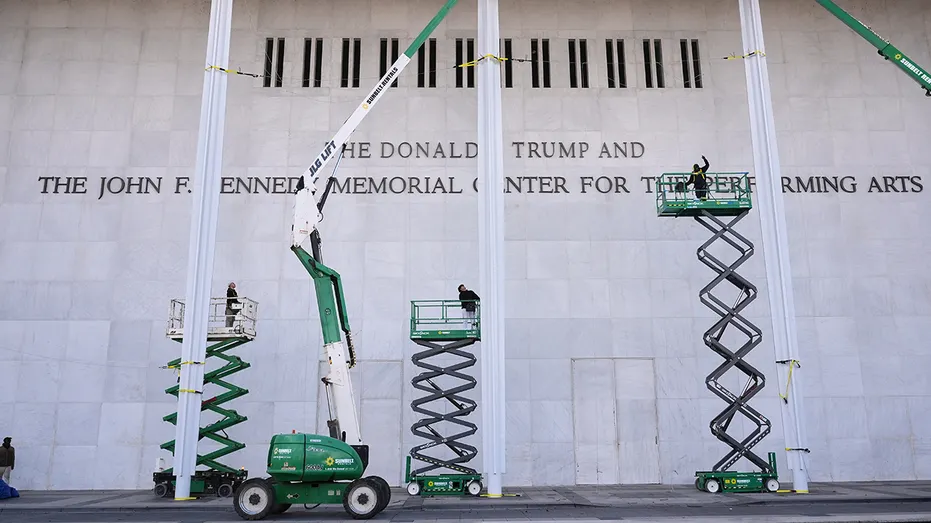
SouthernWorldwide.com – A federal judge has ordered the removal of President Trump’s name from the Kennedy Center and halted all repair plans for the iconic building. District Judge Christopher Cooper issued a detailed ruling on Friday, mandating that Trump’s name be removed within two weeks and that all renovation projects cease.
While the ruling comprehensively addresses the legal arguments, legal analyst Jonathan Turley believes Judge Cooper has erred in stopping the essential repairs. Turley had previously expressed doubts about the board’s authority to unilaterally order such a name change, raising the same concerns about congressional approval that Judge Cooper cited.
Turley agrees with the court’s decision regarding the standing of the litigants, a stance consistent with his past advocacy for broader legal standing. This aspect of the ruling is not surprising given his previous writings on the subject.
However, Turley finds the court’s decision to halt renovations more contentious. The opinion contains pointed remarks aimed at President Trump, referencing his social media activity and his independent plans for a ballroom. Judge Cooper expressed concern that the Kennedy Center might face demolition, drawing a parallel to the demolition of the East Wing of the White House, which occurred despite President Trump’s assurances of respect for the existing structure.
Judge Cooper acknowledges that the center is long overdue for significant renovations and that the board possessed the authority to authorize them. He dismisses claims that Trump intended to raze the center, stating that the evidence does not support the notion of wholesale destruction and rebuilding.
Despite this, Cooper ruled that the board did not allocate sufficient time or attention to the decision-making process for closing the center. He declared that board members lacked adequate information before the March 16 meeting to make a well-considered decision to shut down operations.
Turley contends that the court’s detailed analysis seems to disproportionately support the cessation of repairs. While acknowledging the long-standing plans and studies for renovations, the court highlighted conflicting statements regarding the continuation of operations before the decision to close. The court concluded that the record indicated a failure by the board and its chair to fulfill their fiduciary duties.
The court’s opinion stated that board input was an afterthought, with trustees learning about the closure plan via a social media post. The court found that, lacking time and information, the board had no meaningful opportunity to consider what it deemed the most significant decision since the center’s opening in 1971.
Turley argues that this analysis relies heavily on assumptions about the board’s lack of deliberation. He suggests that a similar approach could be used to invalidate numerous board decisions that a judge deems insufficiently scrutinized.
Judge Cooper appears to recognize the extent of the court’s intervention in overturning the decision. He acknowledged that board meetings in charitable and corporate settings are often structured and that trustees are not expected to scrutinize every preparatory step or debate extensively. This is especially true for large boards with members who may not be experts in the subject matter.
Nevertheless, the court concluded that the board had fallen “grossly short of prudent decision-making.” Turley views this as an overly subjective standard, potentially allowing federal courts to excessively micromanage executive branch decisions.
Turley points to the court’s comments on the presence of lawyers at the critical meeting. Judge Cooper suggested that legal advice was not sufficiently relied upon, citing the lack of recorded statements from counsel. Turley questions the obligation for lawyers’ views to be explicitly recorded in minutes.
The court noted the presence of the Center’s General Counsel and Associate General Counsel at the meeting, but their lack of speaking according to the minutes was highlighted. The court also pointed out that there was no record indicating the Board relied on legal advice for the closure decision, and that the project manager was not a legal expert.
Turley counters that the lawyers were indeed present, and the absence of their spoken views in the minutes does not preclude prior or separate consultations. He further argues that lawyers provide advice, not directives, to political appointees. Turley believes the court is misinterpreting the lack of recorded statements as proof of a lack of legal consultation.
In response, President Trump declared he would order the Commerce Department to transfer the center to Congress for a determination on its future. Turley suggests this response was equally sweeping and unrestrained.
Turley concludes that Judge Cooper’s order to cease repairs may be overturned. He deems the order unnecessary unless the naming of the center is the primary concern. In either scenario, he finds it illogical for the center to be placed under congressional supervision. He suggests that Congress could appropriately address the naming issue and potentially weigh in on the necessity of a closure.
Turley believes the court’s analysis regarding the cessation of repairs provides ample reasons why Judge Cooper and others might be dissatisfied with the decision-making process. However, he questions why this dissatisfaction should necessitate halting the repairs. He reiterates that there are sufficient reasons to close the center for extensive renovations, which would be facilitated and expedited by not having to maintain public operations simultaneously.
Turley recommends that the administration appeal the decision, suggesting that work on the center may resume regardless of its name.