SouthernWorldwide.com – Iconic European landmarks are curtailing their operating hours due to a severe heatwave, impacting peak tourist seasons in cities unequipped for temperatures soaring to 104 degrees Fahrenheit.
In Paris, the extreme heat has disrupted the busy tourist calendar. The Louvre Museum announced it would close two hours earlier than usual, and the Eiffel Tower also ceased operations ahead of its scheduled time. Other prominent attractions have likewise reduced their hours or closed off certain sections, as reported by Euronews.
The Louvre stated that it would be open until 4 p.m. from Wednesday through Saturday, with the final entry at 2 p.m. Visitors with later bookings will receive automatic refunds. Typically, the museum opens at 9 a.m. and closes at 6 p.m. on most days, with extended hours until 9 p.m. on Wednesdays and Fridays. The museum welcomed approximately nine million visitors in 2025, averaging about 25,000 per day.
Despite the adjusted hours, crowds of tourists were still observed queuing outside the renowned museum. Visitors sought respite from the sun using parasols and umbrellas. The area around the Louvre’s glass pyramid saw fewer people lingering, with many rushing across the sun-baked plaza.
The Eiffel Tower’s shortened hours significantly impacted its summer schedule, which normally extends late into the night. During peak season, the monument is usually accessible from 9 a.m. until 12:45 a.m. However, on Tuesday, it closed to the public at 4 p.m., with the last admissions at 12:15 p.m., according to Reuters.
This decision affected one of the world’s most frequented paid attractions. The operator of the Eiffel Tower reported that over 6.75 million people ascended to its upper levels in 2025.
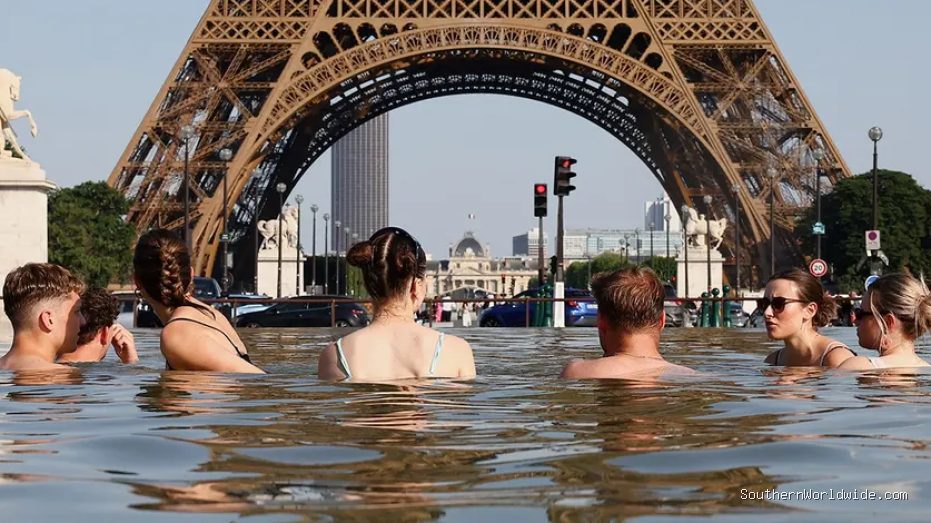
In an effort to cool down, swimmers were seen seeking relief in the Trocadéro fountain, which offers a popular viewing point across the Seine River from the Eiffel Tower.
The heatwave’s impact extended to educational institutions as well. France closed 845 schools on Monday and permitted students at approximately 1,800 other schools to leave early, as cited by AFP via Euronews.
The Eiffel Tower’s official website advises visitors to “protect yourself from the sun and stay hydrated.” It also notes that “Water fountains are available in the walkways leading to the plaza.”
Travel services across other parts of Europe also faced disruptions.
In London, the Changing of the Guard ceremony was scaled back due to the extreme temperatures. Meanwhile, Florence’s Uffizi Gallery temporarily suspended ticket sales following an air-conditioning system malfunction, Reuters reported.
Furthermore, train services were reduced. Approximately one in ten trains in the Paris region were canceled due to infrastructure concerns, Euronews indicated.
Outdoor sporting events were also affected. French authorities canceled some events, while Spain’s Basque region suspended all outdoor competitions, according to AP.
Tragically, the heatwave has also proven deadly. At least 48 individuals in France have drowned while attempting to cool off since the heatwave commenced. In Spain, two elderly individuals succumbed to heat-related illnesses, as reported by Reuters.
Meteorologists attribute the persistent heat to an “Omega block,” a weather phenomenon that traps warm air over a specific region for extended periods, allowing temperatures to steadily rise.
Paris experienced record-breaking heat this week, with temperatures exceeding 104 degrees Fahrenheit, as reported by AP. Southern England recorded its warmest June day since historical records began. Italy has placed 16 cities under its highest heat alert, with forecasters warning that the high temperatures could persist throughout the week, according to Reuters.
Officials continue to urge travelers to remain hydrated, avoid strenuous outdoor activities during the hottest parts of the day, and seek out air-conditioned environments whenever possible.