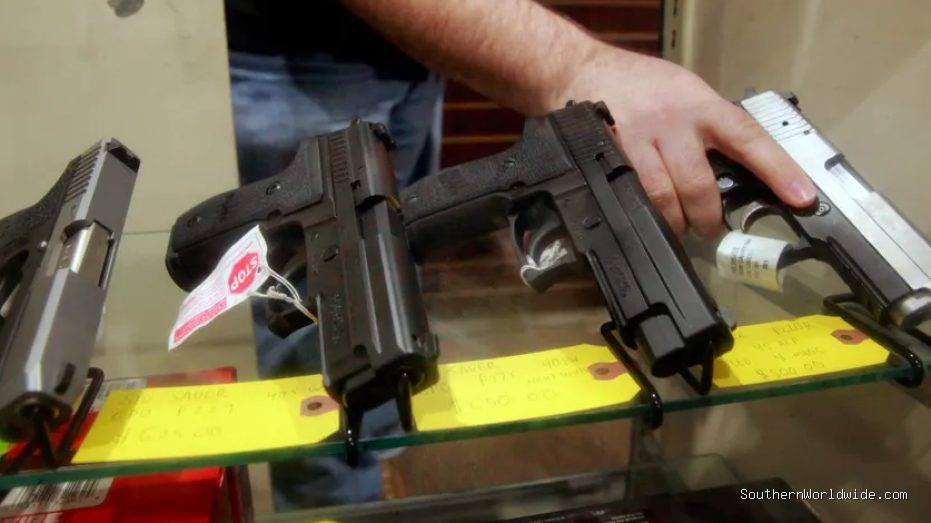
SouthernWorldwide.com – An attorney who successfully challenged Hawaii’s concealed-carry law before the Supreme Court has sharply criticized the state’s attempt to defend the regulation by referencing a Reconstruction-era Black Code.
The Supreme Court, in a 6-3 decision in the case of Wolford v. Lopez, ruled that Hawaii cannot mandate that licensed gun owners obtain explicit permission before carrying firearms onto private property that is open to the public.
Gun-rights advocates had referred to this policy as the “vampire rule,” as it required lawful gun owners to be “invited in” before entering establishments while armed.
The attorney stated that it was unsurprising Hawaii would rely on such a law, given their apparent opposition to the Second Amendment. They expressed that the Supreme Court was expected to recognize this as precisely the type of law that should not be used to determine constitutionality, as it exemplifies something inherently unconstitutional.
A significant point of contention in the case was Hawaii’s effort to justify its law by citing the Supreme Court’s 2022 decision in New York State Rifle & Pistol Association v. Bruen. Following the Bruen ruling, courts have generally assessed firearm regulations by examining whether modern restrictions align with the nation’s historical traditions of firearm regulation.
Hawaii presented several historical laws, including a Louisiana statute from 1865. This law, enacted as part of the post-Civil War Black Codes, prohibited carrying firearms onto another person’s property without their consent.
Justice Samuel Alito, writing for the majority, unequivocally rejected this argument. He described the Louisiana statute as a “tainted artifact” designed to disarm newly freed Black Americans and leave them vulnerable after the Civil War.
Alito concluded that the law “cannot be taken seriously” as evidence of the Second Amendment’s original public meaning.
However, Justice Ketanji Brown Jackson, in her dissent, argued that the Court had bypassed a crucial constitutional question.
Jackson did not defend the Black Codes, acknowledging their racist nature and their use in oppressing newly freed Black Americans. Nevertheless, she contended that the Court should have first determined whether the Louisiana law itself violated the Second Amendment, or if the primary constitutional issue was its discriminatory enforcement based on race.
Jackson wrote that the Black Codes might indeed be considered invalid inputs for the Bruen test, but only if they violated the Second Amendment, which she noted was not definitively established.
She argued that under the Supreme Court’s Bruen framework, the Court could not simply dismiss these historical laws without first explaining why they should not be considered as historical evidence.
Jackson outlined two possibilities: either the firearm restrictions within the Black Codes were constitutional but were enforced in a racially discriminatory manner, making the constitutional defect an equal-protection issue, or the restrictions themselves independently violated the Second Amendment.
She asserted that the Court failed to resolve this question before excluding the Louisiana law from consideration.
Jackson concluded that either history is relevant, in which case all potentially pertinent historical experiences must be thoroughly examined, or it is not, and the Court should admit that its established test is without bounds.
Her reasoning quickly drew criticism. Opponents argued that the Fourteenth Amendment was enacted precisely in response to laws like the Black Codes, which deprived newly freed Black Americans of their constitutional rights, including the right to bear arms.
One critic, identified as Hill, stated that this historical context provided the answer, pointing out that a constitutional amendment was enacted to rectify the deprivation of rights, and that this amendment is now part of the Constitution.
Tyler Yzaguirre, president of the Second Amendment Institute, echoed the criticisms from O’Grady and Hill.
Businesses retain the right to prohibit firearms by posting or enforcing a “no firearms” policy. However, the Court ruled that Hawaii cannot treat all businesses as off-limits to licensed gun owners unless the business owner explicitly permits firearms.