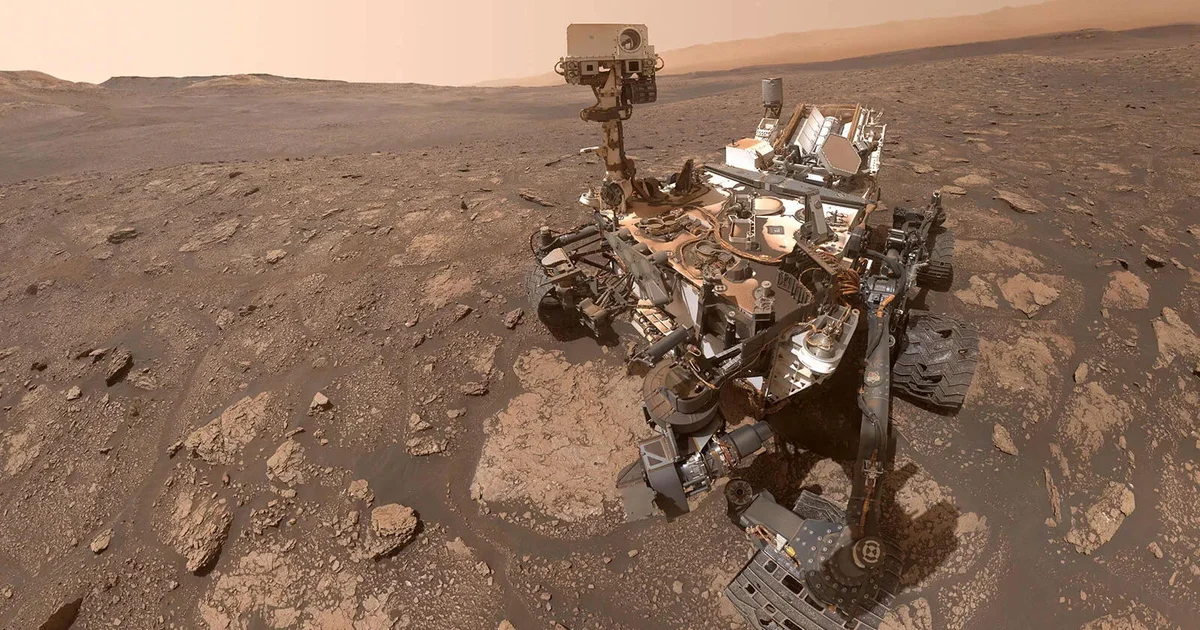
SouthernWorldwide.com – NASA’s Curiosity rover has successfully conducted a groundbreaking chemistry experiment on Mars, identifying additional building blocks of life. This marks the first time such an experiment has been performed on another celestial body.
Scientists leading the NASA mission have stressed that the discovery of these organic molecules does not definitively confirm the existence of past life on Mars. They explained that these molecules could have formed naturally on the planet or arrived via meteorites.
However, the findings do provide strong evidence that these crucial indicators of Martian history have remained preserved on the planet’s surface for over three billion years. During that ancient period, Mars is believed to have possessed extensive lakes and rivers, crucial elements for the emergence of life as we understand it.
The authors of the study, published in the journal Nature Communications, highlighted the significance of this research. They stated that the ongoing analysis of organic matter on Mars is a cornerstone of modern robotic space exploration. Agencies are deploying rovers and landers to investigate Mars’ past and present habitability and to search for any signs of life.
Curiosity, a rover roughly the size of a car, landed in the Gale crater, a region identified as a former lakebed, in 2012. Since its arrival, the rover has been diligently searching for evidence of potential past life.
For this particular experiment, the rover carried two vials of a chemical compound known as TMAH. This substance is capable of breaking down organic matter, allowing scientists to analyze its composition.
Amy Williams, an astrobiologist involved in the Curiosity mission, shared with AFP that this experiment had never been attempted on another world before. She also noted the considerable pressure on the team, as they had only two opportunities to execute the experiment successfully.
The experiment, which took place in 2020, successfully identified over 20 different organic molecules. Among these were several that had not been previously detected on Mars.
One of the notable discoveries was a molecule called benzothiophene. This molecule has also been found in meteorites and asteroids, suggesting a potential extraterrestrial origin or a shared chemical heritage.
Williams explained the significance of this finding, stating that the same materials that fell to Earth from meteorites also landed on Mars. She believes these could have provided the fundamental building blocks for life on our own planet.
Read more : The Perils of Over-Tourism
Furthermore, another molecule detected contained nitrogen. Williams pointed out that nitrogen is a key precursor in the process of DNA formation.
In an interview with Reuters, Williams reiterated that while they cannot definitively claim that life ever existed on Mars, their discoveries further bolster the evidence that Mars was once a habitable environment, coinciding with the period when life began on Earth.
Despite these exciting discoveries, proving the existence of past life, even microbial, remains a significant challenge. Williams suggested that an “extraordinary claim” of this nature would require bringing Martian rock samples back to Earth for more detailed analysis by scientists.
NASA’s Perseverance rover is already collecting rock samples for such a future mission, known as Mars Sample Return. However, this mission has reportedly faced cancellation following a congressional vote earlier this year.
Last year, Perseverance discovered rocks within a dry river channel that might contain potential signs of ancient microscopic life on Mars. The success of Curiosity’s experiment using TMAH also paves the way for future missions.
The European Space Agency’s Rosalind Franklin rover, equipped with a longer drill than Curiosity, is set to carry the TMAH chemical to Mars. Following several delays, NASA announced that this rover is now slated for launch towards the red planet in late 2028.
The TMAH chemical will also be part of the payload for the Dragon rotorcraft, scheduled for a 2028 launch on a mission to explore Saturn’s moon, Titan.
These latest findings from Curiosity follow a series of recent image captures by the rover. In June of the previous year, Curiosity provided the first close-up views of Martian ridges that scientists believe offer evidence of ancient water flow. These formations, resembling spiderweb patterns from orbit, had previously only been observed from a distance.
Five months prior to that, the rover captured striking images of colorful clouds in the Martian sky, adding to the growing visual record of the red planet.