SouthernWorldwide.com – West Coast beaches have been inundated with vast swarms of jellyfish-like sea creatures, leaving scientists stunned and local authorities scrambling to understand the phenomenon.
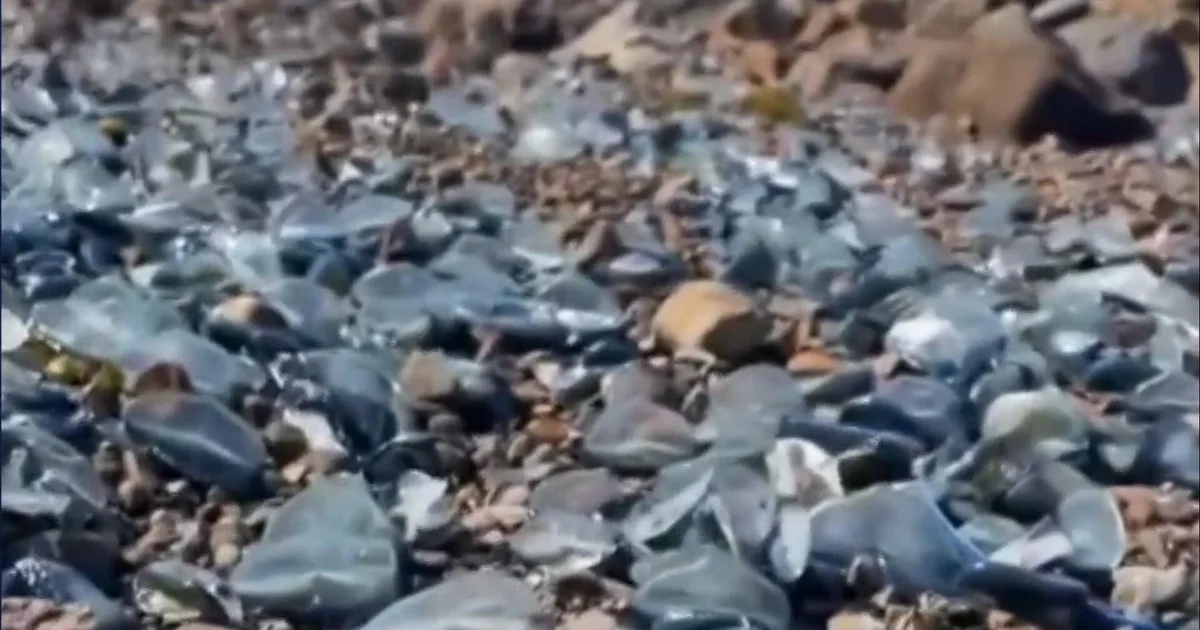
Hundreds of thousands of these gelatinous organisms have washed ashore along the coastlines of California, Oregon, and Washington over the past week.
The creatures, identified as by-the-wind sailors (Velella velella), are not actually jellyfish but are colonial organisms, meaning they are made up of many individual polyp animals that work together to form a single entity.
These small, floating creatures are typically found in the open ocean and are carried by wind and currents. Their sudden and massive congregation on beaches is an unusual event that scientists are closely monitoring.
Dr. Sarah Johnson, a marine biologist at the Scripps Institution of Oceanography, expressed her surprise at the scale of the event. “We’ve seen stranding events before, but never on this magnitude,” she stated.
The sheer number of Velella velella washing ashore suggests a significant shift in oceanographic conditions, potentially linked to changes in wind patterns or ocean temperatures.
These creatures are recognizable by their small, sail-like structure that allows them to be propelled by the wind. They are typically blue or purple and have a diameter of about 3 inches.
While harmless to humans, the vast numbers of Velella velella can create a pungent odor as they decompose on the beaches, leading to public health advisories in some areas.
Local beach cleanup crews are working tirelessly to manage the situation, but the continuous influx of the organisms poses a significant challenge.
Scientists are collecting samples to study the Velella velella and the environmental factors that may have led to this massive stranding.
The event also raises questions about the health of the marine ecosystem and the potential impacts of climate change on ocean currents and species distribution.
The Velella velella are carnivorous, feeding on small marine organisms caught in their stinging tentacles.
However, their small size and the fact that they are not true jellyfish means their sting is not potent enough to cause harm to humans.
The visual impact of the beaches covered in these blue, translucent creatures is striking and has drawn considerable public attention.
Social media has been flooded with images and videos of the Velella velella aggregations, with many users expressing awe and concern.
Researchers are hoping to gain valuable insights into ocean dynamics and the resilience of marine life through the study of this event.
The Velella velella typically live in large rafts, sometimes spanning miles, but their appearance on shore in such numbers is indicative of a major disruption.
Further analysis of water samples and weather patterns is underway to pinpoint the exact causes of this widespread stranding.
The long-term effects on coastal ecosystems are yet to be determined, but marine experts are emphasizing the importance of understanding these natural phenomena.
The public is advised to avoid direct contact with the decomposing Velella velella and to report any unusual observations to local authorities.
This event serves as a stark reminder of the interconnectedness of marine life and the environment, and the ways in which subtle changes can have dramatic effects on coastal communities.
Read more: How 5th Graders in Chicago Continue Pope Leo's Mission
Scientists will continue to monitor the situation and provide updates as more information becomes available about this fascinating and concerning marine event.