SouthernWorldwide.com – The upcoming four months are marked by significant anniversaries, a period of reflection that bridges celebration and remembrance.
Before the vibrant displays of the 250th Fourth of July commence, it is an opportune moment to engage with family and friends to clarify what we are truly celebrating. Furthermore, we should articulate the reasons behind our commitment and the methods by which we safeguard the principles our nation has long upheld in its founding documents and has actively practiced and expanded upon for 250 years.
While the Semiquincentennial is just a month away, we are also merely three months and a handful of days from the 25th anniversary of the 9/11 terrorist attacks orchestrated by Al Qaeda on the United States.
The profound and the tragic anniversaries are intrinsically linked by the very concept that the former proclaimed and the latter sought to extinguish: freedom.
TRUMP LAUNCHES MASSIVE ‘FREEDOM 250’ PUSH TO IGNITE AMERICA’S 250TH BIRTHDAY CELEBRATION
The Declaration of Independence boldly asserted the existence of “rights” inherent to individuals, rights that predate the formation of any government, regardless of its structure.
“We hold these truths to be self-evident, that all men are created equal, that they are endowed by their Creator with certain unalienable Rights, that among these are Life, Liberty and the pursuit of Happiness. — That to secure these rights, Governments are instituted among Men, deriving their just powers from the consent of the governed, — That whenever any Form of Government becomes destructive of these ends, it is the Right of the People to alter or to abolish it, and to institute new Government, laying its foundation on such principles and organizing its powers in such form, as to them shall seem most likely to effect their Safety and Happiness.”
The significance of the Fourth of July, from its inception to its conclusion, is rooted in patriotism, a love for our country because it stands as the protector of our individual rights. These rights are fundamental, bestowed by our Creator and inherent in our very nature. While various interpretations of our natural rights exist, the nation’s founders deemed them sufficiently crucial to risk everything in their declaration and defense.
FOR 2026, YOU SHOULD MAKE A RESOLUTION TO KNOW THE REVOLUTION
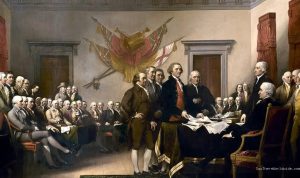
A portion of this celebration should also be dedicated to reflecting upon and admiring the courage of those who not only voted “yes” on the Declaration but also committed their signatures to it on August 2, 1776. Their votes and signatures were cast and affixed in the face of overwhelming opposition, as the American colonists embarked on a war against the formidable British Empire.
As highlighted in Justice Neil Gorsuch’s recent book for younger audiences, “Heroes of 1776,” the sacrifices and hardships endured by our founding families were extreme, and their deprivations were profound throughout the ensuing long war.
(A commemoration of the actual signing of the Declaration will take place on August 2 at Perry’s Victory & International Peace Memorial, situated on the shores of Lake Erie near Put-In-Bay, Ohio. This location is exceptionally fitting, as it was there that the Revolution, announced on July 4, 1776, and solidified on August 2, became enduring with the decisive defeat of a British naval squadron by the American Navy. This victory effectively turned the War of 1812, the second conflict with Great Britain, in America’s favor.)
America’s initial prolonged conflict with Britain spanned from April 19, 1775, with the first shots fired at Lexington and Concord, to September 3, 1783, when King George’s representatives signed the Treaty of Paris, formally recognizing the United States as an independent and sovereign nation. The second war with Britain, which officially began in 1812, followed decades of escalating tensions between the United States and its former motherland.
Genuine peace with the United Kingdom was not achieved until February 17, 1815, with the ratification of the Treaty of Ghent by the U.S. Senate. This marked the end of approximately 40 years of conflict with Great Britain, securing the rights of Americans against foreign entities. Nevertheless, the extensive work of perfecting these rights for all Americans would continue for over another 150 years, encompassing a monumental Civil War, participation in two world wars, and numerous amendments to the Constitution and federal laws, all aimed at making the ideal of a free people more complete.
JONATHAN TURLEY: AOC’S WAR ON BILLIONAIRES TWISTS AMERICA’S BIRTH INTO A SOCIALIST MYTH
The Declaration of Independence has become a cornerstone of “the West,” influencing the founding documents of more than half of the 192 countries currently represented at the United Nations, many of which feature a “Declaration of Independence.” The philosophical roots of the Declaration stretch back to ancient times, drawing from both “Jerusalem and Athens,” representing Ancient Israel and Ancient Greece.
One could even argue that Ancient Persia played a role in shaping “the West.” Cyrus the Great facilitated the return of the Jews to Jerusalem, and his son-in-law, Darius, sanctioned the rebuilding of their Temple. Without the Jewish return from exile, the development of the West might not have followed its historical trajectory.
The Declaration refined the mission statement of “The West.” The long process of its drafting can be traced back to England’s Magna Carta, sealed by King John at Runnymede on June 15, 1215. The United States Constitution, ratified in 1789 and soon after amended to include the Bill of Rights, established the Republic that has successfully protected the rights espoused in the Declaration in theory. However, these rights were only fully realized for all citizens after a devastating Civil War and decades of legislative and constitutional amendments.
The American Republic continues to serve as a model for successful governance through the rule of law, upheld by the separation of governmental powers. This separation operates both vertically, between federal and state governments, and horizontally within these governments, dividing legislative, executive, and judicial branches into co-equal branches.
The First Amendment prohibits the establishment of an official religion in the United States while simultaneously safeguarding the “free exercise” of all faiths, or no faith at all.
A significant source of animosity towards America from fanatics—such as those who attacked on 9/11 twenty-five years ago and those we currently contend with in Iran and its proxies—stems from the American refusal to designate one religion as the “true” religion. All faiths, or the absence thereof, are protected here. This stance, a refusal to establish a national faith, whether religious or secular, is the root of the animosity directed at us by many of our adversaries.
Defining the precise boundaries of “the West” is a complex endeavor. While America sets the benchmark for individual liberty, numerous countries aspire to achieve a similar level of ordered liberty. “The West” should be understood as any nation where the expansion of liberty and literacy is an ongoing process, and where the rule of law governs societal interactions, rather than the rule of a single individual or a select few powerful figures. Nations experiencing a rise in personal freedoms and literacy are either integral parts of “the West” or are actively striving to join it.
Many nations globally have “established” religions, including Israel and its neighboring countries. (The Pew Research Center identifies 80 countries with an official religion or a preference for certain religious groups over others.) The existence of an “established religion” does not automatically exclude a nation from “The West.” Any country that safeguards religious minorities in their freedom to practice their faith and upholds the right of citizens to express themselves freely is unequivocally part of “the West.”
Numerous nations are progressing towards classically liberal ideals. Just as America’s own journey to fully realize these ideals in theory took nearly two centuries (culminating with the Civil Rights Act of 1964 and the Voting Rights Act of 1965), other countries worldwide are also on their own paths toward full integration with “the West.”
America’s 250 years of independence serve as a standard by which other republics are measured. The adversaries of the “American system” are diverse and numerous, but they share a common hatred for pluralism, freedom of speech and belief, the press, assembly, and ultimately, self-governance.
AFTER EPIC FURY: HOW TO DEFEND AMERICA’S SECURITY AND VALUES IN A DANGEROUS WORLD
As America embarks on its celebrations this summer, our global allies will undoubtedly applaud our progress and our pivotal role in liberating the world from totalitarian regimes in the 20th century. They will also recognize our continued function as the paramount protector of maritime freedom and a staunch opponent of absolutism in all its manifestations in the 21st century.
During our observances on the Fourth of July and August 2, it is essential to remember that mere weeks later, we will collectively mourn the grim anniversary of the most devastating attack on America by foreign entities in its history. Fanatical absolutists were the driving force behind the horrific events of 9/11. The fanaticism that precipitated this dark chapter in modern times was fueled by an insistence on exclusive claims to truth, claims that stood in stark opposition to the fundamental structures of the West, which guarantee free peoples the rights of conscience.
Totalitarian regimes can be secular or sectarian. However, their defining characteristic is always an absolutist stance on their claims to truth, coupled with the oppression of any individual or nation that asserts freedom of thought.
This underlying principle underscores why we should view both the current “hot war” with Iran and its proxies, as well as the emerging Cold War 2.0 with the People’s Republic of China and its allies, as integral components of the perpetual struggle between free peoples and those who seek to subjugate them. Ukraine and Israel are our allies, both in action and often in designation, because they embrace a foundational commitment to individual freedom. Their adversaries are our adversaries because they aim to extinguish the freedoms enjoyed by the people of those nations.
Although their modern “foundings” are more than a century younger than ours, they have adopted the correct path and are progressing in the right direction. They are part of “the West,” as are, for instance, the United Arab Emirates and an increasing number of countries in the Middle East and across the Pacific. These nations are gradually modernizing their understanding of their people’s rights and the critical importance of the rule of law.
We should all aspire to a future where, fifty years from now, on our tricentennial, the resilient people of Iran and other nations throughout the Middle East have joined the Abraham Accords. We also hope that our unwavering commitment to individual freedom has expanded throughout our hemisphere.
Furthermore, we hold the hope that the People’s Republic of China, currently a police state, will evolve into a government that uplifts its citizens and safeguards their freedoms, rather than persecuting them for exercising the natural rights that Americans have long recognized and for which they have fought and died.
Baca juga di sini: Democrats' Socialist Reckoning They Fear to Confront
This confluence of anniversaries should serve as a poignant reminder to every American of our nation’s unique and enduring dedication to human liberty. It should also underscore that many in the world harbor fear and resentment towards such ordered liberty, and this sentiment will likely persist. However, if the framers of our nation could endure intermittent battles with the planet’s preeminent power for 40 years, beginning in 1775, then every subsequent generation should recognize its inherent capacity to uphold that foundational commitment to the country’s original principles.