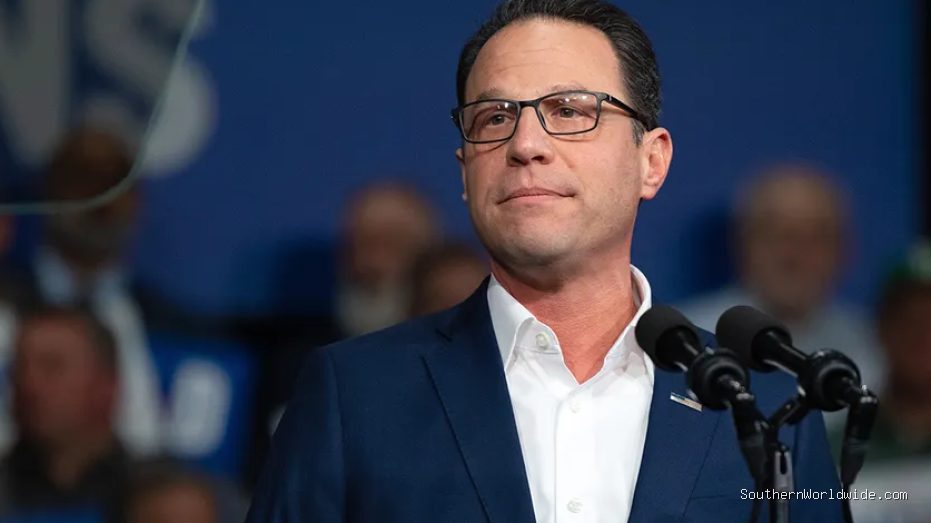
SouthernWorldwide.com – Pennsylvania Governor Josh Shapiro has reached a pivotal moment, drawing parallels to the character Terry Malloy from the classic film “On the Waterfront.” Malloy’s poignant lament, “You don’t understand! I coulda had class. I coulda been a contender. I could’ve been somebody, instead of a bum, which is what I am, let’s face it,” now seems to resonate with Shapiro’s recent political stance.
Shapiro’s defining moment, according to the article, occurred during an appearance on MS NOW’s “Morning Joe.” In what is described as an abandonment of principle, he joined other Democratic leaders in calling for what the article terms “radical reform of the court.” This is interpreted as a coded reference to court packing, aiming to install an immediate liberal majority on the Supreme Court. The objective, as stated, is to overturn recent decisions and enable a radical agenda for political system changes.
The author expresses disappointment, believing Shapiro “truly could have been a contender.” He is seen as having missed an opportunity to be an alternative to politicians who, according to the piece, are yielding to the demands of a “mob.” Figures like Kamala Harris and Pete Buttigieg are mentioned as having embraced the court-packing scheme to demonstrate their alignment with a rising socialist and radical movement within the Democratic Party.
The article highlights a previous report where Josh Shapiro was reportedly rejected as a vice presidential candidate due to his Jewish faith. It suggests he could have served as a voice of moderation within his party, cautioning against the destruction of core institutions. His party is described as “careening toward open antisemitism.”
Instead of pursuing this path, the article contends that Shapiro has chosen to become “another bum in American politics.”
“I think we need radical reform that’s actually going to ensure that the voices of the people are heard from, that the voices of the people are represented in the three branches of government,” Shapiro stated on MS NOW. “We don’t have that right now.”
This sentiment is echoed by other proponents of court expansion, such as Senator Elizabeth Warren. Warren has argued that the court is illegitimate for making decisions that go against “widely held public opinion.”
The article argues that the Supreme Court was not designed to be the “voice of the people.” Instead, it was intended to act as a counter-majoritarian check, protecting minority interests and preventing the populace from enacting impulsive changes. This concept is further explored in the author’s book, “Rage and the Republic,” where he discusses the Framers’ intention to avoid a purely democratic system, which had historically failed and led to what Benjamin Rush termed “mobocracy.”
The piece points to a perceived long-standing effort by professors and pundits to engineer a “hostile takeover” of the court, thereby removing obstacles to fundamental systemic changes. It suggests that, on the 250th anniversary of the Republic, this goal is nearing fruition.
Michael Klarman, a Harvard professor, is cited for outlining a radical agenda years ago aimed at ensuring Republicans “will never win another election.” Klarman reportedly warned that the Supreme Court could thwart these plans, necessitating its expansion to facilitate such changes.
Former Obama Attorney General Eric Holder has openly advocated for court packing. He has framed it as a matter of “the acquisition and the use of power if there is a Democratic trifecta in 2028.”
James Carville has also expressed a strong opinion, stating that if Democrats achieve a trifecta in 2028, they should “expand the Supreme Court to 13. F— it. Eat our dust. Don’t run on it. Don’t talk about it. Just do it.”
The article concludes that Shapiro has now joined these ranks.
Shapiro and his allies are pushing for these reforms despite the court having recently ruled against the Trump administration, including on the issue of birthright citizenship. Shapiro reportedly expressed that this case “should have taken a nanosecond to decide and it should have been 9-0,” a statement the author questions, asking if courts should forgo arguments or issue immediate rulings.
This is seen as sufficient reason for Shapiro to “toss the court to the mob,” a move described as transparent and pathetic.
Shapiro also voiced concerns about the executive branch wielding too much power. However, the article notes that the court has recently made decisions against the president on issues like citizenship and tariffs, drawing sharp criticism from President Donald Trump for limiting his authority.
The author draws a parallel between Shapiro’s current stance and his past controversial action against his neighbor, suggesting Shapiro is attempting a form of “adverse possession” against the court. It is noted that figures like House Minority Leader Hakeem Jeffries also avoid explicitly calling it court packing, opting instead for terms like “radical” changes.
This strategy is described as a tactic to condition voters for the structural changes envisioned by the Left, aimed at preventing Republican electoral success. The article posits that most voters still oppose court packing, and the strategy relies on waiting for public anger to reach a point where they would accept such drastic measures against a stable democratic system.
The Supreme Court may succumb to this “mad frenzy” in the coming years, but the article suggests it will be preceded by the downfall of figures like Shapiro. He and his establishment colleagues are accused of self-deception, believing they will be spared by the “mobocracy” they are helping to create.
Refusing to participate in the 250th-anniversary celebration on the Mall and advocating for changes to the Supreme Court will not appease what the article describes as an increasingly violent and antisemitic far-left movement. The socialists, despite Shapiro’s pandering, recently chanted “you’re next” upon seeing an image of Jeffries at a New York victory party.
The piece concludes by suggesting that figures like Shapiro, once “armchair revolutionaries,” will soon be perceived as “reactionaries” by the very mob they sought to court. His potential is likened to Terry Malloy’s lost opportunity: “he coulda had class. [He] coulda been a contender. [He] could’ve been somebody.”