SouthernWorldwide.com – The Fourth of July is a time to reflect on the courage and sacrifice that forged the United States, and to consider the enduring principles that guide its progress.
A defining characteristic of this nation’s foundation was the willingness to undertake significant risks for a future that its founders might not personally witness. This core tenet, which they termed “virtue,” was deeply ingrained in their commitment. They pledged their “sacred honor,” placing their trust in divine providence.
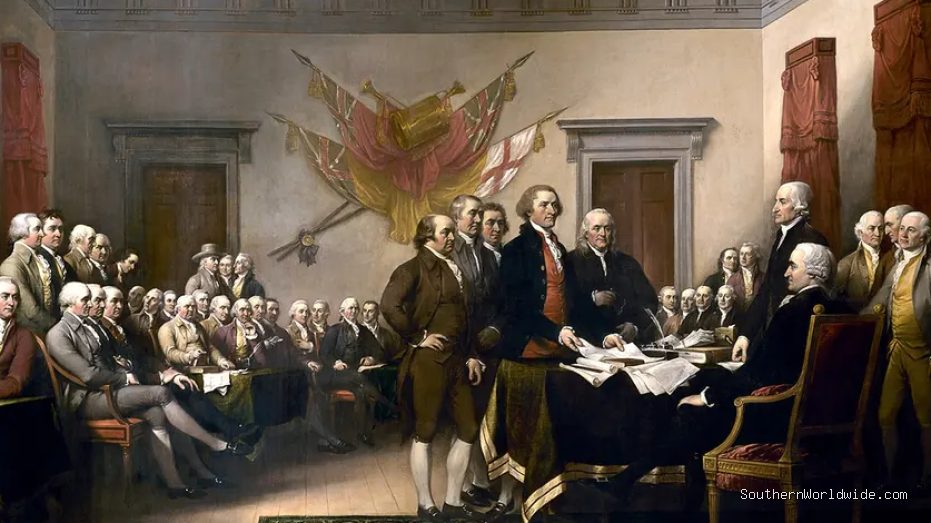
Two and a half centuries ago, a group of individuals affixed their names to a document that could have led to their execution. Their conviction was that people were capable of self-governance and that no monarch possessed an inherent right to rule.
The colonies faced the mightiest empire of the era. The British forces comprised over 50,000 professional soldiers and hired Hessians, supported by hundreds of cannons and the world’s most formidable navy. In contrast, the Continental Army was a collection of farmers and tradesmen, numbering between 10,000 and 15,000 men. They were poorly trained, possessed limited artillery, and lacked any naval force to counter the Royal Navy.
The prospect of defeating such a military power seemed highly improbable. However, George Washington, particularly during his audacious crossing of the icy Delaware River to attack Trenton, demonstrated that victory stemmed not from superior numbers but from strategic brilliance and an unwavering resolve.
While Washington is rightly remembered, it is also important to acknowledge those who fought alongside him, many of whom are now largely forgotten. Among them was Billy Lee, an enslaved Black man who served as far more than just a valet. He rode with Washington into the heart of battles, becoming one of his most trusted confidants. He was by Washington’s side through every major campaign, from the Delaware crossing to Yorktown.
Washington himself was a slaveholder. Yet, uniquely among the founding presidents, he stipulated in his will that all the people he enslaved should be freed. Billy Lee was freed immediately, with a lifetime pension.
Despite being free to depart, Lee chose to spend the remainder of his days at Mount Vernon. This decision speaks volumes about the profound bond that developed between Washington and Lee. The fact that the nation’s first president’s closest companion was a man he had once enslaved is one of the most remarkable, yet often overlooked, aspects of our nation’s origins, frequently relegated to a mere footnote in historical accounts.
This nation was conceived through extraordinary bravery. Like any human endeavor, it has been marked by imperfections. However, it has consistently strived for improvement. At Gettysburg, amidst a nation deeply divided by the abhorrence of slavery, Abraham Lincoln called the war-torn country back to its foundational principle: that all men are created equal, and to the ongoing work of realizing this ideal.
The republic has navigated far more challenging periods than the present and has persevered. With Washington and Lincoln as guiding examples, we continue to advance towards greater progress, equality, and the pursuit of happiness for all citizens.
Therefore, this Fourth of July, regardless of political affiliation or heritage, it is essential to remember those who risked everything for the principle of self-governance, rather than rule by monarchs. We must recall the immense cost of this freedom. It is imperative to resolve to be worthy of this inheritance, encompassing its imperfections, its achievements, and the ongoing work it necessitates.
This inheritance is a collective narrative, shaped by successive generations, and it is passed down from one to the next, a father and his son contributing to its unfolding story.
Joseph Bennett is a veteran of the Marine Corps and serves as a principal at Fabius Group, a strategic advisory firm specializing in the defense sector. He resides in Washington, D.C., and is an alumnus of Princeton University.