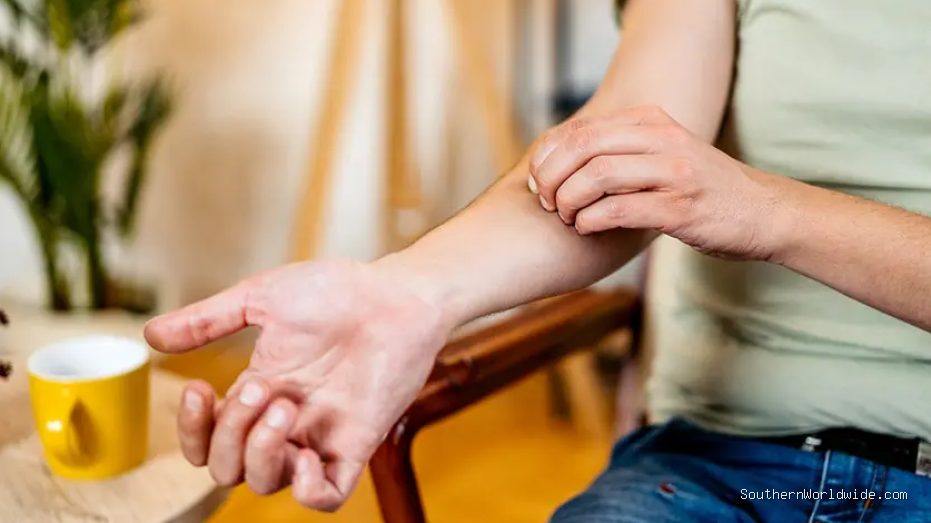
SouthernWorldwide.com – While the urge to scratch an itchy mosquito bite or rash might be overwhelming, research indicates that this action only provides fleeting relief and can actually make the itch last longer.
Scratching is a natural reaction to irritants on the skin. However, it can intensify skin inflammation and potentially worsen certain conditions, such as eczema.
The exact reasons why scratching exacerbates swelling, and whether this instinctive response offers any evolutionary advantage, have been subjects that University of Pittsburgh researchers described as “poorly explored.”
To delve into the connection between itching, scratching, and inflammation, a team led by Daniel H. Kaplan, a professor of dermatology and immunology at the University of Pittsburgh, induced an allergic-contact dermatitis in mice. This condition mimics eczema and was triggered by applying an allergen to the mice’s ears.
The mice subsequently developed a skin reaction comparable to what humans experience with poison ivy, certain metals like nickel, and some cosmetic ingredients.
The study involved two groups of mice. One group was considered “normal,” while the other was genetically engineered to lack a specific type of neuron responsible for sensing itch.
Furthermore, one set of mice was permitted to scratch freely, whereas another set was physically prevented from scratching by wearing an Elizabethan collar, commonly known as the “cone of shame” by pet owners.
The researchers observed that scratching triggered the activation of mast cells. The Cleveland Clinic explains that these cells are part of the body’s “alarm system,” designed to detect and respond to “harmful invaders.”
When activated, mast cells release histamine and other chemicals that contribute to inflammation and the sensation of itching.
As the Cleveland Clinic points out, “Sometimes, they activate when they shouldn’t, causing allergic reactions.”
The study revealed that the mice allowed to scratch freely exhibited higher levels of substance P. This signaling molecule further activated mast cells, leading to increased inflammation and perpetuating an itch-scratch cycle.
Conversely, the mice that were prevented from scratching, as well as those lacking the itch-sensing neuron, experienced reduced inflammation.
Despite the negative consequences, scratching is undeniably satisfying. Science magazine reported that “The capacity to both sense itch and behaviorally respond by scratching evolved hundreds of millions of years ago.”
Recognizing that mast cells also play a crucial role in defending against bacteria and other pathogens, the researchers conducted an additional experiment. Their aim was to determine if scratching-induced mast cell activation could impact the skin’s microbiome, as reported by the University of Pittsburgh.
The scientists discovered that scratching led to a decrease in the levels of Staphylococcus aureus, a bacterium frequently linked to skin infections.
However, Kaplan cautioned that “The damage that scratching does to the skin probably outweighs this benefit when itching is chronic.”
He further elaborated on a perceived paradox: “At first, these findings seemed to introduce a paradox: if scratching an itch is bad for us, why does it feel so good?” Kaplan explained, “Scratching is often pleasurable, which suggests that, in order to have evolved, this behavior must provide some kind of benefit. Our study helps resolve this paradox by providing evidence that scratching also provides defense against bacterial skin infections.”
According to the American Academy of Dermatology, remedies such as cold compresses and the application of 1% hydrocortisone cream can offer relief from itching.
The comprehensive findings of this research were published in the journal Science last year.