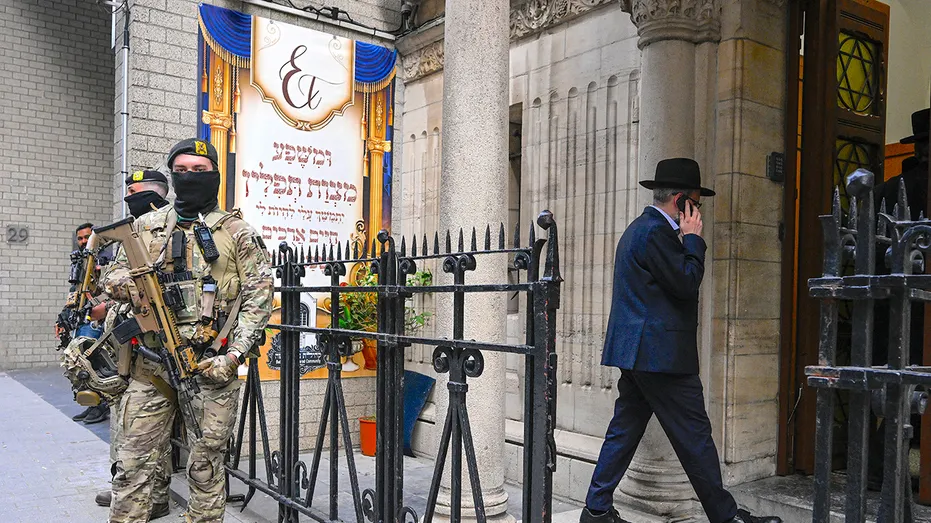
SouthernWorldwide.com – The author, residing in Brussels, paints a stark picture of the resurgent antisemitism he witnesses daily, a phenomenon he fears is now crossing the Atlantic to America.
He describes a Brussels far removed from tourist brochures, a city where Jewish schools require armed guards, synagogues are fortified, and Jewish parents advise their children to conceal symbols of their faith.
Having dedicated his life to observing the return of antisemitism to a continent that vowed it would never happen again, the author poses a critical question.
Why, he asks, can he not effectively warn America about the escalating situation he experiences firsthand? Why should this warning be confined to Jewish leaders when it concerns every American who believes such a threat cannot reach their shores?
The author asserts that this threat is not only real but already present in America. He emphasizes that his message is not solely for the Jewish community but for all public officials—mayors, governors, senators, police chiefs, and university presidents—anyone with the power to act and the inclination to look away.
He urges them to “Wake up.”
In Europe, antisemitism, he explains, did not reappear with swastikas. Instead, it resurfaced cloaked in slogans, marching under the guise of justice, and masquerading as activism, daring any opposition.
This resurgence, he notes, was not an isolated event. It arrived hand-in-hand with violent extremism, which European leaders for two decades dismissed as a fringe element or a transient misunderstanding.
He argues that it was none of these things but rather a warning that was ignored, a refusal to read the signs that is now being paid for dearly.
The author recounts how European societies told themselves they could manage the situation, that it was a problem confined to “someone else’s neighborhood” or “someone else’s children.”
He contends that this perspective was fundamentally wrong on all counts.
He directs attention to the impact of a single weekend’s events on a major European capital, citing Paris as an example.
In Paris, order disintegrated rapidly, hundreds were arrested, and a mob laid siege to a police station in an affluent district, forcing even the Eiffel Tower to close due to security concerns.
The specific trigger for such events, the author suggests, is less important than the consistent lesson they impart: a free and modern city can lose control of its streets far quicker than its leaders will admit.
And when the streets are lost, he states, Jewish communities are invariably the first to feel the repercussions.
Americans, he observes, tend to view these scenes as if watching a distant storm—terrible and tragic, but ultimately remote and unlikely to be replicated at home.
This, he points out, is precisely the sentiment that prevailed in Europe.
For generations, America was perceived as the antithesis of the European continent. A Jewish person could navigate streets in Brooklyn or Boca Raton without constant calculations about their safety.
Children could wear yarmulkes to school without parental anxiety, and synagogues did not need to resemble fortresses. America represented the possibility that history, as it had often ended in Europe, did not have to repeat itself.
This outcome, he stresses, was not accidental but a product of a civic culture that treated hatred of Jews as disqualifying, not a matter for debate.
However, this confidence is now beginning to erode. The author identifies the agents of this erosion not as a masked fringe group but as individuals winning arguments and shaping public discourse.
These individuals are influencing acceptable discourse on campuses, in city councils, and within the digital spaces where young people form their views.
They are cultivating a generation that perceives certain forms of hatred as sophisticated and excusable, treating the oldest of hatreds as merely another political stance.
When antisemitism is justified by its adherence to specific political ideologies, the danger expands. When violent extremism is rationalized due to the discomfort of confronting it, the danger grows.
When leaders offer statements in lieu of concrete standards, the danger proliferates. Every extremist, he warns, receives the same message that Europe heard: “No one is going to stop you.”
The author clarifies that he is not advocating for fear in America, as fear is precisely what these elements desire.
Instead, he urges America to embrace honesty, especially while honesty still carries minimal cost.
He distinguishes this issue from mere disagreement, as democracies are fundamentally built for argument, and a healthy one engages in vigorous debate.
The critical point, he argues, is whether a society consistently confronts hatred, even when its source is fashionable, even when its proponents claim moral superiority, and even when it would be easier to label it with a less severe term.
This, he states, was the test that Europe failed, and the evidence is visible daily on his street, in his city, and in capitals across the continent.
He then poses a direct question to America’s leaders, urging them to reflect deeply on it.
Given the stark reality of Europe—the presence of guards, the fortified synagogues, the families who have already emigrated—how, he asks, could they possibly choose to allow such a scenario to unfold in America?
He presents his message as a warning, delivered early, while the opportunity to act is still present and the cost of intervention remains relatively low—a chance his own generation of leaders never had in time.
Europe has already experienced this narrative, and its conclusion is known. America, he concludes, still has the opportunity to forge a different ending, but time is rapidly running out.
Baca juga di sini: Kuwait Condemns Iranian Attacks After Airport Hit
He implores America not to wait until it requires his lived experience to finally accept his warning.