SouthernWorldwide.com – NASA has officially declared the end of its Mars mission for the MAVEN orbiter after the spacecraft went silent six months ago. The probe, which was studying how the solar wind affects the Martian atmosphere, was lost during a routine pass behind Mars. Despite extensive efforts to re-establish contact and reset the spacecraft’s computer, all attempts have been unsuccessful.
The MAVEN (Mars Atmosphere and Volatile Evolution) mission, costing $582 million, was originally designed for a one-year operational life but was extended multiple times due to its success. Its last confirmed communication with Earth was on December 6, 2025, just before it entered a period of occultation behind Mars.
“The MAVEN spacecraft and all of the subsystems were nominal when the spacecraft entered a normally scheduled occultation where the spacecraft passed behind Mars,” stated Mike Moreau, MAVEN project manager at NASA’s Goddard Space Flight Center. He added that there were no prior indications of any issues with the spacecraft in the week leading up to the loss of signal.
When MAVEN emerged from behind Mars on December 6, the Deep Space Network was unable to detect any signal. This prompted NASA to send commands remotely in an attempt to restart the flight computer, but these efforts proved futile.
“Unfortunately, all of these efforts to reestablish communication with MAVEN were ultimately unsuccessful, and no telemetry or signal has been received from the spacecraft since December 6,” Moreau confirmed. This marks the definitive end of the MAVEN mission.
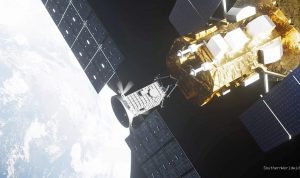
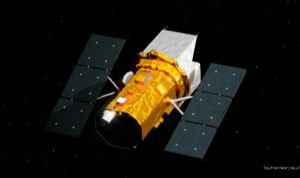
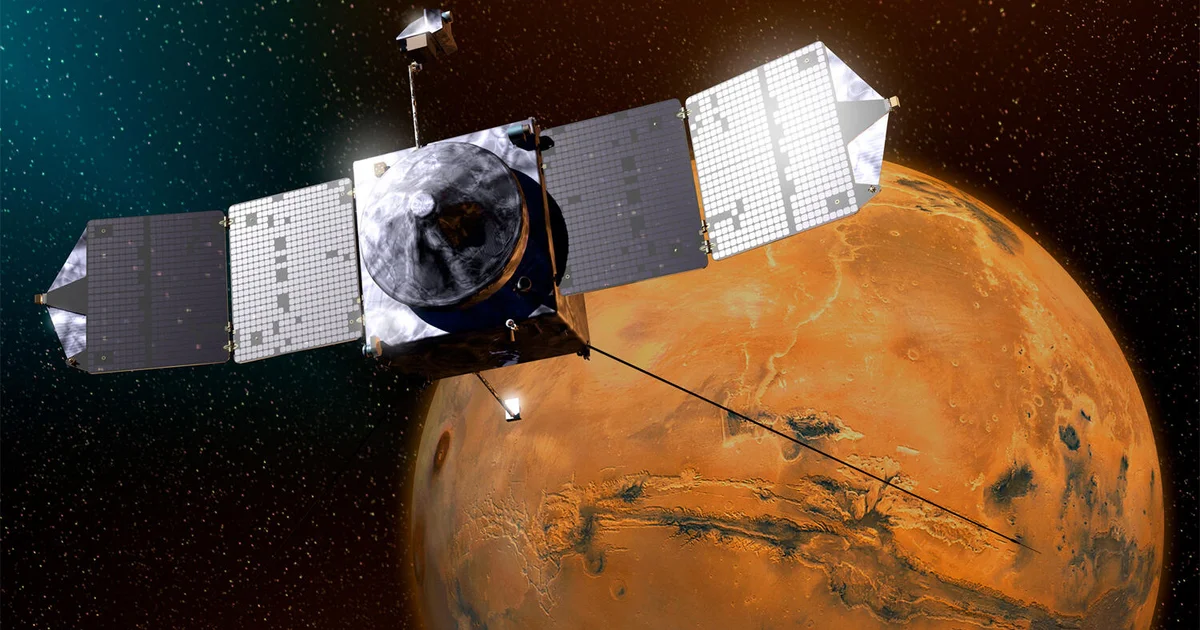
An artist’s impression of the MAVEN spacecraft in orbit around Mars. (NASA)
MAVEN was launched on November 18, 2013, and successfully entered orbit around Mars in September of the following year. The spacecraft was equipped with advanced instruments designed to study the Martian atmosphere and understand how it has been eroded over billions of years by the solar wind.
The mission’s extended operational period allowed for the most comprehensive research into the Martian atmosphere ever conducted. Scientists believe that Mars was once a warmer, wetter planet, requiring a denser atmosphere than exists today for liquid water to be stable on its surface. MAVEN has provided crucial data on how charged particles from the solar wind have thinned the atmosphere over eons.
“One of our most exciting discoveries used 11 years of MAVEN data to observe, for the first time in any planet, an atmospheric escape process called ‘sputtering’,” explained Shannon Curry, the principal investigator at the University of Colorado at Boulder. She likened this process to a cannonball splash in a pool, where charged particles impact the upper atmosphere and eject neutral atmospheric gases.
Curry highlighted the significance of this finding, stating, “Our team (confirmed) that this process has been a dominant escape mechanism for billions of years, which has incredible implications for other planets in our solar system and even exoplanets.” This research has profound implications for understanding planetary evolution beyond our solar system.
In addition to its atmospheric studies, MAVEN played a vital role in communications relay for NASA’s Mars rovers, Curiosity and Perseverance. It helped transmit data and commands between the rovers and mission controllers at the Jet Propulsion Laboratory. While other Mars orbiters also provide this service, MAVEN’s contribution was significant.
Despite the mission’s successful extensions, NASA is actively investigating the cause of the communication loss to glean lessons for future missions. An anomaly review board was established in February to determine the root cause of the incident.
As part of this investigation, engineers re-examined recordings from the Deep Space Network, particularly data captured when MAVEN emerged from behind Mars during a radio science experiment. While normal telemetry was absent, fragments of data indicated that the spacecraft was rotating at approximately 2.7 revolutions per minute.
Normally, MAVEN maintained a stable orientation to optimize solar panel power generation and antenna pointing towards Earth for communication. A continuous rotation at the observed rate would have made normal communication impossible and prevented the solar arrays from generating sufficient power, leading to a rapid drain of the spacecraft’s batteries.
Moreau refrained from speculating on the exact cause of the event, expressing anticipation for the investigation’s findings. He confirmed that the observed rotation rate was likely unsurvivable for the spacecraft.
The MAVEN orbiter is expected to remain in its orbit around Mars for at least another 50 to 100 years, but NASA has stated that no further attempts will be made to re-establish contact. The mission’s conclusion, though abrupt, was marked by deep appreciation for its scientific contributions.
“On a personal note, leading this team has been a privilege and an honor,” Curry shared. “This team has worked tirelessly on operating the spacecraft and delivering exceptional science. It’s their vision, their drive and their curiosity that brought these amazing discoveries into fruition. I will miss the spacecraft and this team dearly.”
When asked by a reporter what epitaph would be fitting for MAVEN, Curry responded with heartfelt sentiment: “Best Mars mission ever.” The sentiment reflects the profound impact and success of the orbiter’s extensive scientific work on understanding the Red Planet.