SouthernWorldwide.com – Nine Native American tribes from South Dakota, North Dakota, and Nebraska have initiated a lawsuit against the federal government. Their objective is to halt exploratory drilling for graphite, which is planned near a sacred site located in the Black Hills.
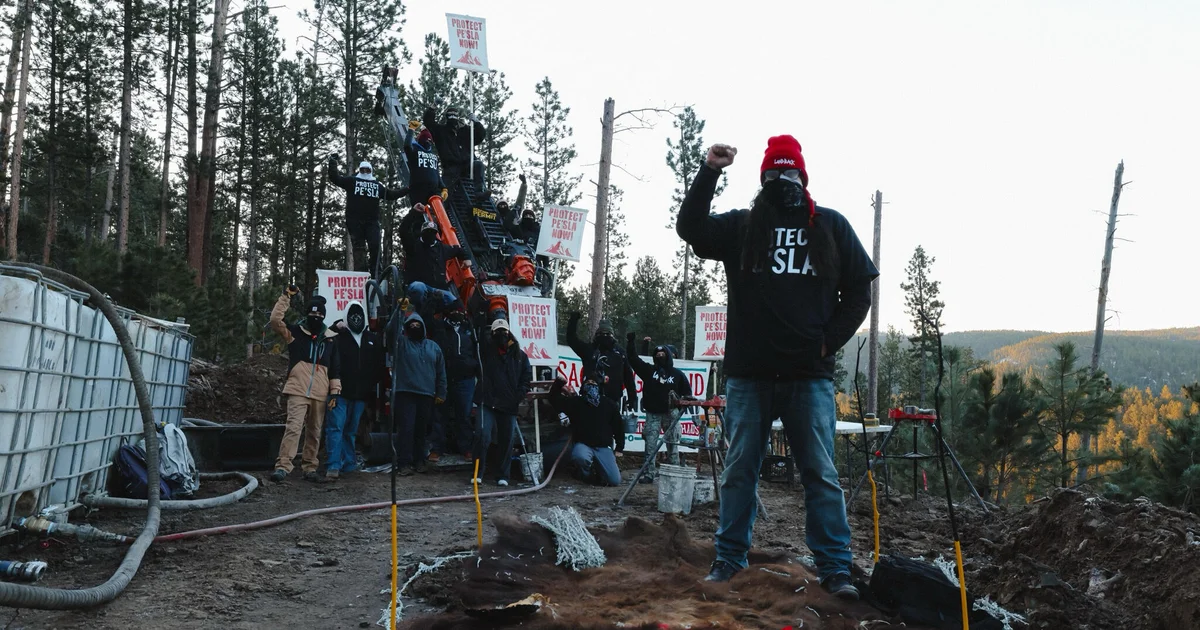
A small contingent of demonstrators has been actively protesting at the drilling site and the headquarters of the mining company. These actions began shortly after they were informed that ground had been broken for the drilling project in late April.
The tribes lodged their federal lawsuit on Thursday in South Dakota. The defendants named in the suit are the U.S. Forest Service and the U.S. Department of Agriculture. The core allegation is that these agencies contravened federal law by approving a project situated close to a significant site known as Pe’Sla.
Pe’Sla is a meadow nestled in the central Black Hills. It has historically been and continues to be a vital location for tribal ceremonies, prayer, and youth camps throughout the year. The tribes argue that the approval of the drilling project jeopardizes its continued use for these essential purposes.
This project represents the latest point of contention in the ongoing conflict between tribal nations and mining interests within the Black Hills. The region, characterized by its lush, pine-covered landscape, spans over 1.2 million acres. It dramatically rises from the Great Plains in southwestern South Dakota and extends into Wyoming.
The Black Hills are a major annual draw for millions of tourists, boasting renowned attractions such as Mount Rushmore and numerous state parks teeming with wildlife. However, for a much longer period, the area has held profound spiritual significance for the Sioux tribes. They refer to the region as He Sapa, and it is considered “the heart of everything that is,” according to the legal complaint filed by the tribes.
Elements of the Black Hills landscape have already undergone considerable alteration. This began with the gold rush of the 1870s, an era that profoundly reshaped the region and led to the displacement of Native American populations. In more recent times, a new wave of mining operations, driven by escalating gold prices, has emerged, seeking to re-enter and exploit the landscape.
The lawsuit explicitly states that the project, spearheaded by Pete Lien & Sons, a mining company based in Rapid City, would negatively impact the traditional, cultural, and religious use of Pe’Sla by the tribes. Furthermore, the complaint asserts that the Forest Service failed to engage in adequate consultation with the tribes prior to granting its approval for the project.
Crucially, parts of Pe’Sla are now owned by Sioux tribes. These acquisitions occurred through land purchases made in 2012, 2015, and 2018. An existing agreement between the tribes and the Forest Service had previously established a two-mile buffer zone on public lands surrounding the sacred site, as detailed in the complaint.
The lawsuit contends that the approval process violated key federal statutes, specifically the National Historic Preservation Act and the National Environmental Policy Act. This is because Pe’Sla was not officially designated as an affected area, and consequently, no comprehensive environmental review was conducted for the project’s potential impacts.
Pete Lien & Sons, a company that supplies essential materials such as limestone, sand, and gravel, did not respond to requests for comments via email or voicemail on Thursday and Sunday. The company’s silence leaves their perspective on the allegations and the project unaddressed.
The legal action is being hailed as a “historic” moment for the involved tribes. Frank Star Comes Out, president of the Oglala Sioux Tribe, issued a statement highlighting the lawsuit as a significant “historic demonstration of unity” among the nine distinct tribes. Although these tribes are separate and federally recognized entities, each possessing its own governance and land base, they share deep cultural and linguistic connections.
Wizipan Garriott, president of the Indigenous advocacy group NDN Collective and a member of the Rosebud Sioux Tribe, emphasized the long-standing connection to the land. “We as Lakota people have been coming and praying and holding ceremony at these places for over 2,000 years,” Garriott stated. “And so us being here is a continuation of countless generations before us. And it’s important that these sacred places be protected for future generations to come.”
The Forest Service granted the project a permit in February. The agency justified this decision by claiming the project met the criteria for a categorical exclusion. This classification typically applies to projects with a duration of less than one year and those deemed unlikely to pose significant impacts on environmental and cultural sites.
However, tribal opponents strongly dispute the agency’s assessment. They argue that the project’s characteristics do not align with the requirements for a categorical exclusion. Moreover, they express concern that drilling projects often serve as an initial phase that can pave the way for more extensive future mining operations.
In addition to the lawsuit filed by the tribes, the NDN Collective, in conjunction with other environmental organizations, has submitted a formal request for a temporary restraining order and a preliminary injunction. The aim of these legal actions is to immediately halt the ongoing drilling project.
According to the NDN Collective, some of the designated drilling pads are situated within the established buffer zone surrounding the sacred Pe’Sla site. The current project plan involves the company drilling up to 18 holes, extending approximately 1,000 feet into the earth, for the purpose of collecting geological samples.
On Thursday, demonstrators voiced their opposition by holding signs with messages such as “Protect Pe’Sla” and “Sacred ground not mining bound.” These protests took place near two of the drilling pads, effectively blocking access. The NDN Collective reported that the Forest Service informed them that drilling operations were temporarily suspended for the remainder of the day, and the contractors were sent home.
When approached for a statement regarding the project, the Forest Service responded that it had no comment. The agency indicated its policy is not to discuss the specifics of ongoing legal cases or matters that are part of active legal proceedings.
The exact commencement date of the drilling remains unclear. However, the NDN Collective noted that they observed drilling pads in operation as of last week. The group has declared its intention to continue protest actions as necessary to ensure the protection of Pe’Sla, underscoring their commitment to safeguarding the sacred site.
Read more : Therapeutic Benefits of Horses
“As Lakota, we pray as long as we need to,” Garriott affirmed, highlighting the enduring spiritual commitment to protecting their ancestral lands.