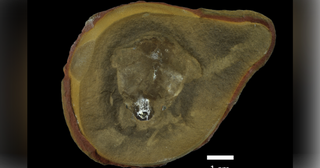
SouthernWorldwide.com – A prehistoric fossil, long believed to be the world’s oldest octopus, has been reclassified by scientists. New research indicates the remains actually belong to a different marine creature, challenging previous understandings of cephalopod evolution.
Thomas Clements, the lead researcher from the University of Reading, stated that the fossil, previously identified as the earliest known octopus, was never an octopus to begin with. His team’s findings suggest the fossil is, in fact, a relative of the nautilus, a type of cephalopod characterized by both tentacles and a shell.
The fossil, known as Pohlsepia mazonensis, has been a subject of scientific debate for years. Clements described it as a difficult fossil to interpret, noting its appearance as a “white mush” that superficially resembles a deep-water octopus, which likely contributed to its initial misidentification.
Discovered in the Mazon Creek area of Illinois, a region renowned for its rich fossil deposits from a pre-dinosaur era, the creature was roughly the size of a human hand. Its identification as an octopus in 2000 significantly altered scientific perspectives on the evolution of eight-tentacled cephalopods, suggesting their emergence much earlier than previously theorized. The next oldest octopus fossil dates back only about 90 million years.
This considerable time gap prompted researchers to question the true identity of the fossil. To resolve the mystery, Clements and his team utilized a synchrotron, a powerful tool that generates intense light beams. This allowed them to examine the fossil’s internal structure.
Inside the fossilized rock, they discovered a radula, a ribbon-like structure covered in teeth, which is present in all mollusks, including nautiluses and octopuses. However, the radula in the fossil had 11 teeth per row, whereas octopuses typically have either seven or nine. This critical difference led to the conclusion that the fossil could not be an octopus.
Read more : Ford CEO: Focusing on Making Vehicles More Affordable
The teeth found in the fossil closely match those of a fossil nautiloid called Paleocadmus pohli, which was also found in the same region. Clements theorizes that the misidentification may have occurred because the creature’s shell decomposed before fossilization, making its identification more challenging.
This discovery highlights the importance of re-evaluating past scientific findings with contemporary tools and techniques. Clements emphasized that examining controversial fossils with new methods can reveal subtle clues leading to significant discoveries.
Following these findings, published in the journal Proceedings of the Royal Society B, Guinness World Records will no longer recognize Pohlsepia mazonensis as the earliest known octopus. Adam Millward, Managing Editor, acknowledged the “fascinating discovery” and stated that the record title would be revised based on the new evidence.
Pohlsepia mazonensis was named after its discoverer, James Pohl, and is part of the collection at the Field Museum in Chicago. Clements suggested that the museum need not be disappointed, as the fossil now represents the “oldest soft tissue nautilus in the world,” a significant find in itself for cephalopod research.
The Field Museum has been contacted for comment regarding this reclassification. The new understanding of this ancient creature offers a valuable insight into the diversity and evolution of marine life millions of years ago.