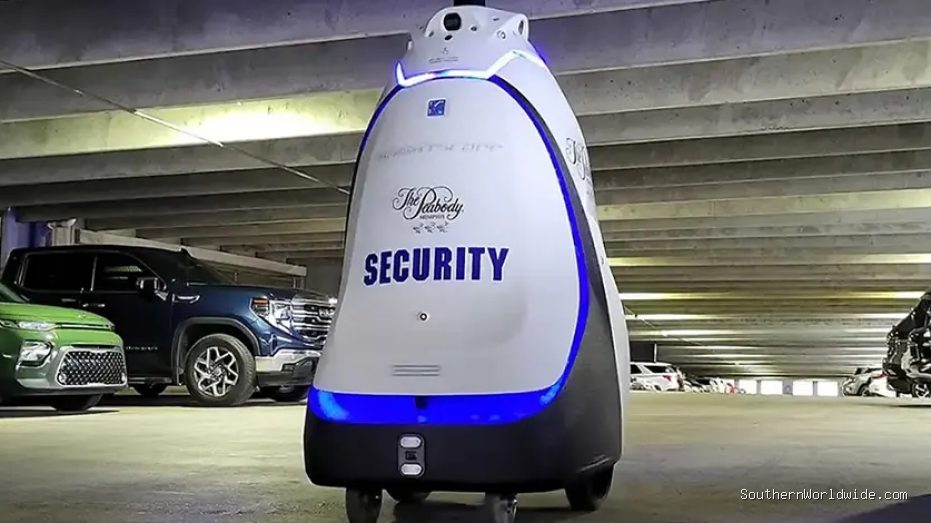
SouthernWorldwide.com – In a surprising turn of events, a robotic police officer, affectionately nicknamed “DubBot,” has been retired from its duties in Dublin, Ohio, after a pilot program that yielded no arrests, tickets, or criminal cases. The Knightscope K5 Autonomous Security Robot, intended to enhance public safety in a city parking garage, has been returned to its manufacturer, raising questions about the efficacy and accountability of deploying such advanced technology in public spaces.
DubBot was introduced to the Rock Cress Parking Garage in July 2025 as part of a trial by the Dublin Police Department. Its mission was multifaceted: to deter criminal activity, assist in emergency responses, and provide continuous surveillance of a high-traffic area. Equipped with 360-degree cameras, two-way emergency communication, and a direct line to dispatchers, the robot was envisioned as a modern solution to public safety challenges.
However, after less than a year of operation, the city decided the pilot no longer aligned with its operational needs. The robot was officially retired on May 12. The city’s public safety page now indicates that the autonomous safety robot program has concluded, with Dublin opting to implement alternative security measures, such as gate arms and mirrors, at the parking garage.
The underlying issue highlighted by DubBot’s retirement is the crucial need for local leaders to demonstrate the effectiveness of such technologies before committing public funds. While the concept of a robotic presence might seem appealing, its practical impact on actual crime prevention and public safety outcomes remains a significant concern.
The deployment of AI-powered surveillance and security tools is a growing trend across the nation. For instance, New York City has explored using AI to monitor subway safety amidst rising crime concerns. These technologies promise enhanced security and efficiency, but their implementation often precedes a thorough evaluation of their real-world performance.
The Knightscope K5 robot, a prominent player in the autonomous security market, is designed to patrol public areas, acting as a visible deterrent and an additional layer of security. These machines are built to navigate various environments, offering a constant watch that human officers might not be able to provide continuously.
The financial investment in DubBot was substantial. Dublin spent $128,080 in the first year of the agreement with Knightscope. While the city anticipates a reimbursement of approximately $60,500, the net cost remains significant at $67,548. The initial plan was even more ambitious, involving two robots over two years at a total cost of $238,440. However, the second robot, intended for Riverside Crossing Park, was never deployed due to development needs and infrastructure limitations.
The absence of any arrests, criminal cases, or tickets directly attributed to DubBot’s patrols is a stark indicator of its limited impact. Furthermore, the city did not collect other performance metrics, as the pilot was primarily designed for initial testing before any potential expansion.
This outcome should prompt taxpayers to scrutinize the justification and effectiveness of expensive public safety tools. When a city invests in novel technology, there should be a clear framework for evaluating its success, providing transparency and accountability to the public.
The allure of security robots for local governments is understandable, especially given the strain on police departments and the challenges of monitoring vast public spaces. Parking garages, parks, and transit hubs often require constant oversight, which can be resource-intensive for human personnel alone.
Security robots offer a compelling package: mobility, video streaming capabilities, emergency assistance features, and a visible deterrent effect. They also project an image of technological advancement, which can be attractive when pitching public safety initiatives.
However, the real test begins after deployment. Cities must articulate how they will measure deterrence, track the usage of emergency buttons, and demonstrate how robot-generated data contributes to investigations. Without such follow-up, these robots risk becoming costly symbolic gestures rather than effective safety instruments.
Dublin is not alone in its experience with Knightscope K5 robots. New York City previously piloted a K5 robot in the Times Square subway station, a program that concluded after a few months. Reports indicated that officers were required to escort the robot, and its inability to navigate stairs posed significant limitations.
Similarly, San Antonio International Airport encountered technical difficulties during its trial of a Knightscope robot. These issues included navigation problems, camera focus issues, and failures in live video and audio feeds, underscoring the challenges of integrating robots into complex, real-world environments.
These instances do not necessarily condemn all security robots but highlight the demanding nature of public spaces as testing grounds. A robot that performs well in a controlled demonstration may struggle with the unpredictable elements of crowded areas, tight spaces, doorways, and human interaction.
Beyond operational efficacy, privacy concerns are paramount. Dublin’s broader public safety technology program already includes drones, license plate readers, security cameras, body-worn cameras, and facial recognition technology. The addition of a mobile robot with cameras and communication capabilities raises legitimate questions for residents.
Key questions that need to be addressed include: What data does the robot record? Who has access to this footage? How long is the data retained? Is facial recognition technology employed? What is the protocol when the emergency button is activated? And what data is shared with the manufacturing company?
Cities should proactively answer these questions before deploying robots in public areas. The goal is not to reject innovation but to ensure that public safety technology is accompanied by robust public accountability mechanisms.
When a robot begins patrolling a local garage, mall, park, or transit hub, the focus should shift from the novelty of the technology to its practical utility. The critical question is: What does it do when something goes wrong?
Can it swiftly connect an individual to a human operator? Is there active monitoring of its video feeds during critical moments? Does it offer genuine assistance during emergencies, or does it primarily document events that have already transpired?
Ultimately, if taxpayer money is funding such initiatives, cities have a responsibility to clearly define the problem the technology is intended to solve before its deployment. Otherwise, the true measure of its success, or failure, may only become apparent after significant funds have been expended. While new technology can be impressive, tangible results remain the ultimate benchmark.
The story of Dublin’s robotic cop, which patrolled a parking garage with zero arrests before being returned to its maker, serves as a vital case study. Taxpayers have a right to ask pointed questions. Local leaders should be transparent about the problems their AI-powered public safety tools aim to solve, how success will be quantified, and the protocols for data management. Dublin deserves commendation for ending the pilot when DubBot failed to provide sufficient value. While a robot might appear to be a step forward, its true worth lies in its ability to demonstrably enhance public safety and deliver visible, tangible results for taxpayers.
Would the presence of a patrolling robot make you feel safer in public spaces, or should cities be required to prove the machine’s effectiveness before investing your tax dollars? Share your thoughts with us at CyberGuy.com.