SouthernWorldwide.com – A significant effort is underway to replace America’s aging Minuteman III nuclear missiles with a new system called Sentinel. This transition aims to modernize the nation’s ground-based nuclear deterrent, ensuring its continued reliability and effectiveness.
CBS News was granted exclusive access to witness this critical modernization process firsthand. We flew aboard the Air Force’s new Grey Wolf helicopter over the Wyoming prairie to visit a Minuteman III Intercontinental Ballistic Missile (ICBM) silo. This area, once a highly secure zone where trespassers faced severe consequences, now serves as a focal point for this historic upgrade.
Hundreds of these active nuclear silos are strategically located across the landscape, stretching from Colorado northward to the Canadian border. These are the pillars of America’s nuclear triad, ready to be deployed at a moment’s notice.
“There are always approximately 400 (ICBMs) ready to go at any moment,” stated Air Force Global Strike Command General S.L. Davis during the flight, communicating over the helicopter’s advanced systems. The presence of these weapons underscores the nation’s commitment to deterrence.
CBS News accompanied General Davis and Admiral Rich Correll, the commander of U.S. Strategic Command, on this inspection tour. Their destination was F. E. Warren Air Force Base in Cheyenne, Wyoming, a key location for overseeing the progress of the Sentinel program. This visit provided an in-depth look at the transition from the Minuteman III to its successor.
L-R: Ian Lee aboard a Grey Wolf helicopter with Air Force Global Strike Command General S.L. Davis and Admiral Rich Correll, Commander of U.S. Strategic Command.
Our landing point was Echo 10, a silo situated near the Colorado border. This particular silo is the first to be taken offline as the Air Force begins the shift to the Sentinel system. Despite its decommissioned status, security remains exceptionally stringent. An Air Force rapid response team, highly trained to reclaim nuclear silos from hostile forces, was already present on the ground.
We were welcomed at the entrance by Colonel Terrance J. Holmes, the wing commander of the 90th Missile Wing at F.E. Warren. This wing is responsible for 150 Minuteman III ICBMs, a significant portion of the nation’s ground-based nuclear arsenal.
Read more: Astronaut Artemis Share Goals for Space Exploration and Desire to Return
“It is a heavy weight,” Colonel Holmes admitted, reflecting on the immense responsibility of commanding such a large number of nuclear warheads. “But I can tell you that our defenders, our operators and the support personnel that drive the mission of the 90th Missile Wing, stand ready every single day, 24/7.”
The upgrade to the Sentinel system is facing a delay of approximately a decade. However, even as Minuteman IIIs are being phased out, Colonel Holmes assured that his forces would remain capable of executing their mission if called upon by the president.
“I am focused on maintaining day to day nuclear surety and deterrence for the nation, and that mission does not and will not ever stop even during the transition to the Sentinel,” he emphasized. This highlights the unwavering dedication to national security during this complex transition.
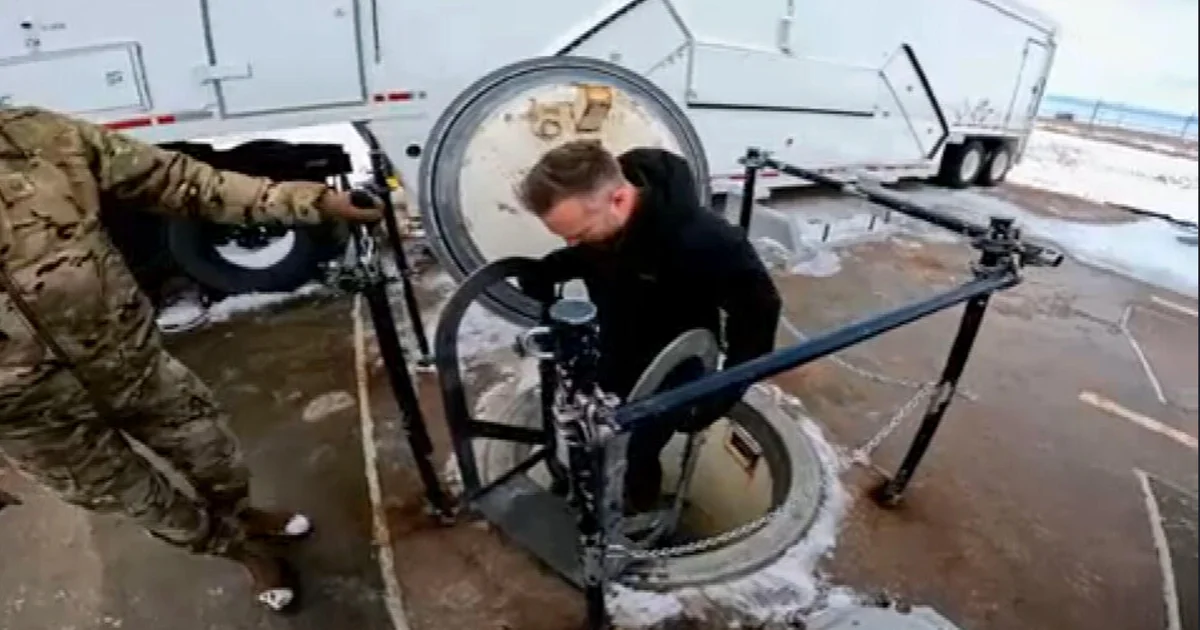
We then descended a ladder through a circular shaft, passing through layers of concrete, entering a subterranean environment designed for ultimate destruction. The equipment within the silo clearly reflects the age of the Minuteman III system.
Ian Lee descends into a decommissioned Minuteman III nuclear missile silo.
“The system was originally designed for a decade,” Admiral Correll explained. “We’ve been operating it since 1961. So, it’s well past its design life.” This statement powerfully illustrates the longevity and the urgent need for replacement of the current missile system.
Surrounding the silo, technology dating back 60 years lines the walls. In the center, a shaft that once housed a 60-foot nuclear missile extends several stories high, a testament to a bygone era of military engineering.
“The Minuteman III that’s on alert today is the Minuteman III that I took command of as a lieutenant over 35 years ago. The launch facility that supports the Minuteman III [was] built before I was born,” General Davis remarked. His words underscore the generational service and the deeply entrenched history of the Minuteman III program.
File photo: A Minuteman III missile engine.
Back at F.E. Warren, the commanders guided us through the facilities where the new Sentinel missiles and their warheads will be assembled. These modern structures stand in stark contrast to the base’s original red brick buildings, remnants of an era when cavalry charges were still a significant aspect of warfare.
“(Sentinel) is bigger, it’s faster. It has longer range and it can carry more payload,” General Davis stated, detailing the superior capabilities of the new missile. “It’s safer, it’s more secure and it’s more reliable.” These enhancements are crucial for maintaining a credible deterrent in the modern geopolitical landscape.
The Sentinel program is currently facing significant cost overruns, exceeding its budget by 80% and projected to cost U.S. taxpayers approximately $141 billion. The Air Force is undertaking the construction of over 450 new launch silos, alongside 50 to 75 launch centers and various other support facilities to accommodate the program.
Despite the substantial investment, the commanders are confident that the Sentinel system will prove more cost-effective in the long run. They argue that it will require less maintenance compared to the Minuteman III once fully operational. Furthermore, the new Grey Wolf helicopters are expected to enhance security, provide greater reach, and improve reaction times to any silo across the country.
While some critics might question the necessity of investing in a weapons system that is never intended for actual use, Admiral Correll offered a strong counterpoint.
“We use it every single day. Deterrence is active,” he asserted. “The absence of action on the part of the adversary to do us harm is employment of that system day after day.” This perspective emphasizes the crucial role of nuclear deterrence in preventing conflict.
The modernization effort is also prompted by the advancements in nuclear weapons programs by other global powers. Nations such as China, Russia, and North Korea are actively upgrading their own arsenals. In response, the Pentagon is concurrently modernizing other components of the nation’s nuclear triad, including replacing the B-2 Stealth bomber with the B-21 and phasing out the Ohio Class nuclear-powered ballistic submarines in favor of the Columbia Class.
“Our nation’s nuclear deterrent is safe, secure, reliable and credible,” Admiral Correll concluded. “America will be safer.” This assurance reflects the strategic imperative to maintain a robust and modern nuclear capability in an ever-changing world.