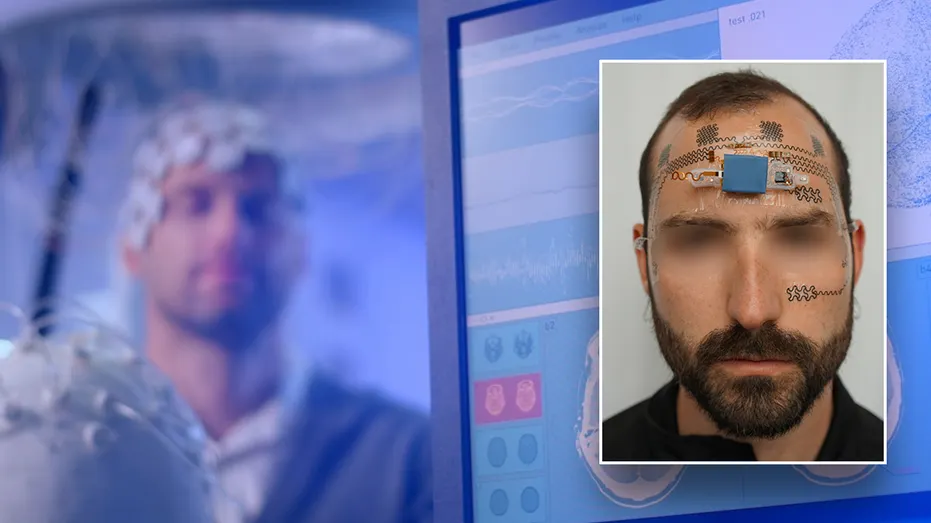
SouthernWorldwide.com – Scientists have developed an innovative electronic tattoo, or “e-tattoo,” designed to be worn on the face to help individuals in high-stress professions monitor their brainwaves and cognitive load.
A study published in the scientific journal Device details how researchers found e-tattoos to be a more accessible and cost-effective method for tracking mental workload.
Dr. Nanshu Lu, the senior author of the research from the University of Texas at Austin, emphasized the importance of mental workload. She stated that it significantly influences cognitive performance and decision-making, especially in human-in-the-loop systems.
This technology could be particularly beneficial for professionals such as ER doctors and drone operators. It offers a means for enhanced training and performance monitoring in demanding roles.
A primary objective of the study was to establish a reliable way to measure cognitive fatigue. This is crucial for careers that are both high-leverage and mentally taxing.
Read more : AI Layoffs: A Company Backfire
The e-tattoo is a temporary device that adheres to the forehead. It is notably smaller than existing technologies used for similar monitoring purposes.
According to the study, the device operates by utilizing electroencephalogram (EEG) and electrooculogram (EOG) signals. These measure both brain wave patterns and eye movements.
Unlike traditional EEG and EOG machines, which are often bulky and expensive, the e-tattoo provides a compact and affordable alternative.
Dr. Lu described the developed system as a “wireless forehead EEG and EOG sensor designed to be as thin and conformable to the skin as a temporary tattoo sticker.” She referred to it as a “forehead e-tattoo.”
She further elaborated on the significance of human mental workload, stating it is a “crucial factor in the fields of human-machine interaction and ergonomics due to its direct impact on human cognitive performance.”
The study’s methodology involved six participants. They were presented with a screen where 20 letters appeared sequentially in different locations.
Participants were instructed to click a mouse if the displayed letter, or its position, matched a previously shown letter. This task was designed to vary cognitive demand.
Each participant completed the task multiple times, with the difficulty level escalating across four distinct stages.
The researchers observed that as the tasks became more challenging, shifts in brainwave activity were detected. These changes directly corresponded to an increased mental workload response.
The e-tattoo device itself is comprised of a battery pack and reusable chips integrated with a disposable sensor component.
Dr. Lu indicated that the current device is a laboratory prototype. Further development is necessary before it can be commercialized.
She outlined the next steps, which include “real-time, on-tattoo mental workload decoding and validation on more people and in more realistic environments.” The current prototype has an estimated cost of $200.