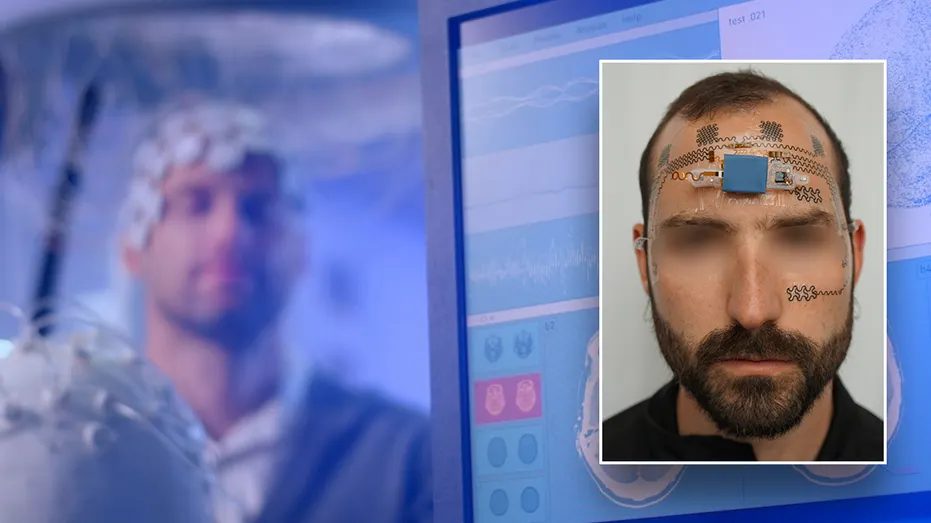
SouthernWorldwide.com – Researchers have developed a novel electronic tattoo, or “e-tattoo,” designed to be applied to the face, capable of monitoring brainwaves and brain usage. This innovation aims to assist individuals in high-stress professions by tracking their mental workload.
A study published in the scientific journal Device highlights that e-tattoos offer a more economical and straightforward method for assessing mental workload. This is particularly relevant in demanding professions where cognitive load directly impacts performance and decision-making.
Dr. Nanshu Lu, the lead researcher from the University of Texas at Austin, emphasized the significance of mental workload in human-in-the-loop systems. She explained that it critically influences cognitive abilities and the accuracy of decisions made by professionals.
Dr. Lu stated that the motivation behind this development stems from the needs of high-stakes professions such as pilots, air traffic controllers, doctors, and emergency dispatchers. These roles demand sustained high levels of cognitive function under pressure.
Furthermore, the technology could benefit emergency room physicians and operators of robots and drones. It offers potential for enhanced training and performance improvement in these fields.
Read more : Disney's Facial Scan Plan: What You Need to Know
A primary objective of the research was to establish a reliable method for measuring cognitive fatigue in careers that are both demanding and mentally taxing.
The e-tattoo is designed for temporary placement on the forehead, and its size is considerably smaller than existing monitoring devices.
According to the study, the device operates by utilizing electroencephalogram (EEG) and electrooculogram (EOG) signals. These technologies are used to measure brainwave activity and eye movements, providing insights into cognitive states.
While traditional EEG and EOG machines are often bulky and expensive, the e-tattoo presents a compact and cost-effective alternative for continuous monitoring.
Dr. Lu described the proposed device as a “wireless forehead EEG and EOG sensor designed to be as thin and conformable to the skin as a temporary tattoo sticker.” This unique form factor makes it unobtrusive and easy to wear.
She further elaborated on the importance of human mental workload in fields like human-machine interaction and ergonomics. Its direct impact on cognitive performance makes accurate measurement crucial for optimizing these systems.
The study’s methodology involved six participants who were presented with a screen displaying 20 letters flashing sequentially at various locations. Participants were instructed to click a mouse if the letter itself or its position matched a previously shown example.
Each participant completed the task multiple times, with the difficulty level increasing across four distinct stages. This allowed researchers to observe the effects of escalating cognitive demand.
The team observed that as the tasks became more challenging, the detected brainwave patterns exhibited shifts in activity. These changes directly correlated with an elevated mental workload response.
The e-tattoo device comprises a battery pack, reusable chips, and a disposable sensor, making it a modular and potentially sustainable solution.
Dr. Lu noted that the current iteration of the device is a laboratory prototype. Significant further development is required before it can be commercialized.
She indicated that future work will focus on developing real-time mental workload decoding directly from the e-tattoo and validating its performance with a larger participant group in more realistic work environments. The current prototype has an estimated cost of $200.