SouthernWorldwide.com – The complex and often strenuous environment of a busy warehouse loading dock, characterized by the constant influx of packages, heavy lifting, and the need for rapid processing, has historically presented significant challenges for automation.
The variability in package sizes, the potential for shifting freight during transit, and the orientation of labels can all complicate automated handling. Furthermore, ensuring a seamless transition of tasks between different automated systems has been a persistent hurdle.
However, Ambi Robotics and Pickle Robot Company have announced a commercial integration aimed at addressing this critical handoff problem. Their collaboration connects Pickle Robot’s trailer-unloading systems with Ambi Robotics’ AmbiStack pallet-building system, envisioning a future where robots manage more of the crucial initial stages of warehouse operations.
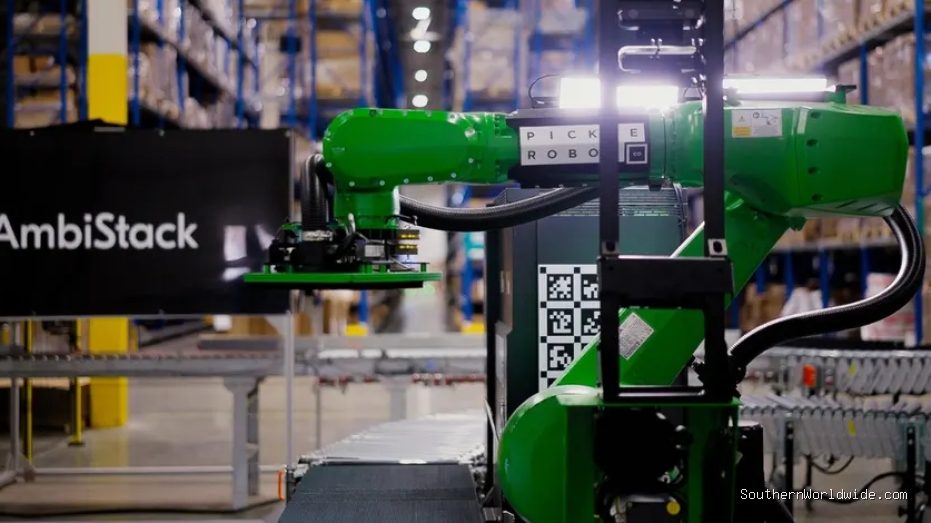
This integration means that one robotic system can unload mixed freight directly from a trailer. Subsequently, a conveyor belt transports these cases to another robotic system, which then scans and stacks them for the warehouse’s receiving process.
Should this system prove effective in large-scale facilities, it signals a significant advancement in warehouse automation, potentially extending robotic capabilities to tasks that bridge the gap between a truck’s arrival and the warehouse floor.
OHIO ROBOT COP RETIRES AFTER ZERO ARRESTS
The process begins at the trailer itself, where Pickle Robot’s system is designed to unload boxes from trailers or containers. This is a vital step, as unloading mixed freight is a physically demanding task and can create significant bottlenecks in warehouses, especially when labor is scarce.
From the unloading stage, packages are moved via a conveyor system to AmbiStack. Ambi Robotics developed AmbiStack as a versatile stacking system capable of reading package information and constructing pallets, preparing them for subsequent stages within the warehouse workflow.
The core innovation here lies in the seamless handoff between these different robotic systems. While many warehouses already employ automation, these systems often operate in isolated segments. One machine might handle unloading, while another manages sorting or stacking. Typically, connecting these disparate operations requires human intervention or custom engineering solutions.
This partnership aims to streamline that connection, with the companies asserting that their integrated system can work with existing warehouse infrastructure. This adaptability could mean that operators can implement the solution without the need for extensive and costly facility redesigns.
The concept of “Physical AI” refers to artificial intelligence that controls machines performing physical tasks. This is particularly relevant in the context of warehouse robotics, which must contend with the dynamic challenges of moving boxes, managing shifting freight, coordinating conveyor belt timing, and ensuring pallet stability.
These are distinct challenges compared to software-based AI that might generate text or answer questions. Warehouse robots must be able to react dynamically to their physical environment. A box might arrive dented, a label could be misoriented, or a pallet might become unstable if the next case is placed incorrectly.
The integrated solution from Ambi Robotics and Pickle Robot demonstrates how these challenges can be managed within a warehouse setting. Pickle Robot takes charge of the trailer unloading, while AmbiStack handles the subsequent scanning and stacking of cases for the receiving department.
Collectively, these systems illustrate how specialized robots can be interconnected to optimize a warehouse workflow. Jim Liefer, CEO of Ambi Robotics, emphasized the importance of interoperability, stating, “Warehouse operators shouldn’t have to choose between best-in-class technologies and seamless integration. As Physical AI transforms supply chains, interoperability will become increasingly important.”
AJ Meyer, founder and CEO of Pickle Robot Company, articulated the customer’s needs more plainly: “Customers want automation that improves real-world throughput while fitting into existing operations.”
AI MAY SPOT DEADLY HEART RISK IN A ROUTINE ECG
The fragility of the supply chain, often evident in delayed package deliveries, can stem from issues that arise long before a delivery truck reaches its destination. Inbound logistics encompasses all activities involved in the arrival of goods at a warehouse, including unloading trailers and integrating them into the correct workflow—a process that appears straightforward but is complex in practice.
Trailers can be loaded unevenly, and boxes may come in various, sometimes awkward, shapes. Warehouse teams also operate under tight schedules and face significant physical demands, making loading docks a prime area for automation efforts.
If robots can effectively unload freight and transfer it to a pallet-building system with minimal human intervention, warehouses could significantly accelerate the movement of goods through one of their most labor-intensive segments.
A key question arises regarding the impact on human workers. Robots are capable of taking over repetitive and physically demanding tasks, potentially reducing workplace injuries and helping to alleviate labor shortages. However, this shift will likely redefine the types of jobs that companies require.
Instead of spending an entire shift unloading trailers, some workers might transition to monitoring the automated unloading and stacking systems. Others may be called upon to intervene when a package jams, a label fails to scan, or a pallet requires human oversight.
Nevertheless, such a transition can be unsettling. Automation is often promoted for its promises of safety and efficiency, but workers need clarity on their future roles. While robots can move boxes, humans are still essential for making judgment calls, addressing customer issues, and executing rapid decisions when workflows deviate from the norm.
Retailers and logistics companies are facing pressure from multiple fronts. Consumers increasingly expect faster shipping, warehouses are grappling with staffing challenges, and the growth of e-commerce continues to drive up package volumes.
This creates a complex equation: companies must handle more goods without compromising speed at the loading dock. The integrated solution from Ambi Robotics and Pickle Robot offers warehouse operators an additional option.
Rather than investing in a single, large system from one vendor, operators can connect specialized robotic tools designed for different aspects of the job. This approach could provide greater flexibility and help avoid the substantial costs and disruptions associated with major redesigns.
In essence, robots are becoming more sophisticated and are increasingly capable of collaborating in more effective ways. Even for those who do not directly interact with warehouses, this type of automation can have a tangible impact.
More efficient warehouse operations can lead to faster restocking of stores, fewer delays in online order fulfillment, and quicker processing of returns. Conversely, increased automation may reshape job roles within warehouses, necessitating new training for workers as companies adopt more robotic systems.
Furthermore, the expectation for faster delivery could rise, as warehouses operating with fewer bottlenecks may lead retailers to set even higher speed benchmarks. While this offers convenience, it also intensifies the pressure on every link in the supply chain.
Your phone is a repository for your email, passwords, photos, banking apps, and personal data. In this free CyberGuy Live replay, Kurt the CyberGuy provides step-by-step guidance on simple phone security fixes that you can implement at your own pace. You will learn how to enhance your privacy settings, identify the latest phone scams, utilize trusted security tools, and receive a straightforward checklist to maintain your protection. Watch the replay and access our checklist at CyberGuyLive.com.
MOST PROMINENT AI CHATBOTS HAVE LIBERAL BIAS, NEW STUDY FINDS
The most compelling aspect of this development is the seamless handoff between robotic systems. One robot unloads packages from a trailer, and another scans and stacks them for the subsequent stages of the warehouse process. This capability has the potential to fundamentally alter how loading docks function.
Warehouses often experience numerous small delays that accumulate rapidly. If a package is misplaced or must wait for human intervention to proceed to the next step, the entire operation can slow down. This integration demonstrates how warehouse robots may begin to manage more of the intermediate tasks between a truck’s arrival and the warehouse floor.
However, the human element remains critical. While these systems can alleviate physically demanding work, a significant benefit, they may also alter the nature of warehouse workers’ responsibilities. Companies that effectively manage this transition, ensuring it is clear, fair, and beneficial for their employees, will be well-positioned for the future.
If robots can handle truck unloading, pallet building, and maintaining warehouse flow, the next question is: what warehouse job will be automated next? Share your thoughts by writing to us at CyberGuy.com.