SouthernWorldwide.com – Figure AI, a robotics startup based in California, has announced a significant milestone in autonomous operation with three of its humanoid robots successfully completing over 24 hours of continuous work without human intervention.
The robots, powered by Figure AI’s proprietary Helix-02 artificial intelligence system, were tasked with sorting small packages around the clock. This extended test, initially planned for only eight hours, continued uninterrupted, captivating viewers who followed the operation via a livestream.
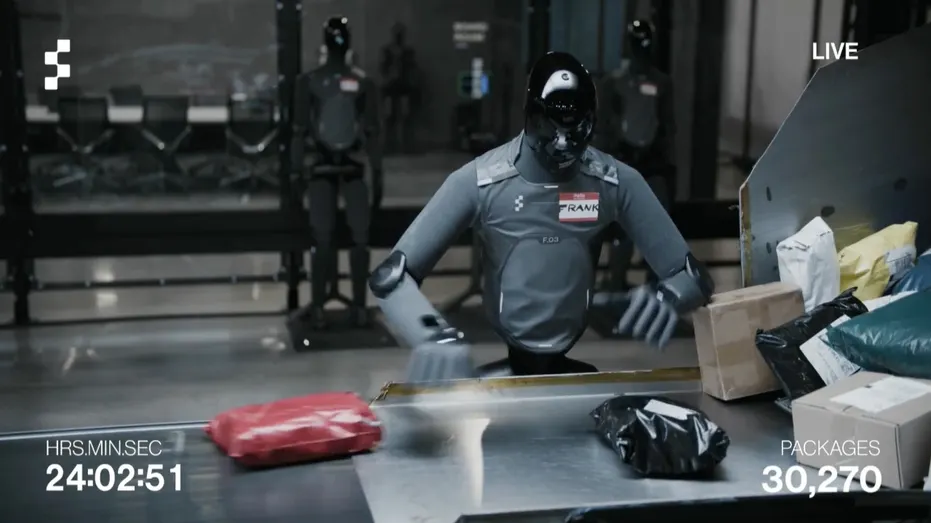
During the livestream, viewers began assigning names to the robots, which were later acknowledged by Figure AI with the addition of visible name tags. The robots were affectionately dubbed Bob, Frank, and Gary.
The core task involved picking up small packages, scanning barcodes, and placing them on a conveyor belt with the barcode facing down. This repetitive yet precise work is crucial in warehouse operations, requiring steady movement, quick decision-making, and the ability to adapt to minor issues.
Figure AI reported that the robots sorted over 28,000 packages during the extended operation. Notably, the company stated that their performance speeds were comparable to those of human workers.
According to CEO Brett Adcock, the initial objective was an eight-hour run. However, upon observing the robots operate without any reported failures, the company decided to let the test continue, demonstrating a high level of reliability.
The Helix-02 AI system is described by Figure AI as a neural network that integrates vision, touch sensing, body awareness, and movement control. This advanced AI allows the humanoid robots to perform complex actions beyond simple arm movements, including maintaining balance, gripping packages, adjusting posture, and reacting to unexpected object placements.
Onboard cameras and AI reasoning were utilized by the robots to detect barcodes and efficiently sort packages. Figure AI emphasized that the robots were not remotely controlled, with every action being a direct output of the Helix-02 system.
The livestream provided an unprecedented, real-time view of humanoid robots engaged in a demanding warehouse task. Viewers witnessed the continuous sorting of packages as the test far exceeded its original eight-hour timeframe.
The informal naming of the robots by viewers added a relatable human element to the demonstration, making the machines seem more like colleagues on a late shift.
Read more : Astronauts Reach ISS for Extended Mission Following Medical Evacuation
Figure AI’s emphasis on the robots’ recovery capabilities is a key claim. The Helix-02 system is designed to initiate an automatic reset if a robot encounters a blockage or an unexpected situation.
This self-resetting functionality is considered a significant advantage for potential real-world applications, as robots that can independently recover from issues are far more practical than those requiring constant human assistance.
Furthermore, Figure AI stated that a robot can leave its workstation for maintenance if hardware or software problems arise, with another robot seamlessly taking over to ensure continuous operation.
The field of humanoid robotics is highly competitive, with companies like Tesla, Agility Robotics, and Apptronik also developing robots for industrial and logistics purposes.
Figure AI has already engaged in trials with its robots at BMW manufacturing facilities in South Carolina, indicating that these robots are likely to be deployed first in controlled industrial environments before potentially entering domestic settings.
The task of package sorting serves as a clear and understandable demonstration of the technology’s capabilities, highlighting its potential for repetitive tasks over extended periods.
The next critical step for Figure AI will be to prove the robots’ performance beyond a single, controlled livestreamed task. While endurance has been demonstrated, businesses will require more comprehensive evidence of reliability.
This includes data on failure rates, maintenance requirements, and the robots’ ability to handle less predictable and more chaotic real-world conditions without impacting overall operational efficiency.
Independent verification, beyond company claims, will also be crucial, especially in public demonstrations where diverse scenarios are presented.
Warehouse environments can be unpredictable, with packages of varying shapes, labels in inconvenient locations, and potential obstructions. A robot that excels in a clean, structured demo must prove its mettle in a messier, more dynamic job.
While the widespread adoption of humanoid robots in daily life may still be some time away, their impact could be felt indirectly through improved delivery times and changes in warehouse staffing models.
Companies may leverage these robots to fill roles that are difficult to staff or are physically demanding for humans.
However, the advancement of automation, particularly robots capable of working long shifts without breaks, raises significant concerns about job displacement for human workers.
While not every warehouse job may disappear, the increasing capabilities of robots suggest a shift in the labor landscape, with automation encroaching further into traditional roles.
Figure AI’s extended test signifies a move from short, impressive video clips toward more substantial workplace trials for humanoid robots.
The 24-hour package-sorting demonstration by Figure AI offers a glimpse into the future of warehouse automation. The robots must still validate their performance in real-world conditions at a justifiable cost for businesses.
Nevertheless, the demonstration suggests that humanoid robots are progressing beyond mere hype and into practical applications, performing mundane tasks like package handling repeatedly and efficiently.
This type of repetitive, seemingly unglamorous work is precisely where automation can begin to demonstrate its tangible value and impact.
If companies can ensure the reliability, safety, and affordability of these robots, the operational landscape of warehouses could undergo a significant transformation in the coming years.
The question remains whether consumers will feel comfortable with packages being sorted by humanoid robots, or if this advancement prompts further consideration of which jobs automation will target next.