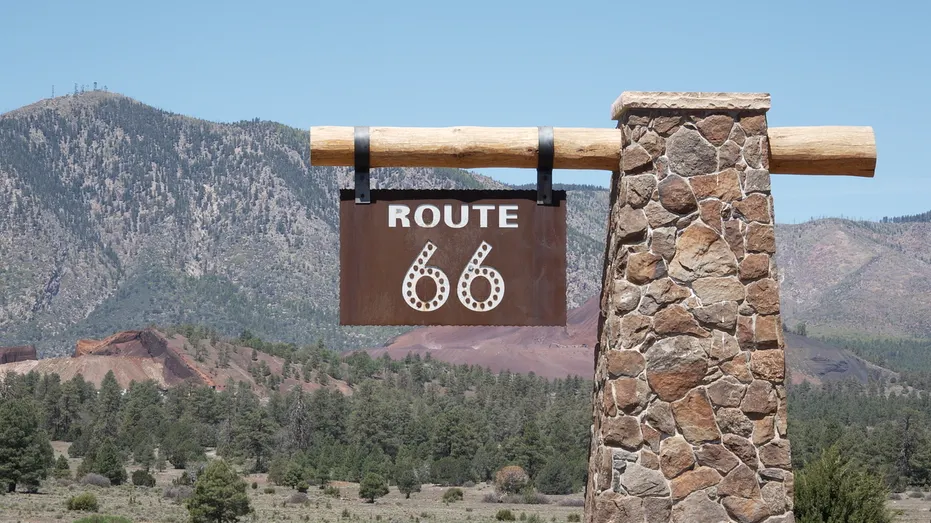
SouthernWorldwide.com – As U.S. Route 66 commemorates its 100th anniversary, it shines a spotlight on extraordinary cosmic sites scattered across Northern Arizona.
This legendary road, spanning an impressive 2,448 miles from Chicago to Santa Monica, California, has etched its place in American history. Though officially decommissioned in the mid-1980s, dedicated organizations and states have stepped in to preserve its rich legacy.
The American Southwest boasts a significant portion of Route 66, and within this stretch, Northern Arizona holds some truly out-of-this-world landmarks.
Meteor Crater, renowned as one of the planet’s most pristine meteorite impact sites, stands as an undeniable cosmic highlight along the route. Adding to the mystique, reports of a UFO crash in Kingman, Arizona, on the western segment of Route 66 surfaced in the 1950s. Midway through Arizona’s section of the historic highway lies Flagstaff, a city that serves as a gateway not only to the majestic Grand Canyon but also, fittingly, to outer space.
Read more : Primary Battles Shape Fierce Midterm Election
FOX’S STEVE DOOCY VISITS KANSAS FOR ROUTE 66’S CENTENNIAL
Long before Route 66 was even conceived, the renowned astronomer Percival Lowell was drawn to Flagstaff to establish an observatory.
“They look up, and they see what looks like a big birthday cake up on the side of the hill,” shared Kevin Schindler, historian at Lowell Observatory.
Percival Lowell harbored a profound belief in the possibility of extraterrestrial life, particularly on Mars.
“And we know today that we haven’t found any intelligent life on Mars. But he built this consciousness that it could be there,” Schindler elaborated.
THE ‘END OF THE ROAD’ FOR ROUTE 66
Later, in 1930, another astronomer, Clyde Tombaugh, made a groundbreaking discovery: what was then recognized as the ninth planet, Pluto.
“And the fellow who discovered Pluto, Clyde Tombaugh, was born in Streator, Illinois,” Schindler noted. “Not all that far off of Route 66, and then he made his great discovery right here.”
The very telescope used to identify Pluto is still housed at the observatory and continues to be utilized for educational outreach.
Flagstaff’s allure has also extended to NASA, which has utilized the area for astronaut training. During the 1960s, Apollo astronauts underwent lunar training exercises at the Cinder Lake Crater Field, located just northeast of the city. NASA scientists further leveraged the terrain north of Flagstaff, employing it as a lunar simulation site for testing rovers and other vital equipment.