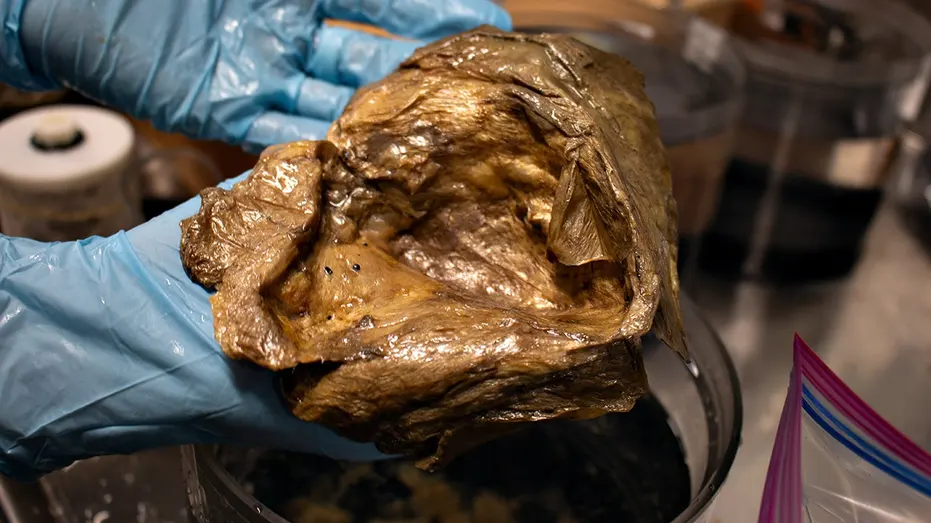
SouthernWorldwide.com – After a lengthy scientific investigation, the identity of a mysterious “golden orb” discovered miles underwater in 2023 has finally been revealed.
This unusual object, retrieved from over two miles beneath the Gulf of Alaska, had previously sparked widespread speculation, with theories ranging from alien eggs to an undiscovered species.
Researchers from NOAA and the Smithsonian announced their findings, identifying the orb as a remnant of a seldom-seen giant deep-sea anemone, specifically a part of the organism that anchors it to the seabed. The species is known as Relicanthus daphneae.
The discovery was made during a deep-sea expedition in 2023, utilizing a remotely operated vehicle. The vehicle was exploring at a depth of approximately 3,250 meters, equivalent to over two miles, when it encountered the peculiar golden structure attached to a rock.
Scientists were initially baffled by the mound-shaped mass, which featured a small opening. At the time of its discovery, they openly admitted to having no immediate understanding of what it was.
The researchers posed several questions regarding its nature: “Was it an egg case? A dead sponge? Had something crawled into it… or out of it?”
The strange find rapidly garnered significant public attention. This led to a surge of speculation, both online and within the scientific community, as people tried to decipher its origin.
However, pinpointing its exact identity proved to be a complex and challenging task for the scientists involved.
Dr. Allen Collins, a zoologist and director at NOAA Fisheries, highlighted the extensive effort required. He explained that the investigation had to move beyond standard procedures and involved the collaboration of numerous experts to arrive at a solution.
“This was a complex mystery that required morphological, genetic, deep-sea and bioinformatics expertise to solve,” Collins stated.
The initial difficulty stemmed from the object’s lack of readily recognizable animal features. Through closer examination, however, scientists detected that it was composed of fibrous layers densely packed with stinging cells.
This discovery strongly suggested a connection to cnidarians, a broad phylum that encompasses familiar marine life such as corals and anemones.
Captain William Mowitt, acting director of NOAA Ocean Exploration, commented on the significance of the find. He described the “golden orb” as just one example of the many “captivating mysteries” that remain concealed within the deep ocean.
“This is why we keep exploring — to unlock the secrets of the deep and better understand how the ocean and its resources can drive economic growth, strengthen our national security and sustain our planet,” Mowitt elaborated, emphasizing the importance of continued deep-sea research.