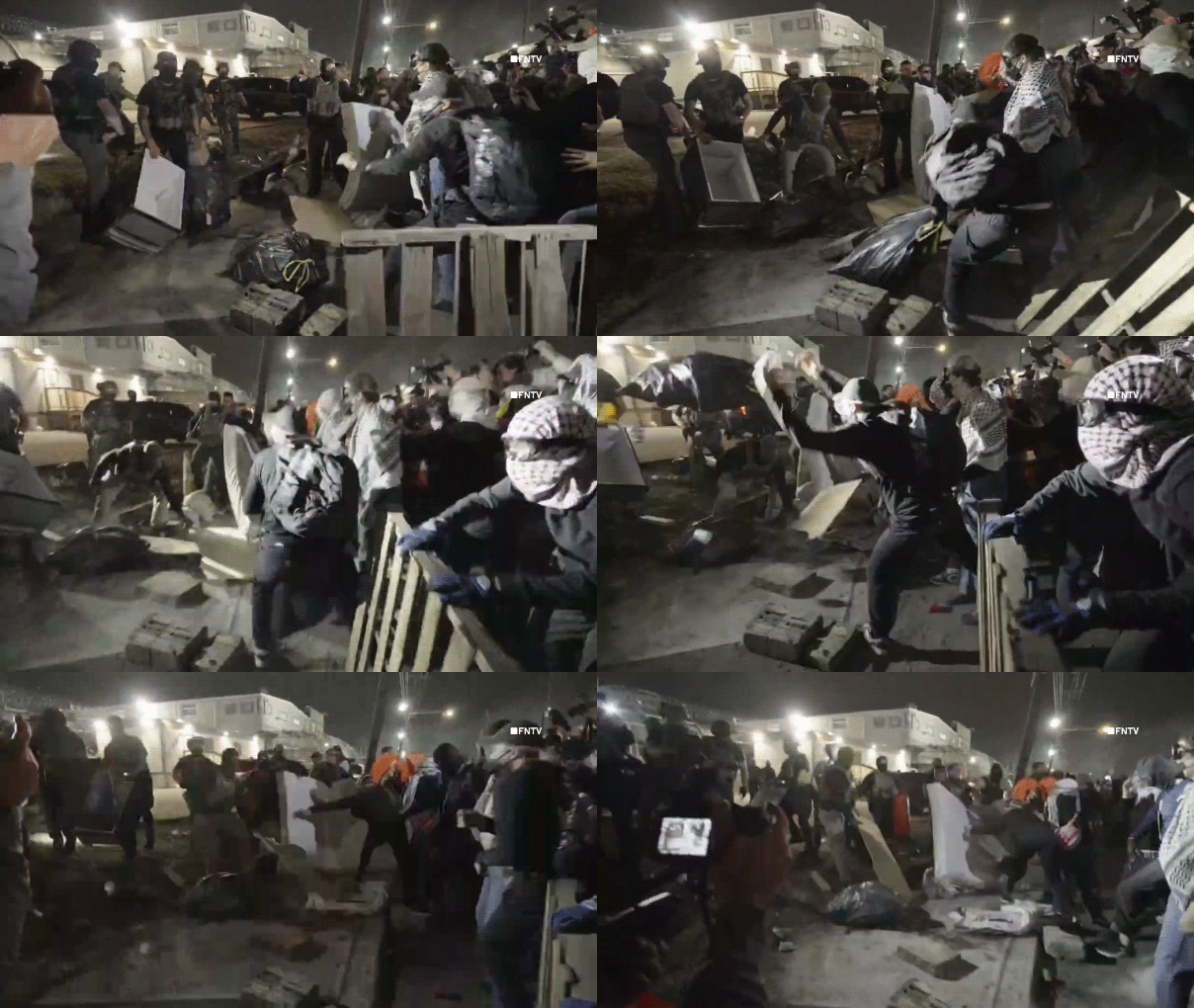
SouthernWorldwide.com – Secret communications on the encrypted messaging platform Signal reveal a sophisticated and coordinated effort by anti-Immigration and Customs Enforcement (ICE) agitators to orchestrate protests and clashes at the Delaney Hall detention facility in Newark, New Jersey.
On June 3rd, at 11:30 a.m., an activation signal was disseminated across social media, summoning protesters and agitators to Delaney Hall. This facility has become a focal point for protests against ICE operations in the United States.
“CURFEW IS OVER. BACK TO DELANEY,” stated an Instagram post. This call to action was amplified by a coalition of diverse organizations, including those with anti-Israel and Marxist affiliations, alongside groups like “Palestine Solidarity Working Group,” Al-Awda, Indivisible, and 50501. These entities have been actively involved in protests against ICE, Newark police, and New Jersey state troopers in recent weeks.
Within minutes, the directive spread through private groups on Signal. This encrypted platform allowed hundreds of anti-ICE activists, using pseudonyms such as “framed.unrest” and “Wicked Something,” to coordinate crucial aspects of their operations. This included arranging transportation, logistics, and the procurement of essential supplies like goggles, protective gear against pepper spray, respirators, and knee pads.
The activities of this network have drawn the attention of a group of tech-savvy individuals operating on X, formerly Twitter, under the handles @DataRepublican, @Astrarce, @bitchuneedsoap, and @gunshymartyr. These individuals have reportedly infiltrated these private groups, accessing their Signal chats and operations, likening their efforts to those of the Avengers.
Many of these organizations have been granted charitable status by the IRS, holding designations as 501(c)(3) and 501(c)(4) nonprofits, as well as 501(c)(5) and 501(c)(6) labor unions. This status allows them to receive tax-deductible donations and enjoy certain tax-exempt benefits.
In recent months, Treasury Secretary Scott Bessent and members of the House Ways and Means Committee, the House Judiciary Committee, and the House Oversight Committee have initiated investigations into the alleged misuse of nonprofit laws. These investigations aim to uncover instances where nonprofit status might be exploited to instigate conflict, sow discord, and potentially incite political violence.
The tactics employed by these groups bear a striking resemblance to the methods used in Minneapolis earlier this year to protest ICE actions. Military experts have also noted that these operations exhibit characteristics akin to insurgent tactics.
“We should be very concerned about the Delaney Hall 100,” stated Chuck Flint, a nonprofit expert and former U.S. Senate chief of staff. He elaborated, “Protests like the kind we’re seeing outside Delaney Hall are not organic protests. These are manufactured strategic, calculated endeavors by an army of nonprofits meant to push subversive activity.”
Flint further explained, “These groups generate annual revenues greater than many of the cities in which they protest. They act like military battalions with the ability to overwhelm a city’s public safety resources.” He characterized the situation as a “David vs. Goliath” scenario, drawing from his experience as a former state prosecutor.
The preparations for the protests on Wednesday night offer a detailed insight into how these organizations motivate, coordinate, mobilize, focus, and discipline their participants.
By 1:17 p.m. on June 3rd, a user identified as “Pete InDC” shared a video depicting a car honking continuously and the message “ICE OUT” chalked onto Doremus Avenue, near the detention facility.
“Come on down!” urged “Pete InDC” in a message accompanying the video.
At 1:29 p.m., a user named “yarrow” inquired about potential carpools from New York City and the availability of medics from the same location.
By 1:46 p.m., other users began asking for confirmation from Cosesha, a prominent protest organizer, regarding approval for the demonstration. Simultaneously, discussions commenced regarding logistics, including food, drinks, bike racks, transportation, parking, and tents, reminiscent of preparations for a large event like a concert.
“Tamale” posed a question: “so if we do go should we be bringing supplies or only rallying? do ppl need water.”
At 2:11 p.m., when “Durga” requested users to “like” a message if they were present on Doremus Avenue, another user, “tiny,” cautioned “Durga,” stating, “please don’t self id in the chat,” and added, “or ask others to.” This exchange highlights the emphasis on operational security and anonymity within the group.
These organizations often employ their own distinct language and terminology. For instance, they utilize “otg,” an abbreviation for “on the ground,” to refer to real-time intelligence gathered from the location of events.
At 3:08 p.m., “Jay D” asked, “Is anyone otg and can give a report?” This question sought immediate updates from individuals present at the scene.
The communications quickly shifted to more serious preparations for potential confrontations with law enforcement authorities.
By 4:07 p.m., “Mason D” offered to bring specific supplies, including “sudecon wipes for help with pepper spray/tear gas attacks, multiple sets of protective pads for elbows/knees, electrolytes” and “non-ventilated goggles.” Sudecon wipes are specialized decontamination towelettes designed to neutralize and remove chemical irritants like pepper spray and tear gas.
Behind the scenes, months, and sometimes even years, of planning and coordination precede these large-scale demonstrations. The violent mobilization witnessed on this past weekend followed approximately a year of more subdued activism by local groups.
In late May, a hunger and labor strike was initiated by hundreds of detainees at Delaney Hall. This action galvanized a broader network of advocacy organizations, legal groups, faith leaders, community organizers, elected officials, and national nonprofits, which rapidly mobilized in support of the detainees.
Within days, congressional delegations began demanding access to the facility. Rapid-response networks coordinated demonstrations across New Jersey, and the issue escalated into a national political story.
The origins of the “Delaney Hall 100” can be traced back to February 2025. At that time, GEO Group Inc., a federal contractor, announced its intention to reopen Delaney Hall in Newark as a federal immigration detention facility. This decision was based on a long-term contract with ICE. The facility, located near Newark Liberty International Airport, had previously housed immigration detainees before its closure in 2017.
In April 2025, the City of Newark initiated legal challenges against the reopening. The city argued that the facility had commenced operations without obtaining the required permits and inspections. Democratic Mayor Ras Baraka publicly opposed the project, making Delaney Hall a central issue in his ongoing dispute with federal immigration authorities and private detention contractors.
Around this period, a small group of local activists began gathering outside the facility. According to accounts from participants, one activist started visiting Delaney Hall alone in the days before detainees arrived, distributing flyers to employees and raising concerns about immigration detention. Within days, two additional activists joined. What began as an informal vigil evolved into a regular presence outside the facility.
These early gatherings laid the groundwork for what would later become known as “Eyes on ICE NJ.”
Throughout the spring and summer of 2025, the coalition expanded. Members of “NJ Peace Action,” “Pax Christi New Jersey,” “Sisters of St. Joseph of Peace,” “First Friends of New Jersey and New York,” and other faith-based and activist organizations began participating in regular vigils and support activities.
The first significant direct-action protest occurred on May 14, 2025. On this date, clergy associated with Faith in New Jersey and several Unitarian Universalist congregations blocked the main entrance to the facility.
By the fall of 2025, multiple organizations had established a consistent presence around the detention center.
The movement surrounding Delaney Hall largely operates through three interconnected coalitions, each with distinct roles and focuses.
The first coalition, “Eyes on ICE NJ,” emerged from the daily vigils held outside the facility. Its members concentrate on monitoring activities within the detention center, providing support to visiting families, documenting conditions, and maintaining a public presence outside the gates. They engage in narrative warfare by sharing family stories with the media, facilitating interviews with family members, and providing lawmakers with case studies to bolster their arguments with federal officials.
The second coalition, “ICE Out of NJ,” serves as a broader mobilization and legislative campaign. This group unites immigrant-rights organizations, rapid-response networks, labor-aligned groups, and direct-action activists. Their primary objective is to oppose detention expansion and advocate against current immigration enforcement policies.
The third coalition, the New Jersey Alliance for Immigrant Justice, acts as an umbrella organization, linking approximately 59 member organizations across the state. Its membership comprises legal advocacy organizations, labor allies, immigrant-rights groups, faith-based organizations, and community organizing networks.
This division of labor allows for a strategic approach: one coalition specializes in observation, media outreach, community support, and personal narratives; another focuses on mobilization, political pressure, and statewide organizing; and the third centers its efforts on the broader immigration issue.
Understanding the influence of the Delaney Hall network necessitates examining the nonprofit funding streams that support many of its key participants. This includes significant contributions from major Democratic donors such as Open Society Foundations and NEO Philanthropies, which serve as a source of financial backing for some of the network’s most influential members.
During the controversy surrounding Delaney Hall, elected officials including Democratic Sen. Andy Kim, Sen. Cory Booker, New Jersey Gov. Mikie Sherrill, Rep. LaMonica McIver, Rep. Rob Menendez, and others have become prominent figures in the debate. However, these same protesters have also targeted these officials. Indivisible organized a protest at Sherrill’s office on a Monday, and the Democratic Socialists of America demonstrated outside the offices of New Jersey Attorney General Jennifer Davenport on a Tuesday.
“Most everything is concealed from the ground up to their identities in Signal chat rooms, their funding and names of the people on the streets and their leaders,” observed Flint, the nonprofit expert. He continued, “They know what they are doing is wrong. They don’t want you to know who is in charge. They have masks on. They don’t want you to know anything about their organizations, their people. They are flipping the rules. They shout to the ICE agents: ‘You all are wearing masks.’ Meanwhile, they are wearing masks.”
“They use nonprofit status as a sword and a shield,” Flint stated. “They use it to take advantage of all the rules and then when they get in trouble they use it to protect themselves.”
This tension has become increasingly evident in recent days as the protests have escalated to violence. More radical elements within the “Delaney Hall 100” have emerged, employing makeshift shields and weaponry.
By 4:31 p.m., an anonymous Signal user, using the moniker “sqeek,” shared a “MEDIC DONATIONS” list. Experts indicated that this list bore resemblance to one prepared for a military operation, detailing specific manufacturers and brand types, including: “3M 8246 respirators,” six “Gas mask filters,” “3M 60923,” and “Goggles — shatterproof, without vents or foam edges (ANSI 87.1 or MIL-PREF 32432).”
“Sqeek” punctuated the message with the emoji of a muscular flexed arm.
As if on cue, agitators, many of whom were described as far-left white protesters wearing the black-and-white checkered Palestinian scarf known as a keffiyeh, began to arrive on Doremus Avenue in front of Delaney Hall around 8 p.m. that evening. They shared their commuting and parking challenges within their Signal chat.
At 9:42 p.m., one agitator, positioned behind barriers, shouted, “This is what counterinsurgency looks like!”
Then, at 9:47 p.m., as if following a predetermined communications strategy, another protester yelled at the predominantly minority Newark police officers and other law enforcement personnel, directing them to refer to Delaney Hall as a “concentration camp.” Her voice breaking, she exclaimed, “You work for a concentration camp! You work for a concentration camp! Quit your job!”
“Kill yourself!” a man added, as the group collectively began chanting, “Quit your job! Quit your job!”