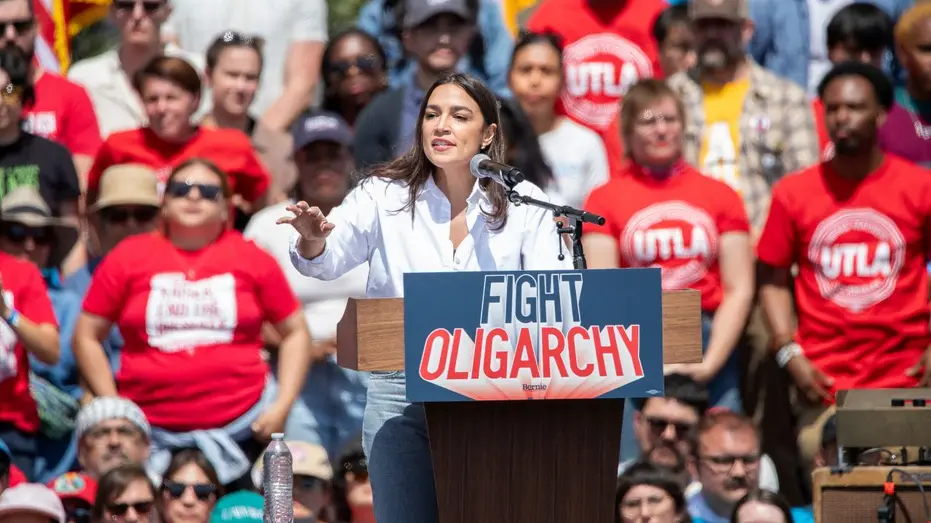
SouthernWorldwide.com – Politicians like Vermont Independent Senator Bernie Sanders and New York Democrat Representative Alexandria Ocasio-Cortez frequently voice a common sentiment: the wealthy do not pay their “fair share,” and the nation does not need “oligarchs.” These phrases are impactful but represent a simplistic view of modern economics.
The core of the issue lies in defining what “fair” truly means, especially when discussing tax contributions. It is crucial to focus on factual data rather than emotional responses.
According to information from the Internal Revenue Service and the Tax Foundation, the top 1% of income earners already contribute approximately 40% or more of all federal income taxes. This figure rises to nearly 70% for the top 10% of earners. In contrast, close to half of all Americans pay little to no federal income tax annually.
Therefore, when individuals argue that the wealthy do not pay enough, they are implicitly suggesting that it is acceptable for many to pay nothing, and that the rich should bear an even greater burden than their current share.
However, this perspective often overlooks the fact that federal income tax is merely one component of the overall tax landscape. A comprehensive understanding requires looking beyond this single measure.
Let’s examine the full spectrum of taxes paid by affluent Americans.
The headline figure often debated is the marginal income tax rate, which can reach up to 37% for top earners, even before considering additional surtaxes.
For those residing in high-tax states such as California or New York, an additional 10% to 14% can be added to the federal rate. This brings the combined tax rate close to levels seen in some European countries.
Baca juga di sini: Spirit Airlines Chaos: A Blow to Budget Travelers Seeking Answers
Homeowners, particularly those with higher-value properties, face significant annual property tax bills. In states like New Jersey or Texas, these taxes can range from $10,000 to over $30,000 annually, often representing 1% to 2% of the home’s value, in addition to potential personal property taxes in some states.
Every purchase made also incurs sales tax. In states like Tennessee or Washington, combined sales taxes can approach 10%. This means that income that has already been taxed is subject to further taxation at the point of sale.
Investments also come with their own tax liabilities. Federal capital gains rates, combined with the Net Investment Income Tax, can push the total to over 23.8%, before state taxes are factored in. This represents a tax on after-tax income that has been invested and then, upon realization of gains, taxed again.
Business owners who have spent years building their enterprises, paying taxes on distributable income along the way, may face the highest marginal tax rate when they eventually sell their business, which has provided employment for decades.
For those who accumulate wealth over a lifetime, there is the potential for estate taxes, where a portion of the assets may be taxed when passed on to heirs. While this does not affect a broad segment of the population, it can be a substantial burden for wealthy families.
At what point does the tax burden become excessive? This is a critical question that remains unanswered.
Is “fair” when the top 1% pays 50%, 60%, or even 80% of all taxes? Politicians making such claims rarely provide a concrete number. The reason is that it is impossible to extract more from those who currently pay nothing.
The current system relies on a small percentage of Americans funding the majority of government expenditures.
What makes this debate particularly frustrating is the lack of a clear definition for “fair share.” It is a perpetually shifting goalpost; the more one pays, the more is demanded.
This is not a matter of tax policy but rather a reflection of contemporary political discourse.
This discussion is not intended as a defense of billionaires but as an argument for the principles of mathematics, incentives, and, fundamentally, capitalism.
When the tax burden on the most productive individuals and business owners is continually increased, it does more than just “tax the rich.” It alters the behavior of the very people who drive the economic system. They are the creators of jobs, innovation, and the future of the nation. Discouraging investment, slowing hiring, and reducing risk-taking are direct consequences that impede GDP growth.
With the national debt approaching $40 trillion, America clearly needs more revenue. However, there is also a significant spending problem that needs to be addressed.
Before demanding more from taxpayers, perhaps more accountability should be demanded from Washington.
Until a clear definition of “fair share” is provided, in terms of actual dollar amounts, percentages, and measurable outcomes, it will remain what it is today.
A catchy phrase and a slogan. These do not, by themselves, balance the budget.