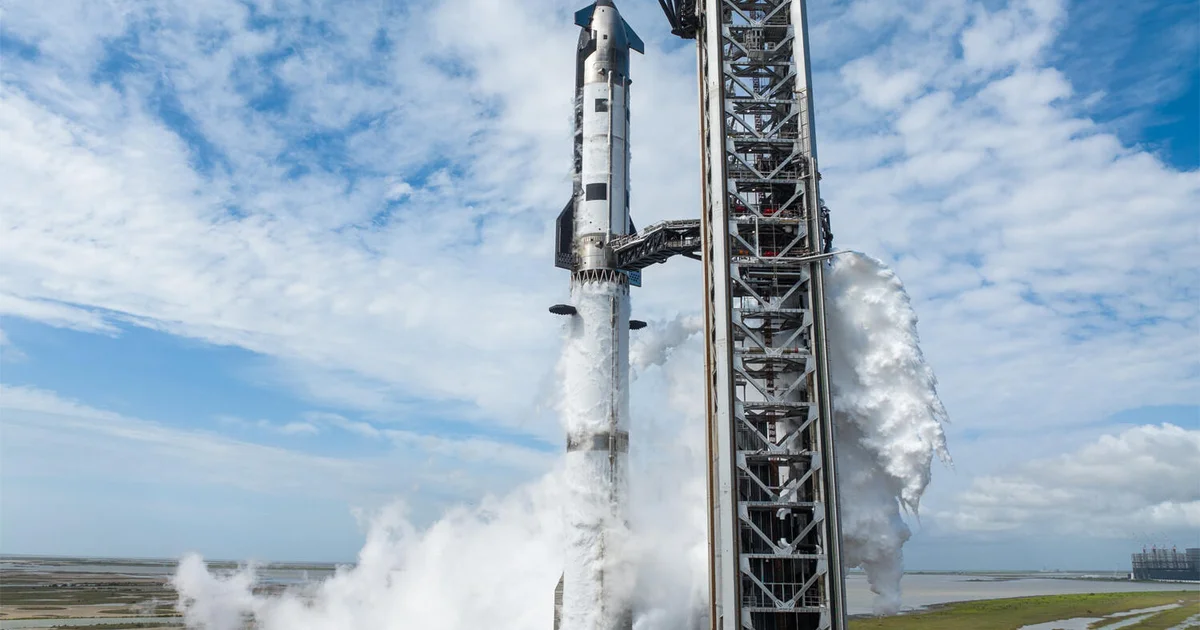
SouthernWorldwide.com – The planned launch of a newly upgraded SpaceX Super Heavy-Starship rocket was aborted at the very last minute on Thursday due to a technical issue.
The issue appeared to be related to the quick-disconnect fittings on the launch pad, which are responsible for supplying propellants to the massive rocket. This particular launch was set to be the first for a redesigned rocket utilizing a newly upgraded launch pad.
“The hydraulic pin holding the tower arm in place did not retract,” stated SpaceX founder Elon Musk on his social media platform X. He added, “If that can be fixed tonight, there will be another launch attempt tomorrow at 5:30 CT.”
A successful launch would provide a significant boost for SpaceX and instill greater confidence in NASA.
NASA is relying on SpaceX to deliver a version of the Starship’s upper stage to transport astronauts from lunar orbit to the Moon’s surface and back before the end of 2028.
Given that numerous successful test flights are required before then, NASA is diversifying its approach by collaborating with Jeff Bezos’ Blue Origin to develop an alternative lunar lander.
The agency’s Artemis III mission, scheduled for late next year, will involve testing rendezvous and docking procedures in low-Earth orbit using one or both of these landers, depending on their readiness. NASA intends to practice these procedures close to Earth before proceeding with a lunar landing during the Artemis IV mission.
However, SpaceX must first achieve mastery of the Super Heavy-Starship launch system. Following 11 test flights that have featured both remarkable successes and notable failures, the company believes that the debut of “version 3” Starship this week marks the beginning of a new phase in the rocket’s development.
Utilizing a new, reinforced launch pad at SpaceX’s “Starbase” facility on the Texas Gulf coast, the 12th integrated test flight of a Super Heavy-Starship rocket will put a range of upgrades and enhancements to the test.
Similar to previous test flights, the 33 methane-fueled Raptor engines of the Super Heavy, which are lighter yet more powerful than their predecessors, will propel the Starship upper stage out of Earth’s lower atmosphere. Subsequently, the first stage will separate and execute a controlled splashdown off the coast of Texas.
As this is the inaugural flight of a version 3 booster, SpaceX has opted for a splashdown in the Gulf rather than a catch by the gantry’s distinctive “chopstick” mechanical arms at the launch pad.
“The booster’s primary test objective will be executing a successful launch, ascent, stage separation, boostback burn and landing burn at an offshore landing point in the Gulf of America,” SpaceX stated on its website. “As this is the first flight test of a significantly redesigned vehicle, the booster will not attempt a return to the launch site for catch.”
Following the booster’s separation, the Starship upper stage will utilize its own set of Raptor engines to ascend to a sub-orbital trajectory. It will complete a trajectory that circles halfway around the planet before re-entry and a Raptor-powered descent, aiming for a splashdown in the Indian Ocean approximately one hour and five minutes after liftoff.
“The Starship upper stage will target multiple in-space and reentry objectives, including the deployment of 22 Starlink (satellite) simulators,” SpaceX announced. “The last two satellites deployed will scan Starship’s heat shield and transmit imagery down to operators to test methods of analyzing Starship’s heat shield readiness for return to launch site on future missions.”
Additionally, the planned re-entry trajectory will “intentionally stress” the Starship’s rear flight control flaps, and the spacecraft will execute a “dynamic banking maneuver” to simulate the trajectory that future missions returning to Starbase will follow, the company explained.
Approximately 50 onboard cameras will record the flight, transmitting images back to Earth via Musk’s Starlink satellite system.
Read more : Anti-ICE Agitator Accused of Biting Officers Amidst Delaney Hall Confrontation
SpaceX has experienced varied results in its previous 11 Super Heavy-Starship flights, but the company consistently incorporates lessons learned into each subsequent launch, and many of these insights are integrated into the version 3 spacecraft.
“The flight test’s primary goal will be to demonstrate each of these new pieces in the flight environment for the first time, with each element of the Starship architecture featuring significant redesigns to enable full and rapid reuse that incorporate learnings from years of development and test,” SpaceX stated on its website.
The Super Heavy-Starship, collectively known as Starship, is recognized as the largest and most powerful rocket ever constructed. Version 3 possesses the capability of generating up to 18 million pounds of liftoff thrust, which is approximately double the power of NASA’s Space Launch System moon rocket.
SpaceX intends to employ the Starship system for launching Starlinks and other satellites into Earth orbit, deploying scientific probes, serving as a lunar lander for NASA, and ultimately, for transporting astronauts to Mars.
While Earth-orbit missions appear relatively manageable, utilizing Starship landers in NASA’s Artemis program presents significant technical hurdles. Many external observers express skepticism about Starship’s readiness in time for NASA’s projected 2028 lunar landing.
Considering SpaceX’s established track record and success in developing reusable Falcon 9 boosters with both sea and shore landings, others place their confidence in the company. Nevertheless, employing a Starship variant as a lunar lander is an exceptionally complex endeavor.
Due to the fact that Starship consumes the majority of its propellants simply to reach Earth orbit, the lander will require refueling before it can embark on its journey to the Moon. Multiple Super Heavy-Starship tanker flights—the precise number remains undetermined—will be necessary to autonomously refuel the lander in Earth orbit before it can proceed to deep space.
Russian Progress cargo ships routinely deliver fuel to the International Space Station. However, the repeated transfer of thousands of gallons of cryogenic propellants between vehicles on a relatively tight schedule has never been attempted in space.
Furthermore, SpaceX has yet to disclose its strategy for minimizing the amount of supercold propellants that will naturally “boil off” in space, converting into gas that must be vented.
All these factors contribute to the challenge of safely landing on the Moon.
To achieve this, Artemis astronauts in an Orion capsule will need to dock with the Starship in lunar orbit, transfer inside, undock, and descend to a fully automated landing near the Moon’s south pole. This involves setting down a 170-foot-tall rocket on uncertain terrain characterized by long shadows and poor lighting conditions.
Once safely on the surface, the astronauts will descend to the lunar surface using an external elevator that deploys from the side of the rocket. Following the completion of their surface mission, they will ascend back to the crew cabin at the top of the Starship via the elevator and launch to rendezvous with the Orion capsule for the return journey to Earth.
SpaceX’s contract with NASA mandates one unpiloted lunar landing mission before the agency will consider placing astronauts aboard.
Despite the future challenges, the latest iteration of the Super Heavy-Starship represents a significant advancement in SpaceX’s pursuit of developing a rocket that Musk envisions will one day transport humans to the Moon and subsequently to Mars.