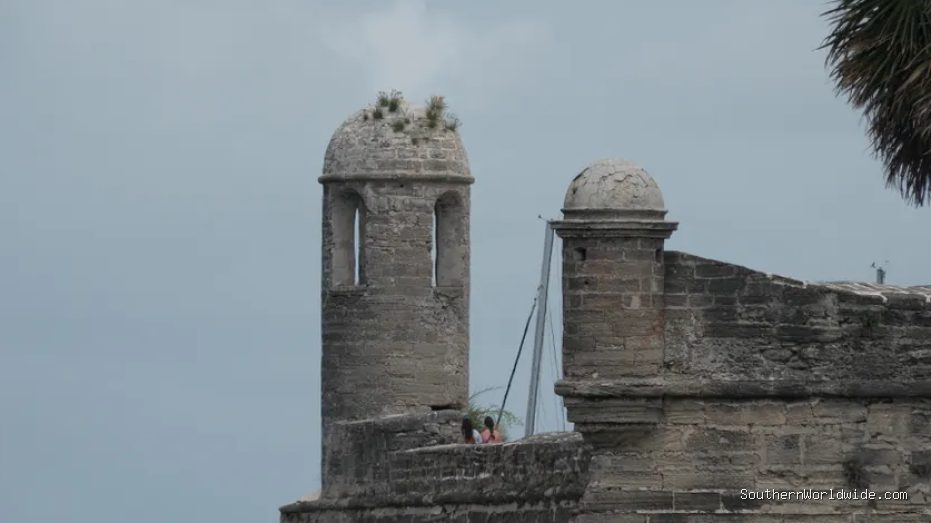
SouthernWorldwide.com – As the United States approaches its 250th anniversary, St. Augustine, Florida, is highlighting its significant, yet often overlooked, revolutionary history. This ancient city, the oldest continuously inhabited European-founded settlement in the continental U.S., was founded in 1565 by Spanish explorer Pedro Menendez. While its Spanish origins and the legend of the Fountain of Youth are well-known, its pivotal role in the birth of America is frequently not fully recognized.
The city, affectionately called the “Ancient City,” will celebrate its 461st birthday in September. Its historical significance extends beyond its founding, encompassing periods of British rule and its unique position during the American Revolution.
Maria Alvarez, with The Historic Florida Militia, emphasizes the historical weight of the city. She notes that St. Augustine’s streets tell a story of a potential alternative path for America had Spanish influence persisted. The city’s history is deeply intertwined with the broader narrative of colonial America, a fact that is being brought to the forefront.
In 1763, following the French and Indian War, Great Britain gained control of Florida from Spain. This period marked a significant shift in the region’s dynamics.
The Peña-Peck House, a historic site in St. Augustine, served as the residence of British Governor Patrick Tonyn during the American Revolution. This connection highlights the city’s direct involvement in the revolutionary era.
Historians point out that the territory of modern-day Florida was divided into two distinct entities: East Florida and West Florida. These were considered by some to be the 14th and 15th colonies of colonial America, a designation that underscores their unique status and historical importance.
Alvarez explains that St. Augustine, as part of East Florida, was a haven for Loyalists who remained devoted to King George. Meanwhile, West Florida, due to its proximity to Spanish territories, experienced a mix of Patriots and Loyalists.
During the Revolutionary War, Florida played a crucial role, maintaining its allegiance to Great Britain and serving as a strategic military base. This loyalty contrasted with the revolutionary sentiments brewing in the northern colonies.
Thousands of British Loyalists sought refuge in Florida, fleeing from Georgia and South Carolina. Concurrently, the Castillo de San Marcos, a prominent fort in St. Augustine, became a place of imprisonment for some of the American founding fathers.
Alvarez reveals that three lesser-known signatories of the Declaration of Independence—Hayward, Middleton, and Rutledge—were held captive at the Castillo for approximately four months. These lesser-known facts are central to understanding St. Augustine’s complex role in the nation’s formation.
To shed light on these often-unexplored aspects of history, St. Augustine City Walks is offering free walking tours every Saturday in July. These tours aim to educate visitors about the city’s revolutionary past.
The tours guide participants through the historic streets and along the bayfront, recounting tales of East Florida’s loyalty to the British Crown, the imprisonment of founding fathers, and the activities of Patriot rebels. These narratives provide a deeper understanding of the diverse perspectives and loyalties present during the Revolution.
Margo Pope, history chair of The Woman’s Exchange of St. Augustine, emphasizes the city’s long-standing presence and its significant contributions. She notes that St. Augustine’s history predates many commonly recognized foundational events in American history.
“We were here before,” Pope remarks, highlighting the city’s claim to being one of the earliest European settlements in North America. She stresses the importance of conveying this rich history to visitors.
The city is also challenging conventional historical narratives, particularly regarding the first Thanksgiving. While Plymouth, Massachusetts, is widely credited with hosting the first Thanksgiving, local history experts in St. Augustine present a different account.
Alvarez asserts that St. Augustine was the site of the first Catholic Mass and the first feast of Thanksgiving. This occurred 42 years before the establishment of Jamestown and 54 years before the arrival at Plymouth Rock, indicating a much earlier European presence and celebratory traditions.
Another significant historical site in St. Augustine is Fort Mose. Established in 1738, it was the first legally sanctioned, free Black settlement in what would become the United States. Although the original fort is no longer standing, a full-scale replica was constructed and opened to the public in 2025.
Alvarez believes that St. Augustine’s rich and multifaceted history, often absent from mainstream historical accounts, deserves greater recognition. She advocates for increased awareness of the city’s contributions to American history.
Numerous events are scheduled throughout St. Augustine to commemorate America’s 250th anniversary. These celebrations aim to engage residents and visitors alike in the city’s historical legacy.
On July 4th, St. Augustine will host “Fireworks Over the Matanzas,” featuring a free concert, fireworks display over the bay, and family-friendly activities in the historic district. This event promises a festive celebration of Independence Day.
St. Augustine City Walks will continue its free “St. Augustine and the Birth of America” tours on July 11, July 18, and July 25. Due to limited space, reservations are essential for these popular historical excursions.