SouthernWorldwide.com – The Artemis II mission has delivered breathtaking photographic evidence of our planet, the moon, and a unique solar eclipse as seen from space.
These stunning images, captured by the Artemis II crew, were released on Tuesday, offering spectacular views from the far side of the moon and a rare eclipse phenomenon.
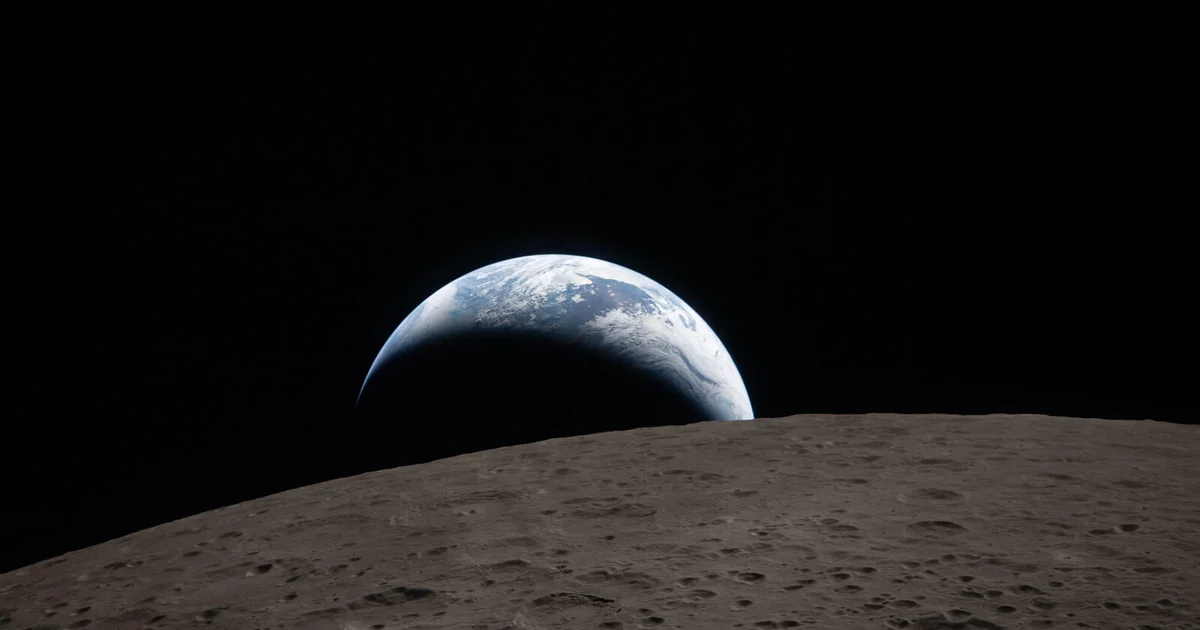
One particularly striking photograph, shared by NASA, depicts “Earthset.” This image shows our planet descending behind the moon, with a portion of Earth cloaked in darkness. Australia and Oceania are clearly visible on the illuminated surface, while the lunar landscape occupies the foreground.
“Humanity, from the other side,” the White House aptly commented on the image, highlighting the profound perspective it offers.
This remarkable “Earthset” was captured through the window of the Orion spacecraft on Monday evening. The Artemis II crew was conducting a flyby of the moon, marking a historic moment as the first humans to witness certain parts of the moon’s far side with their own eyes.
Read more : UnitedHealthcare to reduce prior authorization for 30% of treatments
The mission also represents the farthest humans have traveled from Earth in history. The crew’s journey offers an unparalleled vantage point for observing our celestial neighborhood.
Another awe-inspiring photograph captures the moon in the act of eclipsing the sun. This celestial event was not visible from Earth, offering a unique spectacle solely to the astronauts aboard the spacecraft.
To safely observe this phenomenon, the astronauts were required to wear specialized eclipse glasses until the moon completely obscured the sun.
“From the crew’s perspective, the Moon appears large enough to completely block the Sun, creating nearly 54 minutes of totality and extending the view far beyond what is possible from Earth,” NASA explained regarding the significance of the image.
Astronaut Victor Glover described the experience, noting that the sun’s corona remained visible and brilliantly bright during the eclipse. He compared it to a luminous halo encircling the entire moon.
Glover remarked that the photographs, while impressive, could not fully convey the grandeur of the display. He elaborated on the visual impact, stating, “It just looks unreal. You can see the surface of the moon against the Earthshine. … You can actually see a majority of the moon. It is the strangest looking thing that you can see so much on the surface.”
He expressed his gratitude that the mission launched in time to witness the eclipse, which lasted approximately an hour. Glover mused on the unique evolutionary perspective, suggesting, “Because humans probably have not evolved to see what we’re seeing. It is truly hard to describe. It is amazing.”
A third image, shared by NASA on Tuesday morning, showcases the moon’s surface in intricate detail. The photograph reveals ridged craters and long, dramatic shadows cast by the low-angle sunlight along the boundary between lunar day and night.
This particular view highlights the rugged topography of the moon, with craters and ridges rendered in striking clarity. The interplay of light and shadow emphasizes the moon’s ancient and complex geological features.
The Artemis II crew is now en route back to Earth. Their mission is scheduled to conclude with a splashdown off the coast of California, near San Diego, on Friday evening.