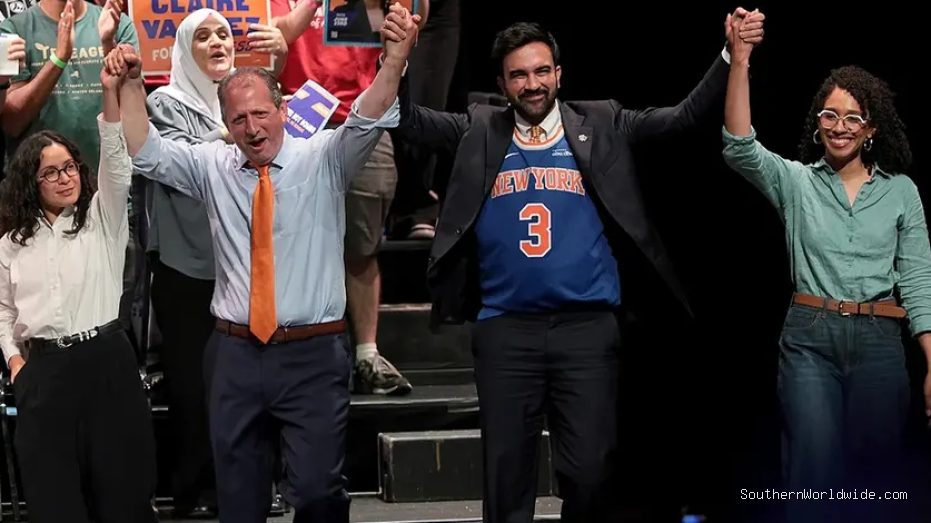
SouthernWorldwide.com – The Democratic Party is grappling with an identity crisis as the recent successes of Democratic Socialists in New York primaries signal a potential shift in the party’s direction.
Democratic Socialists of America (DSA) are gaining momentum following their victories in the New York Democratic primaries. Their wins in several Congressional seats, unseating incumbents like Reps. Adriano Espaillat and Dan Goldman, suggest a segment of the party is eager for change.
Rep. Espaillat previously chaired the Congressional Hispanic Caucus, while Rep. Goldman played a significant role as a House staffer during the first impeachment proceedings against former President Donald Trump.
House Judiciary Committee Chairman Jim Jordan, R-Ohio, commented on the situation, stating, “Even Dan Goldman’s not good enough for them. That is how radical it’s become.”
Some moderate Democrats are attempting to distance themselves from the progressive wing of the party.
Rep. Tom Suozzi, D-N.Y., who represents a competitive district, asserted, “That’s not the same brand of politics that we have. We’re not those type of Democrats.”
Rep. Josh Gottheimer, D-N.J., expressed concern, saying, “There’s a new group of Democratic Socialists who are socialists who are not commonsense Democrats. Who are not interested in getting things done. They’re interested in throwing bombs. Not actually solving problems.”
Concerns are also being raised about the disproportionate attention that far-left candidates are receiving compared to those in the political center.
Rep. Kristen McDonald Rivet, D-Mich., worries that the significant media focus on progressive candidates might send the wrong message to the broader electorate.
“What they don’t want is divisiveness. They don’t want screaming and yelling,” McDonald Rivet noted.
Mainstream Democrats feel caught in the middle as the progressive movement, particularly in New York City, wields considerable influence in media and politics.
Rep. Suhas Subramanyam, D-Va., remarked, “Those candidates would not have won in Virginia where I live.”
Republicans believe these developments position them well to influence the upcoming midterm elections. They aim to nationalize the election by highlighting the progressive views of Democratic Socialist candidates who secured primary victories in New York City, portraying their opponents as moving too far left.
Sen. Roger Marshall, R-Kan., questioned, “These are board-certified communists, right? They want no police. They want no private property.”
Former President Trump seized on the Democratic primary results in his home city.
“The Democrat party is in big trouble because this isn’t stopping with New York,” he predicted.
This internal shift within the Democratic Party has prompted progressive leaders to call for leadership changes at the top.
Rep. Alexandria Ocasio-Cortez, D-N.Y., stated, “You’re going to see, I think, people voting for new leadership and to change their representation.”
The Democratic Party appointed Sen. Elissa Slotkin, D-Mich., a moderate who won a battleground race in 2024, to deliver their official response to President Trump’s 2025 State of the Union speech. Slotkin, however, advocated for a shift in the Democratic Party’s management.
“If people can’t understand that the game has fundamentally changed and they can’t adapt, then they need to let others,” Slotkin said. “The old models do not work for people.”
Republicans see House Minority Leader Hakeem Jeffries, D-N.Y., as vulnerable following the DSA’s success in electing their preferred candidates over his in New York City.
House Oversight Chairman James Comer, R-Ky., commented, “I think Hakeem Jeffries’ friends and neighbors gave him a big middle finger. If you lose three elections in your hometown, that’s a pretty big slap in the face.”
He further characterized the situation as Democrats “are going further and further to the left to the point where they are full-blown, card-carrying socialists.”
Adding to the complexity are the anti-Israel and, in some instances, antisemitic sentiments expressed by certain candidates.
Rep. Greg Landsman, D-Ohio, a moderate Democrat from a swing district and a pro-Israel voice, expressed his concerns.
“There are some on the left who use Israel the way that some on the right use immigrants or trans kids as a way to divide. And I think it’s terrible. It’s also just not what voters want us talking about,” Landsman said.
During a discussion with Rep. John Larson, D-Conn., a former chair of the House Democratic Caucus, the question of how the party would address candidates perceived as too far left was raised.
“What does that mean? That’s your statement. Did the people of New York vote?” Larson queried.
When assured that voters had indeed cast their ballots, Larson responded, “Is that democracy?”
The counterpoint was raised: “But if some of them are antisemitic.”
“Is that a democracy?” Larson reiterated.
A follow-up question was posed: “Will you stand by people if they have antisemitic views?”
Larson’s eventual response, “I’m against antisemitism, if that’s your question,” highlighted the deep divisions within the Democratic Party.
This ongoing debate distracts from crucial economic issues, according to some Democrats.
Landsman argued that voters would prefer their representatives to focus on practical concerns such as the cost of groceries and gas prices.
Rep. Gottheimer echoed this sentiment, stating, “We should be focused on ways to actually solve problems like that. Not coming in here and using tea party tactics and trying to divide up the country and pray to socialist ideals.”
The question remains how the party will navigate these challenges.
Rep. Robert Garcia, D-Calif., the ranking Democrat on the Oversight panel, stated, “They’re our nominees. We’re going to support them. We’re going to welcome them. They’re going to be part of our caucus and we’re going to unite behind Leader Jeffries.”
However, this approach does not fully address the underlying divisions or how voters perceive the party. It also leaves open the question of whether these new nominees will actively support the party’s fundraising and advocacy efforts, or if they will adopt a more confrontational stance, similar to what Republicans have experienced.
Rep. Dusty Johnson, R-S.D., expressed his view, asserting, “It’s going to be a lot harder to get things done when you get more and more extreme candidates who are here because they’re interested in political celebrity. They are interested in fighting. They’re interested in making points.”
Republicans have also faced internal challenges recently, including legislative setbacks and disagreements within party leadership. However, some believe the Democrats’ internal fractures are more significant.
Rep. Mario Diaz-Balart, R-Fla., observed, “While it’s not been a great week for Republicans, I think it’s been a much worse week for Democrats because of these primary elections.”
Democrats plan to focus on economic issues and leverage statements made by the former President on topics like housing. The central question remains whether a substantive policy debate will overshadow concerns about the growing influence of progressives nationwide.
Political discourse is often driven by emotion and sentiment. If Republicans effectively leverage the outcomes in New York and replicate that strategy in competitive districts across the country, it could pose a significant challenge for the Democratic Party.