SouthernWorldwide.com – Satellite imagery has revealed a substantial suspected oil slick near Kharg Island, Iran’s primary oil export terminal. Experts suggest this incident could indicate that Iran’s oil infrastructure is struggling under the increasing pressure from the United States.
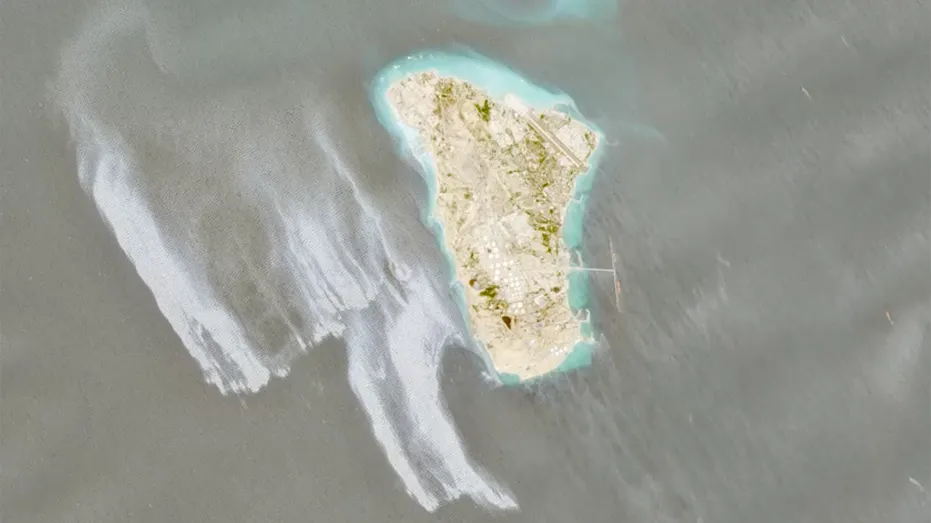
The oil slick, observed in Copernicus Sentinel satellite images between Wednesday and Friday, spanned approximately 45 square kilometers west of the island. This development is being seen as a potential indicator that the U.S. maritime pressure campaign is effectively overwhelming Iran’s export system.
The situation implies that Tehran may no longer be able to move or store crude oil quickly enough to maintain normal production levels. This is a key objective of the U.S. strategy to exert economic pressure on Iran.
US ECONOMIC CHOKEHOLD ON IRAN REACHES PEAK LEVERAGE AS COLLAPSE RISKS EMERGE
The suspected spill near Iran’s main oil hub raises concerns about the regime’s capacity to manage its oil exports and storage. It is possible that mounting U.S. pressure is forcing Iran into risky operational choices with potential environmental consequences for the Persian Gulf.
“At this stage, I see two plausible explanations, and they’re not mutually exclusive,” stated Miad Maleki, an expert on Iran sanctions and energy at the Foundation for Defense of Democracies, in an interview with Fox News Digital.
Maleki elaborated, “One is operational: They simply didn’t ramp down extraction fast enough relative to their true onshore capacity and over counted on empty tankers slipping through the blockade.”
He continued, “Now they’ve effectively over-delivered crude into the export system, with more oil at or near the terminals than they can actually load, and the ‘solution’ is to push some of that excess into the water.”
Another potential cause suggested by Maleki is mechanical failure. This could be linked to Iran’s practice of using aging tankers as floating storage facilities or as carriers to circumvent sanctions.
TRUMP CLAIMS IRAN ‘STARVING FOR CASH,’ ‘COLLAPSING FINANCIALLY’ AFTER EXTENDING CEASEFIRE
“They’ve dragged older, marginal tonnage into service as floating storage or sanctions-busting carriers, and some of those retired or poorly maintained hulls are now leaking,” Maleki explained.
He concluded, “Either way, the common denominator is the same — storage and evacuation capacity are out of sync with upstream output, and the Gulf is paying the price for that mismatch.”
This incident occurs as the Trump administration continues its “Economic Fury” campaign against Iran. This strategy combines the enforcement of sanctions with an increased U.S. naval presence around the Strait of Hormuz, aimed at restricting Iran’s oil exports.
Prior to the current U.S. pressure, Iran was exporting approximately 1.5 million barrels of oil per day, with a significant portion destined for China. Analysts believe the blockade and the threat of sanctions on shipping companies and financial institutions have made it increasingly challenging for Tehran to move crude oil from Kharg Island.
Reuters reported that the slick appeared as a “grey and white” plume to the west of the 8-kilometer-long island.
Read more : Dua Lipa claims Samsung used her copyrighted photo to market TVs
Leon Moreland, a researcher at the Conflict and Environment Observatory, informed Reuters that the slick was “visually consistent with oil.” Louis Goddard, co-founder of Data Desk, noted that it could be the largest spill recorded since the start of the U.S.-Iran conflict approximately 70 days ago.
Kharg Island is crucial, handling about 90% of Iran’s oil exports. It has become a critical choke point in the Trump administration’s efforts to cut off the regime’s primary revenue source amidst the ongoing conflict.
Energy analysts suggest Iran faces a difficult choice. If it cannot export oil or secure additional storage, it may be compelled to shut down oil wells, risking long-term damage to its fields. Alternatively, it might resort to disposing of excess crude in ways that could lead to environmental damage across the Persian Gulf.
US STRIKE ON KEY IRAN OIL HUB WOULD FIT TRUMP’S ‘ENERGY DOMINANCE DOCTRINE,’ SAYS EXPERT
“They’ve already reduced extraction. In a true blockade scenario, the constraint isn’t production at the wellhead, it’s the inability to load tankers at export terminals,” Maleki stated.
He added, “Once onshore storage nears capacity, output has to be cut to match remaining headroom or wells get shut in. In Iran’s case, that’s roughly 13 days.”
The potential environmental consequences are also a significant concern throughout the Persian Gulf region.
Windward, a maritime risk intelligence firm, estimated that the slick was moving southeast at approximately 2 kilometers per hour. They warned that it could reach Qatar’s exclusive economic zone within days and potentially drift towards the United Arab Emirates within two weeks.
The region’s desalination infrastructure, which provides water for millions of people, is particularly vulnerable to significant oil contamination events.
The spill is occurring amidst heightened military tensions in the Persian Gulf. The conflict has led to hundreds of vessels being trapped in the region and has caused one of the most substantial disruptions to global crude and liquefied natural gas supplies in recent years.
Iranian authorities have not yet issued any public statements regarding the suspected oil spill or its potential causes.
Fox News Digital has reached out to the Iran mission to the U.N. for a comment.
Reuters contributed to this report.